Christmas, Faith

The “Merry Christmas” Melee

It’s that time of year again. Time for love and good cheer. Peace on earth. Joy to the world.

And war.

Over the last several years, there’s been a sometimes quiet and respectful, sometimes loud and obnoxious battle raging between conservative Christians and merchants over whether said merchants use the term “Merry Christmas” or the more general “Happy Holidays” or “Season’s Greetings” in their advertising and in greeting customers at their stores.

I don’t know about you, but it’s driving me bananas.

Would I prefer for everybody to say “Merry Christmas”? Sure. But on my list of things to have an aneurysm about, it falls somewhere between my dentist telling me I should floss more and deciding where to get the dog a pedicure. I just really don’t care that much. And I’m wondering, in the grand scheme of things that should be pressing upon Christians’ hearts, should something this minor even register on the scale of issues that upset us?

What Do We Expect?

Speaking strictly numerically and statistically, genuine Christians– not just people who say they’re Christians and/or go to church, but people who have actually been regenerated by the blood of Christ –are a very small minority. Despite what you may hear to the contrary, the United States is not a Christian nation. It may have been founded on Biblically inspiried principles, but in practical societal terms today, this is a nation mostly made up of lost people.

This means that it’s a safe bet that the majority of the people at the helms of these corporations are lost. And guess what? Fish gotta swim, birds gotta fly, and lost people gotta act like lost people (Romans 8:7). What this means is that their decision whether to use “Merry Christmas” or “Happy Holidays” has nothing to do with Jesus or respecting the “true meaning of Christmas”. Their decision is going to be based on what’s going to make the corporation the most money. If saying “Merry Christmas” will get more customers in the door, that’s what they’ll do. It doesn’t mean they’re honoring Christ, it mean’s they’re pandering to Christians.

When we exert pressure on these corporations to say “Merry Christmas”, what real change are we effecting? Are we not just creating more people who honor God with their lips while their hearts are far from Him (Isaiah 29:13)? Are we not sending them the subtle message that external behavior, rather than a reborn spirit, is what counts? One day, every knee will bow and every tongue confess that Jesus is Lord (Philippians 2:10-11). One day. But that day is not today. We can’t force change in people’s hearts by coercing them into saying “Merry Christmas”. And, to God, a change of heart is the only thing that matters.

Where Should Our Passions Lie?

I used to belong to a Christian “social issues” organization. In many ways, it’s a great organization. I got frequent e-mails from them regarding which social issues various corporations were investing their profits in, where politicians stood on the issues, and lots of other helpful information and resources.

But every autumn they would begin their annual “Merry Christmas” campaign. They have buttons you can order that urge people to say “Merry Christmas”. They have leaflets and stickers and videos you can order for your church to promote saying “Merry Christmas”. They publish a “Naughty and Nice” list of merchants who use “Merry Christmas” (nice) or some other wording (naughty), so you’ll know which stores to shop and which to boycott.

And it made me stop and think– how many man hours go into that campaign every year? How much money does the organization invest in it? How much money do churches and individuals spend on their materials? Is investing that much time and money in promoting “Merry Christmas” good stewardship?

We have brothers and sisters all over this planet who would give anything to own a copy of the Bible. There are crisis pregnancy centers that operate on a shoestring trying to help women and their babies. There are missionaries who live in poverty in third world nations taking the Gospel to those who have never heard it. There are people starving. There are children who have been kidnapped by human traffickers.

And “Merry Christmas” is what we want to get all worked up about?

What’s more upsetting to us, the fact that someone says “Happy Holidays” or the fact that the person who said it might die and spend an eternity in hell? Where do our passions truly lie? Are we passionate about the same things God is passionate about?

This Christmas, can we just focus on what’s important? We have a God who loves every person so deeply and so intensely, and whose mercy and grace are so unfathomable, that He came here personally to redeem us.

And there are people all around us who don’t know that.

And they desperately need us to love them enough to tell them that in Jesus there’s hope. A way out of their sin. A way to get clean. A secure eternity. Peace.

God and sinners, reconciled. Oh, what a Merry Christmas!

Sin

The Stench of a Sweet Aroma

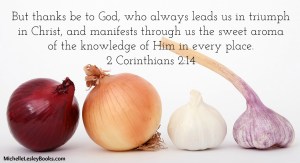
It seems like I’ve been cutting up a lot of onions lately. Fajitas. Chili. Homemade soups. People have been cooking with onions since the days of Israel’s captivity in Egypt, and probably even earlier than that. You’ve really got to wonder about the first person to pick up an onion, slice into it, be overwhelmed by noxious fumes, and say, “Oh yeah. We’ve got to put that thing in the stew. That’s just what it needs!”

But, lately, my walk with the Lord has been a lot like an onion. He keeps peeling back layer after layer of my heart. And the more he does that, the more my sin stinks. And the more I realize I stink, the more it stings me. And the more it stings me, the more I weep.

But God has promised that, when I give Him those sins, He will take them away and “cast [them] into the depths of the sea” (Micah 7:19), and the sting will be gone. Just like when I drop those onions into my pot of soup. No more tears, no more stink. I wash my hands thoroughly, and I’m clean (Psalm 51:2). It’s over.

Or is it?

Why did I cut up that onion in the first place? After all, I could have just left it sitting in the fridge. There wouldn’t have been any pain or tears.

But my soup would have been weak and lacking the robust flavor it could have had.

No good comes from an onion that’s been left in the refrigerator. It’s only when I cut up the onion and put it into the soup that anything good can come out of it. As it cooks, the onion’s awful fumes are transformed into a full and savory flavor that completes the taste of the soup.

And that’s why I keep coming back to God and asking Him to reveal my sin to me. It’s a painful and teary experience, but when He takes my sin, forgives me, and deals with me, only good can come of it. What “cooks out” of my sin might be a lesson learned, compassion for others strugging with the same sin, and the wisdom to help them, humility, or more dependence on God.

Dealing with my sin with the Lord makes me stronger in Him, and that’s mmm, mmm, good.

Obedience, Sanctification

Order My Steps

Whatever I command you, you shall be careful to do; you shall not add to nor take away from it. Deuteronomy 12:32

Remember long division? Some of us probably remember it fondly. For others, it was a nightmare of ghoulish proportions. Likely, most of us can still remember how to do it.

Ever tried to teach it to an eight year old?

That was my life last week.

If you think about it, it’s really not that any of the steps in long division are that hard. You have to know your times tables and you have to know how to subtract. That’s pretty much it as far as mathematical operations go. The tough part is working step by step and getting all the steps in the right order. One number out of place, one step out of order, and the whole thing falls apart.

And then, so does your eight year old.

The Old Testament is the story of long division. God told His people what to do, how to do it, and in what order to do it…

Bring Me the firstfruits, then you can use what is left.

Marriage first, then sex.

Work six days, then rest.

Put Me first in everything.

He spelled it all out for them, even carved it in stone, and still, they couldn’t get it. Many times, the majority of them gave up even trying and openly rebelled. For others, initially desiring to be obedient, striving became the order of the day. They added layers and layers of rules on top of the ones God had given to protect themselves from even coming close to breaking God’s original commands. And somewhere along the way, they lost the heart of God, and began to worship rule-keeping. Their steps were out of order at the deepest and most basic level, and things fell apart for them. Often. And badly.

But don’t judge the Israelites harshly. We do exactly the same thing. Some of us rebel. Some of us strive. And both ways are equally displeasing to God.

Because the first step in coming to God is to realize and admit that we can’t get it right. God never intended that we should be saved and in right standing with Him by keeping His Law and doing good deeds. Galatians 3:24 tells us that the whole purpose of the Law was to show us that we can’t keep it, and to lead us to throw ourselves upon the mercy of God for forgiveness and salvation.

Does God desire our obedience? Of course. But not as a way to garner His favor or to outweigh the bad things we’ve done. Because it’s not our outward behavior itself that pleases Him, it’s a heart that’s wholly His. He desires that we obey out of a heart of love and gratitude to Him for saving us.

Love Him first, then obedience will be a natural outflow.

Just take it one step at a time.

Sanctification

In Dependence

“Now, O LORD my God, You have made Your servant king in place of my father David, yet I am but a little child; I do not know how to go out or come in. Your servant is in the midst of Your people which You have chosen, a great people who are too many to be numbered or counted. So give Your servant an understanding heart to judge Your people to discern between good and evil. For who is able to judge this great people of Yours?”

It was pleasing in the sight of the Lord that Solomon had asked this thing.
1 Kings 3:7-10

Solomon was a little freaked out. God had just given him the huge responsibility of leading the nation of Israel. And King David was a tough act to follow.

“Help, Lord,” he said, “I have no idea what I’m doing.”

Big, strong Solomon felt the same way we all do when faced with a daunting task– like a scared little kid, clomping around in Daddy’s shoes.

It was, at that moment, that God had him right where He wanted him. Vulnerable. Dependent. Seeking God’s face.

In America, we prize an independent, pull yourself up by your bootstraps, self-made man. God desires exactly the opposite. He wants us to realize that without Him we literally can do nothing. He wants to act for His glory and our good through people who are completely dependent on Him for everything.

And, so, sometimes He leads us to places where we have no other option but to cry out to Him for His help, His strength, His wisdom.

I’m in a place like that right now. My first book will be coming out in less than a year, and I’m learning the ins and outs of the publishing world. Fast. Marketing plans, publicity, sales – all, to one extent or another, my responsibility. Are you kidding me? I’m a homemaker with a degree that’s nowhere near the field of business. My sales experience consists of youth fundraisers and a brief stint as a clerk in an office supply store while I was in college. I am totally out of my element. I’m a little freaked out.

Help, Lord, I have no idea what I’m doing.

I think He’s got me right where He wants me. And it’s a great place to be.

Parenting

If You Like to Talk to Tomatoes…Is that Blasphemy?

Larry and Bob meet my two youngest at LifeWay’s Kid’s Day.

Have we got a show for you!

I was recently taken to task on a Christian discussion forum by a brother, –well-meaning, I’m sure– who saw the picture above on my Facebook page, and let me know in no uncertain terms that my kids should not be watching VeggieTales. If you’re at all familiar with this Christian animated kids’ show, you have already recognized its two main characters in the picture, Larry the Cucumber and Bob the Tomato, with my two youngest sons. (If you’re not familiar with VeggieTales, check out the back story here and here. You can also watch some of the videos on YouTube.)

Why the rebuke about my kids watching VeggieTales? Well, he raised some points I thought were important to consider. Maybe he’s right and you’ll agree with him. I don’t happen to, but I’m glad that, through his remarks, God gave me the opportunity to think things through.

His stance? VeggieTales is blasphemous (his word) because it waters down the Bible and doesn’t present Bible stories exactly as they appear in Scripture (for example, in “King George and the Duckie”, based on the story of David and Bathsheba, the king covets someone else’s rubber duckie rather than someone else’s wife; in “Josh and the Big Wall”, based on the story of the fall of the wall of Jericho, the enemy soldiers stand on top of the wall and drop frozen “slushee” drinks on the Israelites as they march around the wall).

Another argument was that VeggieTales never presents the Gospel, and rarely mentions Jesus, reducing the Bible to the level of Aesop’s fables. Without the Gospel, Biblical truth can turn into moralistic deism, the false belief that we can be in right standing with God solely by “keeping the commandments”, and kids may mistake this as the message of the Gospel, rather than salvation by grace alone, through faith alone, in Jesus alone.

Ok, I can see where he’s coming from, but here’s what I think:

Don’t depend on VeggieTales for your child’s salvation.

If you’re a genuinely converted Christian parent, you have a Biblical mandate to raise your children according to the Scriptures. Parents who are raising their kids in a Christian home are already teaching them the truths of the Gospel and taking them to church. They are not depending on VeggieTales or any other form of Christian children’s entertainment to teach their kids the plan of salvation. The Bible, family worship, Biblical preaching, and kids’ classes at church are the main dish with which they feed their children spiritually. VeggieTales, and the dozens of other Christian videos for kids, are like ice cream. They’re yummy and fun, and, technically, they’re part of the dairy group, so there’s a little bit of nutrition in there, but it’s an occasional treat. You don’t feed your kid ice cream three meals a day.

Parents who are not saved are, by definition, not raising their kids in a Christian home. They are likely not teaching their kids the Bible or taking them to church (and, if, for some reason they are, the kids are being taught the Gospel), and VeggieTales isn’t going to make their kids any more lost than they already are. Let’s face it, you can be a nice “good people” family or a family of meth-addicted Hell’s Angels, but without Gospel conversion, lost is lost, and VeggieTales, or the lack thereof, isn’t going to change that.

VeggieTales introduces the idea that there is a God, and He has standards of right and wrong that we need to follow.

Again, kids in a Christian home are already getting this straight from the Bible. Kids who aren’t being raised in a Christian home desperately need to be introduced to this basic concept. How can we know that we are sinners in need of a Savior unless we first know that there is a God, He has standards of right and wrong, and we have transgressed His law? Galatians 3:24 says, “Therefore the Law has become our tutor to lead us to Christ, so that we may be justified by faith.”

VeggieTales teaches kids that they were made by God.

The tagline of every VeggieTales movie is, “Remember, God made you special, and He loves you very much.” Kids in a non-Christian home might not have the opportunity to hear that anywhere else. They’ll be taught in school that they evolved from animals, not that God made them.

VeggieTales teaches positive moral concepts and encourages kids to apply these concepts to their behavior.

Unselfishness, kindness, courage, obedience, love. These are attributes that most parents, whether saved or not, want their children to attain to. As Christian parents, we teach our children that we love because He first loved us (I John 4:19), that we can be courageous because God will give us strength for whatever task He has called us to (Philippians 4:13), etc. We funnel these concepts through the message of the Gospel.

Non-Christian parents are also trying to teach their children these concepts. How can it possibly hurt their efforts for a cartoon to not only reinforce what they’re trying to teach, but also show both child and parent that these moral concepts are not the result of societal pressure to conform (as evolution teaches) but that they’re God’s idea?

Additionally, even if a child is lost, we want him to behave himself. What’s wrong with a cartoon that encourages him to share, love, be kind, or talk through disagreements instead of punching his brother in the face? SpongeBob isn’t teaching that kind of stuff.

Lord of the Beans vs. Lord of the Rings?

The Chronicles of Narnia, Lord of the Rings, Christian romances, mysteries, historical fiction. Christian fiction is one of the largest and fastest growing book genres these days. Perhaps my brother would eschew all of these as well. I would hope so, if his argument is to have any integrity whatsoever. I have read the Chronicles of Narnia series (I read all the books to my children one summer) and numerous Christian fiction books, and I can tell you that most of them don’t specifically mention Jesus, present the plan of salvation, or present Bible stories verbatim. So, if you’re going to throw out VeggieTales, you’re going to have to throw out a lot of other books and movies as well.

“I will open my mouth in parables…”

All these things Jesus spoke to the crowds in parables, and He did not speak to them without a parable. This was to fulfill what was spoken through the prophet: “I WILL OPEN MY MOUTH IN PARABLES; I WILL UTTER THINGS HIDDEN SINCE THE FOUNDATION OF THE WORLD.” Matthew 13:34-35

While nearly all of the parables Jesus told had to do with salvation (a few don’t center specifically on salvation, such as the parable of the persistent widow {prayer}), He certainly was not against the idea of the parable itself as a vehicle of conveying Biblical truth. Though He did quote Scripture, Jesus was not teaching solely by telling Bible stories verbatim. He used illustrations and told stories. Lots of them. And Jesus wasn’t the only person in the Bible to use parables. Isaiah did, Ezekiel did, and so did Nathan.


So search it out. Pray about it. Seek God for the kind of entertainment you place in front of your kids and be obedient to His leading. As for me and my house, it’s time for VeggieTales.