Ministry, Tragedy

How Can Christians Help Victims of Hurricane Harvey?

I originally published this article on August 21, 2016, just a few days after the historic flood in my own area last year. I am re-running part of it now (along with some current tips about disaster relief) because the situation in the Houston/Galveston/Corpus Christi area in the aftermath of Hurricane Harvey is going to be nearly identical when it comes to flood relief efforts. If you have midweek services at your church this week, it might be a good time to get with your pastor and fellow church members to talk about how your church can help.

And just to drive home the point of how much help is going to be desperately needed in Texas, the one year anniversary of the Baton Rouge area flood was about a week ago, and we still have many people who are not yet back in their homes and need help rebuilding.


Originally published August 21, 2016

high-water-123201_1280Imagine 90% of the homes and businesses in your town destroyed by a flood. Thousands of your friends and neighbors rescued from rapidly rising deadly currents by boat, sometimes, literally, with only the clothes on their backs. Some separated from spouses or young children for days because they had to get into different boats and ended up at different shelters. No homes to go back to. No jobs to go back to because businesses flood just like homes do. No cars to drive because cars flood, too. No clothes, no food, and often, no money to rebuild and replace everything they owned.

Now try to imagine, in the aftermath, having to choose whether to scramble to clean out your own flood ravaged house before it molds and mildews or helping a loved one who desperately needs you. Or, if your home didn’t flood, feeling torn between helping your family, your best friend, your church, and other relief ministries.

This is the situation my community, and communities across south Louisiana, are facing right now. Those of us whose homes and businesses God spared are doing what we can to help friends, loved ones, and strangers, but we are spread dreadfully thin. Shelters and relief ministries are in desperate need of food, supplies, and volunteers.

In Louisiana, we take great pride in taking care of our own, and our locals are doing an astounding job of it. But the situation is so overwhelming that this time we need help.

We need your help. We need your church’s help.

How? Could you spare a few days or more to come down and volunteer with a flood relief ministry? Could your church send a team? Would you like to make a donation, or could your church collect a love offering, to help the many people whose lives have been turned upside down by the flood?


The areas of Texas hit by Hurricane Harvey are going to need tons of help, too. I am certainly no expert in disaster relief, but, having helped out in my own area last year, here are some observations and suggestions:

First, if you go to a doctrinally sound church near a hurricane damaged area that will be helping with flood relief efforts, please contact me so I can help get the word out. (This needs to be a church you have personal, solid knowledge about regarding both their theology and organized flood relief efforts.)

For those in other areas of the country who would like to help:

If you have a contact at a church near a hurricane damaged area, get with that person and find out how their church is helping or needs help.

If you don’t have a contact in the area, get with your local Southern Baptist association (you can do this even if you’re not Southern Baptist) and find out if they’re organizing help, offering disaster relief training, or collecting donations. If you don’t have a local association, contact Southern Baptist Disaster Relief and find out if they could use a team from your church or if you could make a donation.

There are two reasons I strongly recommend donating to, or volunteering with, SBDR or a local doctrinally sound church rather than a secular or governmental agency: first, SBDR or a trustworthy church will not merely help people with physical needs, they will also share the gospel with the people they’re helping, and that could make this hurricane the best thing that’s ever happened to somebody. Second, as my area witnessed with local churches, the “Cajun Navy,” and other neighbor helping neighbor relief efforts, it seems like the more grassroots the organization, the better and less expensive the help. I even heard a government official say something similar to that on the news yesterday.

Three things I would not recommend:

1. Do not just get a bunch of people together and drive to Texas with no contact person to organize your group, especially right now when the resource grid is down. That is not “stepping out on faith,” that is acting in foolishness, and possibly doing more harm than good. You need to have a confirmed place to stay, access to food, working plumbing and utilities, and somebody to put you to work where work is needed.

2. I would personally not recommend donating to Red Cross based on what I have heard from local flood victims. They have a very high overhead, and I have heard nothing but complaints about how they deal with people personally and the red tape that’s involved with getting help. Again, if you’re going to donate, I strongly recommend either donating to SBDR or directly to a church in the area that’s helping people and sharing the gospel with them.

3. This one comes from a local pastor friend who is still coordinating flood relief efforts in my area: Do not randomly send used clothing to the area.

(In fact if you want good, godly, expert, practical advice on flood relief, just go over to Todd’s Facebook page and start scrolling. He’s got lots of great resources and information over there.)

If your church can put together a team to travel to Texas to help and you can wait a few months to go, you may want to consider that. What’s going to happen is that a lot of people are going to volunteer right now while Harvey is fresh on everybody’s mind, and then people are going to forget about it and go about life as usual. But the hurricane victims will still need help months down the road from now. Start thinking about Thanksgiving break, Christmas break, 2018 winter/Easter/spring break when students and other people in your church might be off school and work. That will also give you time to start collecting monetary (and material, if needed) donations to take with you.

Don’t forget about the little guys. Something I observed with both last year’s flooding and Hurricane Katrina was that media attention was focused almost exclusively on the major cities of Baton Rouge and New Orleans. Smaller towns and rural areas were virtually ignored (even though, during last year’s flood, it was a few smaller towns on the outskirts of Baton Rouge that received the majority of the damage) in the coverage. With the media’s current focus on Houston, it looks like the same thing is happening with Harvey. When you’re thinking about flood relief, don’t forget about the small towns and rural areas that may have received even more damage than the major cities and have fewer resources.

Pray. Tangible help is desperately needed, but spiritual help is even more important. And God is the One who coordinates that disaster relief. Pray for specific people you know. Pray for the spread of the gospel. Pray that Christians affected by the hurricane will grow in their dependence on Christ. Pray that God will provide for the needs of the people. Pray that God will give Christian disaster relief workers the right words and opportunities to share the gospel with people.

Let’s all be in prayer for those affected by this devastating hurricane.

PLEASE SEE THE COMMENTS SECTION FOR READER SUGGESTIONS AND  INFORMATION ON HOW YOU CAN HELP THOSE IMPACTED BY HURRICANE HARVEY.

Ministry, Throwback Thursday

Used by God

When I was sixteen years old, I was convinced God was calling me to be the next Sandi Patty (if you’re under 40, she was the Kari Jobe of my day). I had been singing solos and in church choirs since I was in the second grade. I was taking professional voice lessons and spent my first year of college as a vocal performance major.

Not to toot my own horn here, but, while I’m not the greatest singer in the world, certainly not even in the top 10 percent, I’m also not one of those people you see during the audition rounds of American Idol who makes you want to conduct a nationwide manhunt for every person who ever lied to this poor soul and told her she could sing just so you can beat all of them senseless with a pitch pipe.

But anyway…

I had a modicum of talent, and I wanted to put it to work doing “great things for the Lord.” I wanted God to use me- to put me on a stage every night in front of thousands of people so I could sing to them about Him.

Paragon of adolescent spiritual maturity that I was, it somehow never occurred to me to care what God thought about all this or what He might want to do in my life. If I thought about it at all, I just assumed He was on board with my plans. Like, how could He not be, right?

It somehow never occurred to me to care what God thought about all this or what He might want to do in my life. If I thought about it at all, I just assumed He was on board with my plans. Like, how could He not be, right?

Because even in my day, that was the subtle message that was coming from the pulpit (and Christian media) and landing in the pew: If you really love Jesus and prove it by walking faithfully with Him, He’s going to use you to do some big, fat, awesome thing for Him. You’ll be the next David or Esther or Paul or Mary, and your name will go down in history just like theirs did. You’ll be famous, dahling.

Only I’m not really sure where Christian preachers, authors, and entertainers got this idea, because it sure as heck isn’t in the Bible.

The Bible knows nothing of the idea that we can behave our way into getting God to “use” us in some big way.

The Bible knows nothing of the idea that we can behave our way into getting God to “use” us in some big way. Quite the opposite, in fact. Take a look at some of the “big names” in the Bible and what they were up to when God drafted them.

Noah- just a godly guy trying to survive a sin sick world

Moses- on the lam for murder and hanging out in the desert with a bunch of sheep

Paul- Christian-killer

David- more sheep

Gideon- just trying to feed his family

Peter- gone fishin’

Abraham- even more sheep

Were some of these guys walking faithfully with the Lord? Absolutely. But they were walking faithfully simply because they loved the Lord and desired to please Him, not with the goal of getting God to do some big thing in their lives. In fact, most of them were downright shocked when God showed up and revealed His plans for them.

They were walking faithfully simply because they loved the Lord and desired to please Him, not with the goal of getting God to do some big thing in their lives.

And have you ever noticed that God doesn’t just use “good guys,” or guys who eventually become “good guys”? Ever read the story of Samson? Going strictly by his words and behavior mentioned in Judges 14-16, the dude comes off as a self-centered, slobbering ball of lust with anger management issues. Yet, knowing all about him before he was even born, God said He would use Samson to “…begin to save Israel from the hand of the Philistines.”

And what about Pharaoh? In Exodus 9:16, God says to Pharaoh, “But for this purpose I have raised you up, to show you my power, so that my name may be proclaimed in all the earth.” The plagues…the parting of the Red Sea…I’d say God used Pharoah for His glory in a pretty big way.

God can use anybody He wants for any purpose He wants, and He’s not at the mercy of their behavior in doing so.

God can use anybody He wants for any purpose He wants, and He’s not at the mercy of their behavior in doing so.

What do we mean when we say we want to be “used by God,” anyway? I think what we often have in mind is something awesome, something grandiose. Something that will bring us fame, fortune, and glory. I’ve never heard someone say she wanted God to use her for His glory like God used Job.

Or, for that matter, Jesus.

What do we mean when we say we want to be “used by God,” anyway?

The greatest event in the universe, the one that brought God more glory than any other phenomenon in the history of ever, was also the most excruciating moment of sorrow and suffering eternity has ever known: the crucifixion of Christ for our sin.

When we say we want God to use us, we want the stupendous, not the suffering. The crown, not the cross. Yet it is often in suffering that God is most glorified. So, just whose glory is it we’re seeking, again?

When we say we want God to use us, we want the stupendous, not the suffering. The crown, not the cross. Yet it is often in suffering that God is most glorified.

If you live your life clamoring after God to make you an Esther or a Paul, or a Sandi Patty or a Billy Graham, you are almost certainly going to be disappointed. And not just because there are only a handful of “big name” God-followers out there compared to the nameless millions who have followed Him faithfully in obscurity, but because being used by God in some big, ostentatious way is not what He calls us to clamor after.

When you stand in front of God on the Day of Judgment, He’s not going to say, “Well done. You did some phenomenal things for Me that people are still talking about!” He’s going to say, “Well done, good and faithful servant.”

Faithful servants aren’t out to change the world, they just obey. They go where they’re told to go. They do what they’re told to do. And they do it to honor their masters.

For servants of Christ, most of the time that means getting up every day and doing the same humble tasks over and over for a lifetime: cooking meals, going to work, changing diapers, serving the church, cleaning the house. You know, servant stuff, all done to the glory of God. This is what God calls us to.

God doesn’t call us to seek to be used, He calls us to seek to be faithful.

“So you also, when you have done all that you were commanded, say, ‘We are unworthy servants; we have only done what was our duty’.”

Luke 17:10

The famous people mentioned in this article are mentioned for frame of reference purposes only – because they are recognizable names with large platforms in evangelicalism – not because I’m recommending you follow them. I am aware of the biblical issues with each of them.


Originally published (in another publication) April 9, 2015

Ministry

Providentially Hindered: Is Your Church Taking Care of Caretakers?

“I desperately want to go to church, but I take care of my elderly mother who has Alzheimer’s. I can’t take her with me, I can’t leave her alone, and I can’t afford someone to sit with her while I’m at church.”

“We’d love to be faithful church members, but our child has a disability that makes him extremely sensitive to the light and sound stimuli in the worship service and he becomes uncomfortable and disruptive. Attending church is rarely an option for us.”

“I’m the sole caretaker of my husband who is a quadriplegic. It takes several hours to get him up, dressed, and ready in the morning. We’ve tried, but there’s no way we can make it to the 9:00 a.m. service of the only doctrinally sound church near us, and no other service times are offered.”

These are just a sampling of the stories I’ve heard from readers recently as I’ve written about the importance of church membership and attendance. The Bible is clear that we’re to be faithful members of a local body of believers. The entire New Testament assumes that Christians need to meet together to worship, pray, encourage and exhort each other, study and hear the preaching of God’s word, celebrate the ordinances of baptism and the Lord’s Supper, and serve one another. “Lone Ranger Christians” don’t exist in the New Testament. Neither do Christians who are perfectly able to attend church, but choose to skip it in favor of sleeping in, kids’ soccer games, birthday parties, frequent travel, shopping, and other non-essential activities. We aren’t to place such a low value on meeting together that we attend church only if it happens to fit into our busy schedules; we arrange our busy schedules around being faithful, active members of a local church. Yes, Scripture insists, it’s that important.

When I was a child, there was still the notion among Christians that you were to attend church unless “Providentially hindered,” meaning that God, in His providence and sovereignty placed you in a situation that made it impossible for you to go to church that day- illness, death, unavoidable imperative travel, an emergency.

What about people who are Providentially hindered from attending church for an extended period because they’re taking care of somebody else who’s Providentially hindered by illness or disability from attending church? How can we help?

But what about people who are Providentially hindered from attending church week after week – maybe for years on end, maybe even for the rest of their lives – because they’re taking care of somebody else who’s Providentially hindered by illness or disability from attending church? How are these precious brothers and sisters who are honoring their parents or laying down their lives for their children not only to obey the Scriptural admonition to meet together, but also to receive the encouragement, edification, and spiritual nourishment they desperately need and want?

It takes two, baby. Both the caretaker and the church itself bear some responsibility here.

The caretaker needs to make sure she’s put in the effort to explore all possibilities of physically attending a doctrinally sound church or meeting of believers before concluding that she can’t. Her first priority is to pray fervently that God will provide a way. God honors the prayers of believers who are looking for ways to be obedient to Him. The caretaker might have to make some sacrifices of time, money, convenience, or preferences, but God can and will make a way.

Most of the caretakers I’ve heard from are praying. They have made the effort. And that’s where the local church comes in.

Local churches often don’t even think about what it’s like to be a caretaker. To long to simply attend church for worship, fellowship, and refreshing of soul, only to realize it’s the impossible dream.

It is to our shame (and I include myself in this obliviousness) that local churches often don’t even think about what it’s like to be a caretaker. To long to simply attend church for worship, fellowship, and refreshing of soul, only to realize it’s the impossible dream. Christian caretakers are often out of sight, and, thus, out of mind, but they are not out of God’s heart, His mindfulness, or His family, and we need to be ministering to them.

Christian caretakers are often out of sight, and, thus, out of mind, but they are not out of God’s heart, His mindfulness, or His family, and we need to be ministering to them.

How? It’s a great question, and I don’t have all the answers because each situation is unique. But guess who can answer that question? God, and the caretakers your church needs to minister to.

Pray:

Does your church have a heart to reach out to caretakers, but isn’t quite sure how to go about it? Pray. Ask God for the wisdom to find caretakers who need to be ministered to and to know how best to meet their needs for fellowship and worship.

Find Them:

Go to your pastor or church secretary and ask for the names of families who are already on your church roll or who are in some way connected to your church, and start with them. Ask friends and family members for names of caretakers your church can minister to. Go to your local agencies, hospitals, organizations, schools, businesses, and other entities that provide services to people with disabilities or chronic illnesses and let them know your church wants to reach out to caretakers.

Ask Them:

Contact caretakers and ask them how your church can meet their needs both inside and outside the church. Caretakers often feel invisible to the church. They need to know Christ loves them- that they matter to Him. We can demonstrate His love by coming alongside them and making a sacrificial effort to help. And, who knows? It might be simpler than you think.

Think Outside the Box:

Put yourself in the caretaker’s shoes. What could be a creative solution to helping her attend church while still tending to her loved one? Just a few ideas…

Sitter rotation– The caretaker in the first scenario of this article could attend worship if just a handful of church members would volunteer to come over to her house and sit with her mother during church on a rotating basis. It wouldn’t even cost anything.

Transportation– Maybe the caretaker’s loved one uses a wheelchair and could attend church with her, but she doesn’t have access to wheelchair accessible transportation on Sundays. Could your church borrow or rent a van and set that up for her?

Special classes– We already provide things like nurseries and children’s church for babies and small children. What about a similar concept for ill or disabled people of any age?

Home church– Perhaps there are a few families with disabled loved ones who would like to meet together for worship in one of their homes. Could the church send a pastor or elder to lead and teach them?

Home groups– Does your church do home groups? Could one of them meet in the caretaker’s home and bring church to her?

Medical needs– Could a caretaker bring her loved one to church if there were medical help available should the need arise? Perhaps a church member who’s a doctor or nurse would agree to be “on call” if needed while the family is at church.

Service times– The caretaker in the third scenario would be helped by the church simply pushing back its service time an hour or so. Could your church adjust its Sunday morning worship time or offer additional services, Bible studies, or small groups on Sunday evenings, on Saturdays, or on a week night?

Accommodations– Could your church make structural changes such as installing wheelchair ramps, elevators, modified seating, or other adjustments to the physical property that would make it possible for the caretaker’s loved one to attend with her? What about turning off the strobe lights and turning down the volume of the sound system for those sensitive to these stimuli? If the caretaker’s main concern is the distraction (noises, etc.) her loved one might create, would it be possible to simply educate the church body about the disability and train them to make loving allowance for these distractions during the worship service?

In home help– Perhaps it would be helpful to the caretaker for a church member to volunteer to come to the caretaker’s home and help get the disabled person ready for church on Sunday mornings while the caretaker gets herself ready.

Professional help– Are there members of your church who are special education teachers, doctors, nurses, home health care aides, contractors? Enlist their help for suggestions on how to make your church accessible to the ill and disabled and how to help caretakers both at home and inside the church.

The spiritual needs of caretakers have been overlooked by the church for far too long. Thanks to technology, transportation, and other modern conveniences God has blessed us with, it has never been easier to reach out to caretakers and meet their needs. Are you looking for a place of service in the church? Maybe you’ve been a caretaker and are all too familiar with ways the church failed to help you? Reaching out to meet the needs of caretakers is a ministry that’s practically tailor made for godly, nurturing women, especially since the majority of caretakers are also women. Could God be calling you to help bridge the gap between caretakers and the church?

Could God be calling you to help bridge the gap between caretakers and the church?


Additional Resources:

Want more suggestions? Check out how these churches and ministries are assisting caretakers and their loved ones, and if you have a helpful idea or link, or if your church offers a ministry to caretakers, please share it in the comments below. Another reader could be looking for your church, resource, or idea!

Does your church have the resources to “go big” in ministry to families with disabled children both inside and outside the church? Could you partner with Jill’s House and import their respite services to your area? Could you replicate their services at a level your church could fund and staff? Check out this amazing ministry. No doubt there’s a need for it in your area.

What is the biggest mistake churches make when caring for children with special needs?

Valley Community Church, Pleasanton, California, Disability Ministry

How to Love Those Who Care for the Hurting

Six Ways Not to Forsake the Assembly

Suggestions from a reader:

My former church was a megachurch that had a great special needs kids ministry: A special classroom for children and a classroom for teens who needed more care, pairing a special kiddo with a buddy to go to the regular kids’ program, a once a month respite night.

1) The first step is to welcome the family. Caregivers are tired and can be easily discouraged. If your church only has one service, consider adding another service.

2) Be patient. You may not see them every Sunday; medical emergencies and other stuff happens. They also may not have time to volunteer or attend Bible studies. Someone from the church will have to take the initiative to contact them: a phone call, an email, a postcard are HUGE. Also, having sermons available to stream online may help the caregivers to catch up on missed sermons.

3) Offer a once a month respite night to the whole community. If you can muster the volunteers then for 2 hours a month, you can offer parents (or spouses) the chance to drop off their special kids at your church and give them a much needed break to grocery shop or take a nap. Seriously, this is a huge ministry to parents – especially single parents. Also, I have seen teenage volunteers absolutely flourish by being a buddy to a special needs child. Another great opportunity for teens and adults is to be a buddy to a special needs child for your VBS or AWANA programs as well.

4) Joni and Friends is a Christian organization that ministers to the disabled. In California where I’m from, there are regional offices that offer to host disability ministry workshops to local churches.

5) Realize that at least with special needs children it is not all sunshine and lollipops. There are behavioral, cognitive, and physical challenges. But these kids need to hear about Jesus, and their parents need to feel loved and a part of the wider church body. They need to feel they’re not alone.

Ministry, Tragedy

Baton Rouge Flood Relief- We Need Your Help

Regular readers: This week’s edition of The Mailbag answers the question I’ve received from several readers: “How can we help with flood relief?” I’m posting it today, Sunday, in hopes you can catch your pastor or small group at church and talk to them about sending a team or a love offering. Please share this around to help us get the word out, and thank you so much for your love and desire to help.

high-water-123201_1280Imagine 90% of the homes and businesses in your town destroyed by a flood. Thousands of your friends and neighbors rescued from rapidly rising deadly currents by boat, sometimes, literally, with only the clothes on their backs. Some separated from spouses or young children for days because they had to get into different boats and ended up at different shelters. No homes to go back to. No jobs to go back to because businesses flood just like homes do. No cars to drive because cars flood, too. No clothes, no food, and often, no money to rebuild and replace everything they owned.


Now try to imagine, in the aftermath, having to choose whether to scramble to clean out your own flood ravaged house before it molds and mildews or helping a loved one who desperately needs you. Or, if your home didn’t flood, feeling torn between helping your family, your best friend, your church, and other relief ministries.

This is the situation my community, and communities across south Louisiana, are facing right now. Those of us whose homes and businesses God spared are doing what we can to help friends, loved ones, and strangers, but we are spread dreadfully thin. Shelters and relief ministries are in desperate need of food, supplies, and volunteers.

In Louisiana, we take great pride in taking care of our own, and our locals are doing an astounding job of it. But the situation is so overwhelming that this time we need help.

We need your help. We need your church’s help.

How? Could you spare a few days or more to come down and volunteer with a flood relief ministry? Could your church send a team? Would you like to make a donation, or could your church collect a love offering, to help the many people whose lives have been turned upside down by the flood?

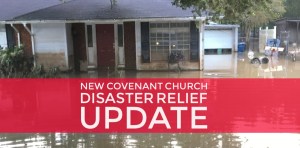
If so, I’d like to direct you to the relief efforts at New Covenant Church. New Covenant is about 15 minutes from me in Denham Springs, Louisiana, one of the hardest hit areas. Blessedly, God spared this precious church to be a ministry to others during this difficult time.

download

New Covenant is a doctrinally sound local church where several friends and loved ones of mine, including the associate pastor (who is heading up flood relief efforts there), are members. My family and I have worshiped with New Covenant numerous times. If you or your church would like to help by making a donation, I can personally assure you that your money will be handled in a godly way and will go directly to flood victims who will also hear the biblical gospel. New Covenant needs volunteers for various aspects of relief ministry, too, and would welcome you or a group from your church if you are able to come down here and help out.

You can give on line or via text. And, if you’d like to come down and help out, you can contact Pastor Todd Whirley by phone or e-mail, or (possibly more quickly- phone service is still somewhat spotty) by private message on Facebook or Twitter.

Thank you so much for your kindness, prayers, compassion, and generosity, and please share this with your friends and on social media to help us get the word out.

Same street as the one in the video above.

Ministry, Throwback Thursday

7 Ways to Encourage Your Minister of Music

Originally published November 18, 2014

Numerous articles have been written about how you, as a church member, can be an encouragement to your pastor- how you can constructively praise his sermon, pray for him, get him a great gift for Pastor Appreciation Month, etc. These are good things. Please be sure to support your pastor. Being a pastor is one of the toughest and most thankless jobs out there, and if you’ve read the statistics you know pastors need and deserve all the encouragement they can get.

Your preaching pastor isn’t the only person on your church’s staff who needs your support. So does your minister of music.

But your preaching pastor isn’t the only person on your church’s staff who needs your support. So does your minister of music. And, having been married to one for over twenty years, I can tell you there aren’t many articles out there letting you know how church members can encourage their ministers of music. Ready to show some love? Here are seven ways you can be an encouragement to your minister of music.

1.
Make practice a priority.

Before you join the choir or praise team or volunteer to play an instrument, find out how much of a time commitment it will be, and consider whether or not you can diligently keep that commitment. Once you’ve joined or volunteered, attend rehearsals, worship services, and performances faithfully, and be sure to arrive on time. You have no idea how much it means to your minister of music that he can count on you.

2.
Get to church on time.

Think about how you would feel if you planned a dinner party, worked hard all week cooking and cleaning, and then one of the couples you invited carelessly showed up halfway through the meal. You’d probably think that was kind of rude and feel somewhat discouraged. That’s sort of the way a minister of music can feel when people (especially the same people every week) habitually arrive late to church for non-emergency reasons. Not only that, but it’s a distraction to others when you come in late, plus you’re missing out on praising God and getting your heart prepared to receive His Word during the sermon. Being on time and ready for worship benefits everybody!

3.
Sing!

If you were in a meeting at work or in a college class, would you pick up your knitting, clip your nails, walk around the room chatting with friends, or bury your nose in your phone the whole time? Probably not, yet, over the years I have seen church members do all these and more during the music portion of the worship service. It’s disrespectful to the God we’re supposed to be worshiping and to the minister of music who is trying to do the work God has called him to. On the other hand, I love it when we get in the car after church and my husband says, with a smile on his face, “Wow, they were really singing today!” We have an incredible Savior who has given us the privilege of praising Him, so let’s take Him up on it. Sing out! You can worship and be an encourager all at the same time.

4.
Smile!

It’s pretty disheartening for a minister of music to stand up front, giving it all he’s got, and then look out over the congregation and see a bunch of people looking like they’d rather be at the dentist. Think about Who you’re singing to and all the reasons why you’re singing to Him, and I challenge you to keep a frown on your face! Just the simple act of smiling while you’re singing will do wonders for your minister of music (and for you!).

5.
Think before you complain.

Has your minister of music said or done something that’s clearly a sin or false doctrine? If so, you have a biblical obligation  to go to him -kindly and in love- and talk to him about it directly.

Is your complaint a matter of personal preference- style of music, whether or not he wears a tie, etc.? Give it 24 hours. Does it still seem just as important? Could you possibly be a servant to him (and others in the congregation whose opinion is the opposite of yours) by overlooking an offense and not complaining?

If you do feel the need to voice your concern (and there are valid concerns that aren’t sin-related), approach your minister of music the way you would want to be approached. Instead of, “Turn that dadgum volume DOWN!” how about, “I was wondering if it would be possible to ask the sound tech to lower the volume in the house speakers a little? My baby’s ears are very sensitive and she gets fussy when it’s that loud. I hate missing worship when I have to take her out to the lobby.” Instead of, “Hymns are so boring. I don’t see why we have to sing them half the time,” how about, “I really loved those two worship songs we sang this morning! Do you think we might be able to sing more songs like that soon?” Christ wants us to be kind to one another, so show your minister of music a little “Golden Rule” love.

6.
Speak encouraging words often.

It’s been our experience, and seems to be the general consensus among ministers of music, that the most common kind of feedback they get is negative feedback. People are much quicker to complain than affirm. Buck the trend. Did he choose one of your favorite songs for the service? Did a certain song help you to understand one of God’s attributes better? Did the choir do a nice job on their anthem? Are you praying for him? Tell him. He appreciates it more than you know.

7.
Show tangible appreciation.

It is amazing what even the smallest gift can do to lift my husband’s spirits. A card of appreciation (I have come across cards that he has saved for years), something related to one of his hobbies, a church member buying him lunch at a fast food place. They might be small items monetarily speaking, but their message is, “I care about you, and I appreciate your hard work.” And that’s priceless.

We have been blessed over the last two decades to serve at several churches that had members who were very good at encouraging their minister of music. Their love and support made my husband’s ministry a joy. What are some ways you can think of to encourage the minister of music at your church and spread that same kind of joy?