Guest Posts, Holidays (Other), Reformation Day

Guest Post: The Reformation – An Invitation to the Gospel

If your theology pretty much matches up with mine (as outlined in the โ€œWelcomeโ€ and โ€œStatement of Faithโ€ tabs) and youโ€™d like to contribute a guest post, drop me an e-mail at MichelleLesley1@yahoo.com,
and letโ€™s chat about it.

The Reformation: An Invitation to the Gospel
by Matt Shown

For most, October 31 is about costumes and candy. But something far more frightening and weighty is also celebrated on that day. October 31 is Reformation Day. On October 31, 1517, a hammer strike would echo through centuries – in fact, the echo is still reverberating today. In 1517, Martin Luther would nail his ninety-five theses to the church door in Wittenberg, Germany sparking the Protestant Reformation that shaped Christian history.

The Reformers sought to bring the church back under the authority of Godโ€™s Word. This wasnโ€™t to say tradition had no value, but rather that the sole โ€œGod-breathedโ€ authority for any believer was not the word of Popes or councils, but the words of the Bible. The Reformers echoed the conviction of Jesus when He responded to the Sadducees in His day, โ€œHave you not read what was said to you by God?โ€ (Matthew 22:31). The words on the pages of Scriptures were Godโ€™s very Word- God breathed and sufficient to equip believers to do every good work (2 Timothy 3:16-17). Sola Scriptura – that Scripture alone is the supreme authority for faith and practice was the formal, or foundational, principle that sparked the Reformation.

But there was a second principle – a material principle- that dealt with the content of the gospel. This material principle was called sola fide. Sola fide was the confession that faith alone was the way in which mankind can be in right relationship with God. By grace alone through faith alone in Jesus Christ alone mankind can be justified, which means to be set in a right relationship with God. Romans 4:5 tells us, โ€œAnd to the one who does not work but believes in him who justifies the ungodly, his faith is counted as righteousness.โ€ John 3:16, the most popular verse in the Bible, reminds us, โ€œFor God so loved the world, that he gave his only Son, that whoever believes in him should not perish but have eternal life.โ€

Many misunderstand what sola fide means because we misunderstand what faith is. Faith is not a blind leap into the dark. Faith isnโ€™t separate from repentance of sin (Mark 1:15). Faith isnโ€™t simply beliefs in our head, but transformation of our head, heart, and will. Biblical faith is conviction rooted in assurance (Hebrews 11:1, Romans 4:21). It isnโ€™t the empty profession that James 2 illustrates. Faith isnโ€™t walking an aisle at church on Sunday and walking in darkness Monday through Saturday. Saving faith is conviction rooted in assurance that Godโ€™s Word is true. It is marked by a transformation of self (2 Corinthians 5:17).

Jesus illustrates saving faith in parable about a tax collector and the Pharisee. Luke tells us he told this parable to those who trusted in themselves that they were righteous, and we may be surprised what self-righteousness looks like. Both men entered the temple to pray, and the Pharisee gave lip service to Godโ€™s grace, โ€œGod, I thank you that I am not like other men, extortioners, unjust, adulterers, or even like this tax collector. I fast twice a week; I give tithes of all that I getโ€ (Luke 18:11-12). He recognizes Godโ€™s grace, yet ultimately found hope in his own works. While the tax collector displays reverence toward God by bowing his head and praying a simple prayer, โ€œGod, be merciful to me, a sinner!โ€ The Pharisee recognizes Godโ€™s grace, the tax collector relied on it. It was the one who relied on Godโ€™s grace, through faith, that went home justified, not the man who simply gave lip service to grace while trusting in himself.

This is an illustration of why the Reformation matters. The church was making men into Pharisees rather than into justified tax collectors. The message of the Reformation was to cease simply recognizing grace, and to instead rely on it. The message was a confession of mankindโ€™s ungodliness, Godโ€™s incomprehensible holiness, and the sufficiency of Jesusโ€™ cross and empty tomb to save!

The Reformation is an opportunity to, by faith alone, rely on Godโ€™s grace. It is an opportunity to trust the promises of God in His Word because the Bible is enough for us. It is an opportunity to let go of unbiblical traditions and to embrace the apostolic traditions found in the pages of Godโ€™s Word. The Reformation is an invitation to the reader who may not have assurance of their relationship with God. It is an invitation to assurance through faith in Jesus Christ.

โ€œHow can I be right with God?โ€ There is no more important question. It is that question that ignited the Reformation and it is a question all of us must answer.


Matt Shown has served as a bi-vocational pastor and church revitalizer for the past 4 1/2 years. He loves God’s Word, good preaching, and Mac N Cheese. He is married to his incredible wife Dana. Matt received his Master of Divinity degree from the Southern Baptist Theological Seminary. He blogs at http://www.ShowntheWay.Wordpress.com.

Holidays (Other), Mailbag

The Mailbag: Mardi Gras, Ash Wednesday, and Lent

For an expanded and more detailed treatment of this topic (based on this brief article), please listen to the Mardi Gras, Ash Wednesday, and Lent episode of A Word Fitly Spoken.


What are Mardi Gras, Ash Wednesday, and Lent? Are they biblical? Should Christians participate in them?

If you don’t live in Louisiana or a heavily Catholic area, maybe you’re not very familiar with these observances. Let’s take a look at each of them:

What is…

Lent Lent is a forty day period (not counting Sundays) leading up to Easter. It is observed by Catholics and some Protestants. Historically, it is supposed to be a period of repentance, penance, fasting, and self-denial. The aspect of Lent that people tend to be most familiar with is the idea of giving something up (self-denial/penance) for Lent such as watching TV, chocolate, smoking, or eating meat.

What is the meaning of Lent? at Got Questions

What is Lent? at US Conference of Catholic Bishops*

Ash Wednesday Ash Wednesday is the first day of Lent. Ashes are applied to the forehead in the shape of a cross to indicate repentance and that the recipient will begin the Lenten fast. Ash Wednesday is primarily observed by Catholics and some Protestants.

What is Ash Wednesday? at Got Questions

Ash Wednesday at Catholic Online*

Mardi Gras (Fat Tuesday) Mardi Gras is the day before Ash Wednesday. It has its roots in Shrove Tuesday, which was originally a day of feasting on all of the foods that were forbidden during Lent so these foods would not spoil or go to waste since they could not be eaten again until after Easter. Through the years, this day of feasting has morphed into drunken revelry – sort of a “last hoorah” for getting all the sin out of your system before you have to start “being good” for Lent. In Louisiana (and a few other places), it is much more a cultural holiday than a religious observance. People from various religions as well as non-religious people participate in Mardi Gras. It is celebrated with numerous parades, balls, and other festivities. The colors of Mardi Gras are purple (representing justice), green (representing faith), and gold (representing power).

What is the origin of Fat Tuesday / Mardi Gras? at Got Questions

Mardi Gras History at Mardi Gras New Orleans*

Are these days/observances biblical?

Lent Yes and no. Mostly no. The fundamental components of Lent – repentance, fasting, and the pursuit of holiness – are biblical. Repentance and holy living should be practiced by all Christians every day, and biblical fasting as the Holy Spirit convicts the individual Believer.

However, Lent is not mentioned or even hinted at in the Bible, and any Catholic observance (of Lent or anything else) is fundamentally unbiblical because the Catholic religion itself is unbiblical. It is also unbiblical for a church to require that its members observe a man-made religious ritual or to imply or teach that participating in this ritual earns favor with God or absolves or makes up for sin. Furthermore, to teach that there is a special time of the year set aside for repentance and holiness is unbiblical. Christians are to walk in holiness and repentance every day.

Ash Wednesday Again, yes and no. Mostly no, and for most of the same reasons Lent is generally unbiblical. The fundamental components of Ash Wednesday – repentance of sin and the pursuit of holiness – are biblical and should be practiced by all Christians every day.

In addition to the unbiblical facets of Lent, Ash Wednesday’s forehead ashes “disfigure[s] their faces that their fasting may be seen by others” which is the exact opposite of the humble way Christ teaches us to fast.

Mardi Gras No. The drunkenness, sin, and lasciviousness that go along with typical Mardi Gras celebrations are patently unbiblical as is the idea of getting all the sin out of our systems before we have to start being good. The Bible teaches against these things.

Should Christians participate in…

Lent Catholic observances of Lent – no. Some doctrinally sound churches and individuals freely choose to set aside a time of biblical fasting, prayer, and worship in anticipation of Easter. For Christians who observe Lent in this way, as long as it is observed in keeping with Scriptural principles, it can be a valuable and meaningful time of respite and renewal with the Lord just as it could if observed at any other time of the year.

Ash Wednesday No. It is unbiblical, as cited above.

Mardi Gras Christians should not participate in any sinful activities any day of the year, including Mardi Gras, nor believe or portray to others by their actions, the unbiblical “theology” behind Mardi Gras. (And as a non-theological aside, violent crime in New Orleans during Mardi Gras has made attending Mardi Gras parades and other events very dangerous.)

However, as I mentioned, in Louisiana, Mardi Gras has become much more of a cultural holiday than an observance with religious undertones. Many smaller towns (and even some larger ones) eschew the debauchery that takes place in New Orleans and offer family-friendly parades which are basically as innocuous as our local Christmas parades or a Fourth of July fireworks show. For Christians who have worked and prayed through the appropriate biblical principles and whose consciences allow them to participate in non-sinful Mardi Gras activities such as attending these types of parades, I believe this is an issue of adiaphoraย (Christian liberty) similar to participating in non-sinful aspects of Halloween. (Don’t forget to take along some tracts to hand out!)


*These articles are linked for informational purposes only. Obviously, I’m not endorsing Catholic websites or anything on a secular website that’s ungodly.


If you have a question about: a Bible passage, an aspect of theology, a current issue in Christianity, or how to biblically handle a family, life, or church situation, comment below (Iโ€™ll hold all questions in queue {unpublished} for a future edition of The Mailbag) or send me an e-mail or private message. If your question is chosen for publication, your anonymity will be protected.

Holidays (Other), Mailbag

The Mailbag: Patriotism in Church

Every year on the Sunday closest to the 4th of July, our worship service turns very patriotic. All of the hymns and worship songs are replaced with patriotic songs like God Bless America, America the Beautiful, and the National Anthem. The choir and whoever is singing a solo that day sings a patriotic song. A color guard marches in with the American flag and we say the Pledge of Allegiance. Sometimes the sermon is even on a patriotic topic. It makes me uncomfortable because I think the worship service should focus on God, not America. What do you think?

Independence Day is one of my favorite holidays. I love the fireworks and picnics, the bands, and watching my favorite musical, Yankee Doodle Dandy.

I’m as red, white, and blue, rah rah America as the next guy, but there’s a time and a place for all that, and the Sunday morning worship hour isn’t it. You’re correct. The worship service is exactly that: worship and service. And who are Christians supposed to worship and serve when we go to church? God.

We are to sing to, and about, God. The pastor is to preach the Word of God. We pledge our allegiance in prayer, worship, and confession to God. Our thoughts are to be focused on God. Every element of the worship service – songs, symbols, readings, offerings, prayer, praise, everything – is to draw our attention to God. He is the only One worthy of our worship.

Patriotic songs, the Pledge, and all of those other things can take the focus off God and put it on something lesser. Sometimes God gets pushed aside in favor of what we want to focus on. That’s a very man-centered attitude in the very place and time when everything is supposed to be centered on God.

And really, if you think about the main reason America was founded – freedom of worship – what better way is there to honor our forefathers and celebrate the gift of freedom God has given us than to exercise our First Amendment right to worship God? Certainly, we could use the 4th of July as a reminder to take some time in corporate prayer to express gratitude to God for our country and our liberties and to pray for our country. Scripture tells us to present our requests to God with thanksgiving. We could also dedicate some time to praying for our governmental officials as 1 Timothy 2:1-4 instructs us to do. There’s a biblical, worshipful way to be thankful for the freedoms God has blessed us with and intercede for our country and our governing authorities. And it shouldn’t be limited to one Sunday a year.

But when it comes to patriotic hoopla, we can set aside another time for that and still celebrate with our brothers and sisters in Christ. If your church family wants to celebrate America’s birthday together, that’s great! Have a church-wide cookout on the 4th. Schedule an Independence Day patriotic sing-along or choir pageant. Meet up and head out to the county fireworks show together. Fellowship! Have fun!

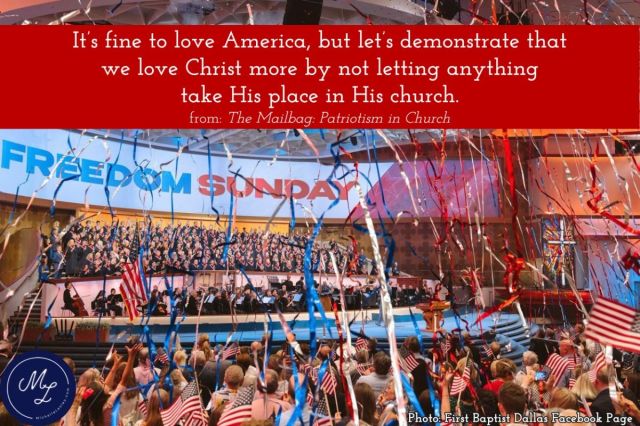
But when it’s time to worship, let’s make sure we’re reserving that time for worship of the King of Kings and Lord of Lords. It’s fine to love America, but let’s demonstrate that we love Christ more by not letting anything take His place in His church.

It’s fine to love America, but let’s demonstrate that we love Christ more by not letting anything take His place in His church.

photo source

If you have a question about: a Bible passage, an aspect of theology, a current issue in Christianity, or how to biblically handle a family, life, or church situation, comment below (Iโ€™ll hold all questions in queue {unpublished} for a future edition of The Mailbag) or send me an e-mail or private message. If your question is chosen for publication, your anonymity will be protected.

Calvinism/Arminianism, Church, Holidays (Other), Reformation Day

The Five Solas of the Protestant Deformation

This year marks the 500th anniversary of the beginning of the Protestant Reformation. October 31, 2017 will commemorate the date in 1517 when Martin Luther famously nailed his 95 theses – a list of grievances against the Catholic church for unbiblical doctrines and practices – to the door of Castle Church in Wittenberg, Germany.

Lutherโ€™s calls for reform spread quickly throughout Europe, inspiring the likes of church fathers Ulrich Zwingli (Zurich), John Calvin (Geneva), and John Knox (Scotland) to join the effort in their own locales. As they worked to address the issues raised in Lutherโ€™s document, these men codified what we know today as the โ€œFive Solas of the Reformation,โ€ the basis of Protestant church doctrine. The five solas are:

1. Sola Scripturaโ€“ Scripture alone is the basis for all church doctrine, belief, and practice. (2 Timothy 3:16-17)

2. Sola Gratiaโ€“ Salvation is by grace alone. It is an unmerited gift of God based solely on His goodness, not our own (because we donโ€™t have any). (Ephesians 2:8-9)

3. Sola Fideโ€“ Salvation is through faith alone. Faith is a gift bestowed by God. We are saved only by placing that faith in Christโ€™s finished work on the cross, not by doing good works or by any other attempts to earn salvation. (Ephesians 2:8-9)

4. Solus Christusโ€“ Salvation is found in Christ alone. As Acts 4:12 says, โ€œAnd there is salvation in no one else, for there is no other name under heaven given among men by which we must be saved.โ€

5. Soli Deo Gloriaโ€“ God saves man for Godโ€™s glory alone, and Believers are to live our lives to glorify Him alone. (Romans 11:36)

The five solas should be the foundation of the church’s orthodoxy (beliefs or doctrine) and our orthopraxy (church practices). But over the past five centuries there’s been a declension. A downgrade. The church has become deformed from the beautiful biblical portrait of a bride “without spot or wrinkle or any such thing, that she might be holy and without blemish” because we’ve functionally replaced the Five Solas of the Reformation with pragmatic, and often idolatrous, solas of our own making…

No longer is Christian doctrine and practice governed strictly by sola Scriptura, especially among Christian women. Now it’s all about our own personal feelings, opinions, and life experiences. Won’t go to a church that preaches sin and repentance because it offends your sensibilities? You’ve become accepting of homosexual “marriage” because someone you love dearly has adopted that lifestyle? Believe God is in the habit of talking to people because you’ve “heard His voice”? Then you’re basing your doctrine and practices on your own feelings and experiences rather than on what the Bible says.

The Christian’s instructions for life and godliness are found in only one place: the Bible. We do not squish Christianity into the mold of what makes us happy, what we agree with, our relationships with others, or the things we’ve experienced. We start with the Bible and we bring everything else in our lives – everything we think, feel, believe, say, and do – into submission to it. If a personal feeling, opinion, or experience conflicts with Scripture, it is wrong. We don’t change Scripture to fit our perspective, we change our perspective to fit Scripture.

We don’t change Scripture to fit our perspective, we change our perspective to fit Scripture.

If you want to know what road the modern church is headed down simply pick up your Bible and turn to… the Old Testament. Especially the verses that say “everyone did what was right in his own eyes.” Jesus said the way to greatness was humility, servanthood, and anonymity. We want glory, recognition, and applause. God says, “walk in My ways.” We say, “I’ll consider that if it fits in with my plans, is agreeable to me, and makes me look good to others.” We “welcome” the Holy Spirit into His own church as though we own the place. We are so used to being on the throne of our own lives that we use words like “letting” or “allowing” God to do something without even realizing it. We don’t ask, “Is it pleasing to God?”, we say, “If it’s pleasing to me, it must be pleasing to God.” Goodbye soli Deo gloria. Hello soli ego gloria.

Instead of asking, “Is it pleasing to God?”, we say, “If it’s pleasing to me, it must be pleasing to God.”

More and more, “Christians” are driven by the selfish greed of “What can God do for me?” rather than the pursuit of holiness. So-called Christian teachers who will scratch itching ears are sought out, and an abundance of hucksters are at the ready, eager to “give the people what they want” in order to make a fast buck.

These people who claim the name of Christ care nothing about following in His footsteps – or even knowing what those footsteps are – craving instead the temporal creature comforts of wealth, success, popularity, health, self esteem, and influence. They want to be told what their flesh wants to hear, and they want to believe that’s Christianity. Share in Christ’s sufferings? Never. Away with the Via Dolorosa. Lead us down the primrose path.

Share in Christ’s sufferings? Never. Away with the Via Dolorosa. Lead us down the primrose path.

Spotlights. Merch. Audiences of thousands. Agents. Entourages. Sometimes it’s hard to tell the Christian celebrities from the secular. The star-struck church has created its own caste system in which biblical fidelity is measured by how many books you’ve sold, the number of attendees at your megachurch or conferences, and the size of your audience on social media. That many followers? That number of bestsellers at the Christian retail chain? She must know what she’s talking about. We’ll use her books for our women’s “Bible” study – no vetting necessary! But that 85 year old pastor who’s been faithfully expositing the Word to his rural congregation of twenty for the better part of his life? No kudos. No esteem for honorable servants of the Lord such as he. We want glitz and glam and hype and bling. We want to be cutting edge, relevant, and attractional. Because maybe – just maybe – some of that glory will rub off on us. And so it goes – we follow the latest and greatest Christian authors, bands and personalities, attracted more to their pretty faces, stylish clothes, and charisma than to sound doctrine, while Christ’s sheep, relegated to a dark corner of the sanctuary, bleat to simply be fed the Bread of Life and the Living Water.

The star-struck church has created its own caste system in which biblical fidelity is measured by how many books you’ve sold, the number of attendees at your megachurch or conferences, and the size of your audience on social media.

What’s hot rightthisminute? What’s the current style, the latest trend, the fad du jour? The Church of What’s Happening Now wants to know. Whether it’s today’s Christian bestseller that simply every small group is using now, dahling, or caving to whichever way the wind is blowing today when it comes to the world’s sexual morality, if we can just ride the viral wave of the immediate we can get people in the doors, money in the offering plate, and souls into Heaven. Maybe.

Vox populi, vox Dei? Have we forgotten how uncool it was to be the only one building an ark before rain was invented? That idol worship was the latest thing going in Jeremiah’s day? That it was the crowds who cried “Crucify Him!”?

The God of the Bible is not hip and groovy. He’s seen as hopelessly out of touch with current morals and values. A doddering old fool who just can’t seem to get with the times. His holy ways are antiquated and obsolete. We’re modern and educated and wise to the ways of the world. We know better how His church and our lives should run.

The God of the Bible is not hip and groovy.

Just what is it we’re building our Christian doctrine and practices on these days? ‘Cause it sure isn’t the unadulterated written Word of God and the original five solas. Maybe it’s time we took a good hard look at how far we’ve slidden in the last five hundred years. How far we’ve strayed from the purity of Scripture and doctrine the Reformers worked so hard for, were imprisoned and persecuted for, were martyred for.

Maybe it’s time for another Reformation.


Additional Resources:

NEW! Why We’re Protestant: The Five Solas of the Reformation and Why They Matter by Nate Pickowicz

What was the Protestant Reformation? at Got Questions

5 Questions and the 5 Solas at The Cripplegate

Reformation Resources to Feed Your Heart and Mind at G3 Ministries