Guest Posts

Guest Post: Moving Off the Sure Foundation

If your theology pretty much matches up with mine (as outlined in the “Welcome” and “Statement of Faith” tabs) and you’d like to contribute a guest post, drop me an e-mail at MichelleLesley1@yahoo.com,
and let’s chat about it.
Moving Off The Sure Foundation
by Kerri Sheldon

The authoritative rule for Christian belief and practice is Scripture – pure and sound. It should be the church’s first say, only say, and final say. If the truth within Scripture is compromised, then by default, the new norm will become muddled thinking and false teaching. Such a compromise will transpire when biblical truths are subtly displaced by other ideas that perhaps on the surface appear innocuous, but with further consideration are found to be a diversion from truth.

Unfortunately, such a shift is happening today among evangelical circles at an increasing rate. A prime illustration is seen when a church has a statement of faith that includes something like, “We believe in the sole authority of Scripture for faith and practice,” yet they have practically abandoned that stance by allowing false teachings to enter in, whether deliberately or indirectly. If Scripture is really their authority, as they say, it should be in actuality, not just in statement. Sometimes it can be more telling to view a church’s list of current studies to know if they truly adhere to God’s Word.

Let’s turn our attention to a few specific examples of untrue teachings that have entered the visible church, making way for a foundational swing.

Hearing God’s Voice

It is quite possible you have heard the phrase “hearing God’s voice,” whether from some teacher or in conversation. Upon hearing such an expression, we should ask ourselves what the person means. Are they saying they were reading the Bible and the Holy Spirit illuminated the truth meaning of the text to their minds? Perhaps that is what they mean. But generally when the phrase is used it means something quite different. Authors Henry and Richard Blackaby, as well as teachers Beth Moore and Priscilla Shirer, to name a few, typically use it to convey the concept that God’s voice is heard when one opens themselves up or learns through experience apart from and outside of Scripture. Keep in mind they might affirm that God’s voice is heard only in Scripture. However, in reality, usually the idea is that one should hear fresh inner promptings or whispers that are not found in the Bible. In fact, they suggest that to hear God’s voice immediately and directly is fresher and greater than simply reading and studying His Word. Do you see why this teaching is so deceptive? It is not because of what is actually stated – to hear God’s voice, but because of what is not stated – how, when, and where to hear God’s voice. The truth is that Christians are commanded to read, study, memorize, believe, and obey God’s Word, not to listen for a voice. It is in the hearing and illumination of the Word that the Spirit then promises to be with us, guiding and empowering us, as we simply walk by faith.

Experiencing God

“Experiencing God” is another commonly heard theme. The idea is associated with having fresh encounters with God. An example can be seen in the book Jesus Calling by Sarah Young. Young states, “I knew that God communicated with me through the Bible, but I yearned for more…” (p. xi) What is this “more” for which Young longs? Is it for more of the Bible? It is not presented that way. Implicit in her statement is the desire for a personal encounter or direct experience with the Living God that is beyond, or other than through, the Word of God.

Should Christians desire to personally encounter God based on their own devices or whims? Is this even attainable? Mystics would answer “yes.” They believe that direct knowledge of God, spiritual truth, or ultimate reality can be attained through subjective experience as intuition or insight. But the believers’ “experiencing” of God is a knowing of God through His means – the Word of God and the Spirit of God. The eternal invisible God is unknowable to fallen and rebellious sinners apart from His own provision for them. Unfortunately, when someone wishes to experience God directly they will be operating from worldly or sensual desires. Let’s remember what one of the more prolific writers and theologians of the 20th century, Francis Schaeffer, said: “We must stress that the basis for our faith is neither experience nor emotion, but the truth as God has given it: in verbalized, propositional form in the Scripture and which we first of all apprehend with our mind – though, of course, the whole man must act upon it.”

Benjamin Warfield, a professor at Princeton Theological Seminary, explained the difference between biblically “experiencing” God and mystical experience, in The Biblical Review, Volume 2, 1917: “Evangelical Christianity interprets all religious experience by the normative revelation of God recorded for us in the Holy Scriptures, and guides, directs, and corrects it from these Scriptures, and thus molds it into harmony with what God in His revealed Word lays down as the normal Christian life. The mystic, on the other hand, tends to substitute his religious experience for the objective revelation of God recorded in the written Word, as the source from which he derives his knowledge of God, or at least to subordinate the expressly revealed Word as the less direct and convincing source of knowledge of God to his own religious experience. The result is that the external revelation is relatively depressed in value, if not totally set aside.”

One of the more prominent people who introduced experience-based emphases and techniques into the visible church was author Richard Foster. His book Celebration of Discipline: The Path to Spiritual Growth took the church world by storm when first published in 1978 (from which the below quotes are taken). It is about the quest for spirituality based on the inner workings of the soul and spiritual techniques. Interestingly, Foster was raised a Quaker. They believe in the “inward light.” To give you a taste of Foster’s book the following quotes are given:

The inner world of meditation is most easily entered through the door of the imagination. (p. 22)

Another meditation aimed at centering oneself begins by concentrating on breathing…become silent outwardly and inwardly. Be attentive to the inward living Christ…then listen once again. (p.25)

You can see Foster believes that imagination, meditation, and the quest for the “inward Christ” are the new mediation before God. Of course that is absolutely not biblical, and is in contrast to the “outward” light who invaded our world of darkness in the person of Jesus Christ, who is the Way, the Truth and the Life. He and His Word are the Light having come into our darkened lives. Not long after Foster’s book, a new seminary category of study was born – spiritual formations. It is quite a conglomeration of teachings in most seminaries these days.

The Cosmic Christ

Another false thought that has entered into evangelicalism is that of a Romantic and/or Cosmic Christ. It says God comes to us “in stuff” (like the creation) and that we need “spiritual eyes” to see Him there. But does Christ make Himself known personally through the creation? No, the true God reigns transcendent over His creation and made Himself personally known in the Person of the Lord Jesus Christ as revealed in Scripture. Yet many are flocking to such authors as Ann Voskamp who writes in her book One Thousand Gifts, “Do I have eyes to see His face in all things…” (p.112). This is a new-age concept in that there is an ever present deity in the creation. It is not talking of the real Jesus, the One who became flesh and dwelt among us and died and was raised again and is seated at the right hand of God the Father. If you want that Christ, you should stick with only the Scriptures.

The End of this Present Evil Age

Unfortunately, the introduction of many false teachers and false doctrines as mentioned here has been “winked at” by most evangelical leaders. This is not ok. If we move even slightly off a biblical foundation, where does that take us? In Acts 20:17-38 we read of Paul’s ministry to the elders of Ephesus and his emphasis in that ministry. True shepherds warn the flock of such impending dangers just like Paul. In light of this, we must not overlook the very nature of the end of this present evil age. Remember what Paul says in 2 Thessalonians 2. He warns that there would be a falling away from the faith led by the man of sin. In the midst of the church at the end of the age a beast will arise and be the catalyst of a false church and the world’s final rebellion against the God of the Scriptures. The spirit of antichrist starts in the visible church and the final apostasy will be no exception. For saints who are alive, it will be very costly to maintain a faithful testimony to the Lord Jesus Christ in the environment of both the visible apostate church and the fallen world.

But our ultimate hope is eternal and will be revealed when the Lord Jesus Christ Himself returns on that glorious day of His revelation! Until then, we should be on guard even while sitting in a church pew and wait patiently with watchful eye and prayerful hearts.


This article is drawn, in part, from Resolute: An Unwavering Stance on the Truth of God’s Word by Kerri Sheldon and her father, David Sheldon. Kerri and David believe that making true disciples of Jesus Christ can only happen when one is presented with sound theological doctrine, and their desire is to help Christians guard against deception and ignite a stance on the Word of God alone. Check out Kerri and David’s website, 4 Truth Ministry and follow them on Facebook and Twitter.

Check out the 4 Truth Ministry Facebook page to find out how
you could win a free copy of Resolute!

Church, Guest Posts

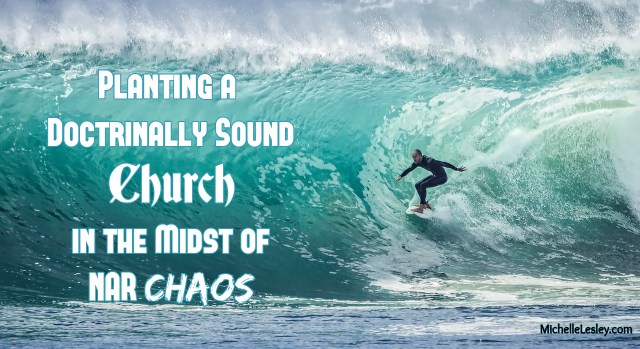
Guest Post: Planting a Doctrinally Sound Church in the Midst of NAR Chaos

If your theology pretty much matches up with mine (as outlined in the “Welcome” and “Statement of Faith” tabs) and you’d like to contribute a guest post, drop me an e-mail at MichelleLesley1@yahoo.com,
and let’s chat about it.


A Brief Word from Michelle:

I’m frequently asked by readers what to do if, despite their best efforts, they can’t find a doctrinally sound church within reasonable driving distance from home. One of my suggestions has been to look into church planting. Here is Elliott’s story of planting a doctrinally sound church in an area where none exist. If you live nearby, consider joining him in this work or at least stopping by to encourage Elliott and Naomi.


Planting a Doctrinally Sound Church
in the Midst of NAR Chaos
by Elliott Micha

I walked into a church on a normal, mid-February cloudy Sunday. An elderly woman came up to me and in a rather creepy timbre, leaned over and said, “God always shows up here.” Then the service started, and an old man in rusty Birkenstocks got up and started screaming. From that point forward all chaos broke loose.

The worship team played a well known Pentecostal song about the fire of the Lord falling down, and bodies started to drop like it was a World War II battlefield. A woman convulsed on the ground in front of me making inappropriate sexual-sounding noises. She appeared to have no control of her body and was almost drooling on the floor. Young people all wearing matching checkered flannel shirts ran to the front of the room to get the anointing as random people laid hands on others. It was a violent scene. This was my first experience witnessing Charismatic chaos in person.

Later, I went to visit a buddy, Russ, who was a local young adults pastor at the time. I asked, “Russ does that happen every week at that church?”. He said, “Yes, Elliott, every single week they do the exact same thing.”. From that day forward I was determined to stop the rise of the Charismatic chaos that had started to infiltrate Orange County Christianity.

At this point I was a young adult. Many years later, the chaos, false teaching, and carnage would escalate to a new level. Some of my close friends from my early twenties sadly got sucked into the emotion and started following famous traveling prophets. My wife, Naomi, coined a term for the fringe Charismatic churches: “koo koo land”. Many people I know, including Naomi’s boss and my dentist both were turned off to ever checking out any Christian church due to their bad experiences with Charismatic churches.

Over the years, Naomi and I saw more and more “pastors” who wanted to be viewed as Spirit-filled men of God, but had little care for God’s word. For a little while I became a church planter working alongside a group of churches, but then the faith healers, “prophets”, and skinny jeans started to arrive. I left that group of churches and dusted off my computer which contained the name of the church Naomi and I felt called to originally plant – Outpouring Church.

Naomi and I knew the blueprint the Lord gave us. There was no more biting my tongue and trying to be politically correct about the madness I had witnessed unfold in so many churches. We were called to plant a church that would be fiercely devoted to educating young people, old people, and those caught in deception about the dangers of the modern day prophets and apostles movement. We felt called to not just sit on the sidelines any longer, but to stand up and not be pushed around by the false prophets (who many times tried to intimidate me, calling me, “just some young punk”) in our region.

The city we live in, San Clemente, is a town that 68,000 people call home. For southern Orange County, that is a rather large population. Our area is home to three mega churches that have a weekly attendance between 700 and 2,000 people each. On the surface many people would say San Clemente has 15 churches total, so what’s the need for another church? These churches are all within a 4 mile driving radius of the rich white suburban side of town, and unfortunately, many of them now feature associations with the New Apostolic Reformation, prophets and apostles, worship music with aberrant theology, and loads of seeker friendly, watered down theology that turns church more into a ringside circus then an actual church service.

Naomi and I originally felt called to San Clemente before we got married. We didn’t want to move to San Clemente, actually. We wanted to move to inland Orange County. Inland Orange County is our version of the Midwest – everyone is hardcore Christian, and many of the people actually know the Bible. We knew it would be a life of contentment if we moved there, but we would be running from our calling. Many of the pastors in our town have even said, “I don’t feel called to San Clemente, I moved there because of the sunny weather,” or “I moved there because I love surfing.”. Naomi and I have zero interest in surfing or the ocean. By the time I was 18 (after working in the skimboard industry) I was really sick of going to the beach. We felt called to San Clemente because we met many “Christians” who were confused about what they believed. In that group we saw a massive need for discipleship and really sitting down and teaching people the Bible.

Our good friend, a local San Clemente native and faithful Christian mother who is 55 years old, went to a house one day for a “women’s gathering”. The women in attendance all said they were “Christians”. At this gathering one of the women started saying how it was okay for Christians to use horoscopes. Our friend rebuked the woman and the woman got really angry. This gives you an idea of the type of danger that has seeped into our local Christian scene. Many of these people don’t understand the basics of the faith and some of them have been walking with the Lord for years.

Naomi and I also felt called to San Clemente because no one wanted to go near the area we felt called to plant a church in. We felt called to Southern San Clemente and specifically an area called Surfer’s Row. Everyone plants churches in Talega (inland San Clemente) which Naomi and I joke is like Utah (it has a massive Mormon population) and is home to many wealthy Caucasian families. We live in a neighborhood in the middle of town that is largely Mormon and has lots of older Roman Catholics. In our actual tract of homes there are only a few Christians.

Naomi and I know another group of people right now that are leaving our area to plant a Bible-based church up in Idaho. We have watched as many people plant great churches in our town and then after a few years leave San Clemente due to the spiritual warfare and backlash. We were attracted to planting in Surfer’s Row because it is still unchurched. Surfer’s Row is home to drug addicts, local professional surfers, various ethnic people groups, a low income school, and dive bars that look like they belong in a Harley Davidson ad.

One of the huge battles we face in San Clemente is that many professing Christians idolize the sport of surfing. There have been Christian parents in our area who have gotten divorced because of their obsession with surfing. Some of the local pastors base their life and schedule around surf contests and conditions. We even have one pastor in the area who will skip being in the pulpit if there is a good swell coming in to surf. When I went to share the story of our church plant with another well known retired surfing pastor, he said to me, “Do you surf?”, as though surfing was a requirement for planting a church in our town. It was a very weird experience. (For the record I don’t surf. I grew up skim boarding.)

Instead, my father-in-law, Pastor Bob, has had a big influence on me. He is a retired pastor, Vietnam vet, and seminary grad who served for 50 years. But in his words, “You never retire from ministry.”. He’s my mentor when it comes to day to day church planting. In our first church planting experience, Naomi and I were struggling to find someone to really disciple us. At a certain point (when one of the pastors started teaching that Christians can be demon possessed and that Christians can walk on water just like Jesus did) we left that group of churches and realized that her folks had seen it all in a long career of ministry and would be great mentors on this crazy journey of planting a church.

We also have a few buddies that pastor churches in inland Orange County who are all great allies. These men have shown us how this whole process of church planting works and what it looks like to be faithful to the flock that God has given them. (The funny thing is we aren’t Calvinist, but we have a large following of Calvinists now because we are one of the only vocally anti-charismatic chaos churches in our area.)

So the next logical question is: how do you evangelize the people who call Surfer’s Row home? Naomi and I get up every Sunday and prayer walk the Surfer’s Row area. The main way we invite people into the story of Outpouring Church is door to door knocking. One day my friend Billy said to me, “You door knock to tell people about your church plant? That’s hardcore Elliott.”. It may be a rare thing nowadays, but so far it has worked to help start getting the word out. I door knock a few times a week, give out free Bibles at the local surf spot, give out free surf supplies to the surfers (if their boards need repair), deliver Bibles to the homes of people who need them, utilize social media (Twitter, Instagram, churchfinder.com, Yelp), hand out contact cards with our info on it, and distribute free surf wax with our church logo on it. So far, these simple forms of outreach have started to build a small following of people in our area. Currently, we have four people on our church interest list. Once we get enough people, we will start our once a week “house church” style Bible study.

It might shock you, but many of the people in Surfer’s Row have never seen a Bible or heard about Jesus. The Bahai faith, Mormonism, fringe Charismatic Christianity, and the New Age are all large religions in that specific area. Some people within Surfer’s Row have large tiki statues of various Hawaiian gods they worship displayed in their front yards. Many of the pro surfers run nonprofits that push mindfulness, yoga, and New Age belief, and have no frame of reference for Christianity. I have had many good discussions with young (18-19 years old) surfer kids and they are blown away that Christians would actually care for them and want to talk to them. I always try to share the gospel with them. Slowly but surely we are starting to build a following.

That is just a little of our story. It has been a crazy ride so far. Through it all we have learned to always come back to Hebrews 13:8 which says, “Jesus Christ is the same yesterday and today and forever.” Naomi and I have learned the true meaning of the narrow road. We have seen what happens when you call out false teachers and stand for truth. I have learned what it feels like when you get home from plowing the fields for the sake of the Gospel and just want to sit in your chair. We are a tiny church with just a handful of people, but we are ready to make a big dent in San Clemente for the kingdom of God.

We are Outpouring Church and as always, “Our mission is His mission.”


Elliott Micha is the Founder and Senior Pastor of Outpouring Church at Surfer’s Row located in southern San Clemente, California. Elliott and his wife Naomi have two English bulldogs and are looking forward to one day starting their own family. Naomi loves equipping young women with biblical knowledge. Elliott, Naomi, and their ragtag group of friends are excited to see people who are far from Jesus come to know Jesus. Follow Outpouring Church on Twitter or Instagram.

Guest Posts, Ministry, Prayer

Guest Post: 7 Ways You Might Not Know You Need to Pray for Your Pastor ~ Part 2

If your theology pretty much matches up with mine (as outlined in the “Welcome” and “Statement of Faith” tabs) and you’d like to contribute a guest post, drop me an e-mail at MichelleLesley1@yahoo.com,
and let’s chat about it.

7 Ways You Might Not Know
You Need to Pray for Your Pastor
Part 2

by Pastor John Chester

This is Part 2 of the article. You can read Part 1 here.

He is affected by counseling

It is a great privilege and joy to counsel God’s people. It is an absolute joy to point them to the cross and the sure hope we have in Christ. It is a wonderful privilege to see people change in response to God’s word and the work of the Holy Spirit in their lives. I love counseling and I’m sure your pastor does too. I don’t want anyone to reach the wrong conclusion that your pastor would be served by your not coming to him or that you can serve him by keeping your trouble to yourself. We need to and should rejoice in bearing one another’s burdens (Galatians 6:2). Yet the fact is it can take a toll. A true shepherd loves the sheep, and he hates to see them hurting. Your pastor knows the pain in your church family in ways you do not. He knows who has trouble in their marriage, who is struggling with a rebellious teen, who is living with acute chronic physical pain, who has a besetting sin, who is on the verge of hopelessness and so much more. And his heart breaks over all of that. I don’t know a single pastor who hasn’t wept after a counseling session, and I don’t know a single pastor who hasn’t had some version of the conversation with their wife where their wife notices right away they are obviously down and sorrowful and asks why and they respond, “It’s a counseling thing, I shouldn’t talk about it.”.

And it can be even harder when he has to rapidly shift gears from weeping with those who weep to rejoicing with those who rejoice (Romans 12:15). Counseling is my absolute favorite thing to do in ministry, it brings me great joy, but one hour of counseling wears me out as much as ten hours of studying or four hours of administrative work.

How you can pray for your pastor: Pray for the empowering of the Holy Spirit during counseling sessions, pray that counseling would make him long more intensely for heaven, and pray that he would be able to sleep at night.

He lives on wartime footing

Once, when I was fly fishing at a small hike-in lake in the reassuringly-named Bear Tooth Mountains in Montana, I was having such good luck I fished the entire evening rise. As I packed up my gear in the gloaming for the 3½ mile hike down single track to the trail head and my car, I realized that I smiled like fish, and my wader, wading boots, net, and the rest of the gear I was about to strap to my back smelled like fish too.  So, to any bears that happened to live in the Bear Tooth Mountains, it would smell like a giant trout was walking through the woods.

As I hustled down the two foot hide trail that wound through dense woods, I was hyper-vigilant knowing that an attack could come from the right, left, front, or back, and that if it came it would be sudden and savage. Not only was I an the lookout for the attack to come, I was expecting it. So, as I made my way down the trail yelling, “Hey Bear!” I was thinking about how to respond to the various ways the attack could come.

Thankfully the attack never did come, but the memory of that dark jog through the woods is etched upon my mind. I’ll never forget that feeling. And it is the closest thing to the feeling of being faithfully vigilant in ministry I can think of. Paul told the Ephesian elders that ravenous wolves would rise up from among them and that they needed to be alert and to follow his example of persistent vigilance and purposeful teaching (Acts 20:29-31). Vicious, violent attacks against the church can come from anywhere and at anytime.

Lest you think I am exaggerating, let me tell you that every man I know in the ministry who has served for ten years or more has faced at least one serious existential attack against the church he serves. And truthfully it averages about once every 2.5 years. Let me tell you about the two serious existential threats we have fought off in our five years here at Piedmont Bible Church.

One that I saw coming was that we had a number of families (a large enough number to alter the complexion of our small church) who came with the intention to take directional control of the church and steer it toward the Family Integrated Church movement. I saw this coming because I am friends with a pastor in a neighboring town whose church had been attacked by this group of marauders. I was able to recognize them and drive them off before they could cause any mischief.

One attack took me entirely by surprise. A man who had been vetted for years, who had been examined by the church and appointed to the office of elder, within sixty days of becoming an elder demanded that the church functionally abandon sola scriptura in favor of making the traditions of men binding for the church. He sought to elevate the traditions of the church he grew up in – regarding music, dress, and the exercise of Christian freedom in a myriad of areas – to be on par with the authority of Scripture. He went so far as to say that there were no categories of preference or wisdom in the Christian life or the life of the church and that if you were truly sanctified, the Bible gave you a definitive (yes or no) answer to every question. Although he would angrily say his position was scriptural, he saw things as diverse as VBS, singing Amazing Grace accompanied by any instrument other than the piano, and people wearing the wrong colored shirt when teaching or leading in any capacity in a corporate setting as fitting into the phrase “and things like these” in Galatians 5:19-21.

And here is the remarkable thing, when I confided in a mentor that in the midst of this crisis I was so stressed and worn out that I hadn’t slept in weeks and that I had been vomiting blood, he didn’t say that was the worst thing he had ever heard (as I expected), he said, “Welcome to ministry. You need to learn to take care of yourself.” It’s not that he was unsympathetic or compassionate – without his advice, comfort, compassion, and actual practical help I don’t know if I would have made it through – it was that out of love he wanted me to know that this is what it is like. Ministry is a battle. It is no accident that Paul uses so much military language and imagery when he wrote to Timothy and Titus.

The kicker is that while this conflict was raging I worked hard to protect the church from it and from the knowledge of it. Although the battle raged for eight months, until the final week of the conflict (by which time other pastors and counselors were deeply involved), no one in the church outside of leadership knew that this battle for the life of the church was going on. A good shepherd doesn’t alarm the sheep, he protects them. If you have been at your church for five years and you have never heard of anything like this happening, it is more likely that you have a very good shepherd than a church that has never come under attack.

Additionally, pastors (and their wives) are often subjected to personal attacks. I’ve been told angrily that I am a liar who is disqualified from ministry because I turned over a cushion without telling anyone. I’ve been told I dress too nice/not nice enough for a pastor. And I’ve been led away from the church in handcuffs for removing political signs placed on church property without permission.

Every day when pastors go to work they are in a fight. It’s not hyperbole and there is no other way to put it. That in no way eliminates or even dampens the joy of pastoral ministry, but it is true. And living that way can take a toll. One of the risks is exhaustion, fatigue, and burnout. Find someone who boxed growing up and also played a sport in college and then ask them, “What took more out of you, three minutes of fighting or sixty minutes of lacrosse/football/hockey/basketball or whatever sport you played?”. They will all say the three minutes of fighting. Fighting and being ready to fight just takes a lot out of you.

And it can make you cynical. There is a fine line between learning to have a thick skin and building up callouses. After my battle with the false elder, my wife said to me, “Well, you learned a lot.”  I replied, “I learned that I’ll never again trust a man who didn’t play Little League.” I was only half kidding (probably down to 12% by now).

[Special note: It is always enormously sad when a pastor fails morally.  I am convinced that many more are casualties of war, than double agents who were exposed. A pastor who falls into sexual sin is permanently disqualified (Proverbs 6:32-33), but he should be treated according to Galatians 6:1.]

How to pray for your pastor: Pray that the Lord would protect him as he protects you. Pray that he would not become jaded and would love as described in 1 Corinthians 13:4-7. Pray that no matter what is going on that his time of study would be a refuge and a refreshment to him.

He gets discouraged

If there is one thing I can say with 100% certainty of all pastors it is that they are all human. And because they are human sometimes they get discouraged. Some are more prone to discouragement than others, and it is not a weakness or a flaw. God uses all kinds of men. Spurgeon famously called his depressive, discouraged mood “the black dog” and said sometime he was on the verge of tears for no apparent reason.

While some pastors are more prone to melancholy moods that others, every pastor I know has experienced this acutely, sharply and often enough to talk about it. In fact, there is a kind of gallows humor among pastors about how bad Mondays are and how you should never resign on a Monday.  

Most faithful pastors I know are estranged from at least some of their extended family because of ministry and fidelity to Scripture. My wife once overheard my older brother (who I looked up to and adored growing up) say he wouldn’t come to a family gathering if I was there because he couldn’t take my “Jesus ‘stuff’” (he didn’t say “stuff”). I know a man whose parents won’t speak to him because he left a lucrative, high prestige career to become a pastor. I know another who is told to just stay in the basement after dinner on holidays by his wife’s family.

Every faithful pastor has known the pain and disappointment of having someone he has poured into, discipled, and taught walk away from the faith (or at least the church), not to mention the pain that comes when people you love, have invested in, and count on as key contributors to the ministry of the church simply move away. The day after he was confirmed into the office of elder, our first elder as a new church plant was downsized and had to move away. I wouldn’t be human if I didn’t find that discouraging.

Every faithful pastor has been deeply wounded by someone he thought of as a friend and ally. In fact, this is so common that a proverbial saying among seminary professors that all seminary students roll their eyes at is, “The man who brought you in will be the man who tries to take you out.” While that may not always be true, it is true often enough that no pastor five years in would roll his eyes.

Add to all of that how in pastoral ministry you can do everything “right” and not be “successful.” No other vocation that I have experienced is like that in any way. There is a popular preacher and conference speaker who often says to pastors (and those training for the ministry) that if you take care of the depth of your ministry, God will take care of he breadth. But what no one says is that sometimes the breadth is 40 people. The median size of an evangelical church in the U.S. is 184 but more than half have less than 75 regular attenders. The very best pastor I know has been faithfully preaching, teaching, and discipling for over thirty years at a Reformed Baptist church that has never cracked the 100 member mark. He has missed probably 500 weeks’ pay over that time as he always allowed his salary to be cut out of the budget when there wasn’t enough financial support to do the work of the ministry.

Oh, and everything that is common to believers and can drive them to discouragement, pastors also experience. They get sick and injured, they get flat tires, they experience the loss of loved ones, they have unexpected financial expenses, their dogs die. And they sin too. Even Paul was overcome at this, saying that he didn’t do the good he wanted to, that he did the wrong he despised, and called himself wretched (Romans 7:15-24).

You hear a lot about pastoral burnout, depression and how few ordained men actually retire from or die in pastoral ministry, but I don’t think it is really a matter of burnout or depression. More often than not I think it is profound, prolonged and unaddressed discouragement. Even in churches that are great at the “one anothers”, the pastor(s) are often viewed as “other”, not “another”. No one thinks to encourage them (other than in preaching), and their burdens are not borne (Galatians 6:2).

How to pray for your pastor: Pray that he would see enough of the Lord working that he would be encouraged that the Lord is at work through his ministry. Pray that the Lord’s grace would always be sufficient for him. Pray that the Lord would guard his heart from discouragement and pastoral jealousy. Pray that the Lord would strengthen him when he is weak and lift him up when he is down.

When Michelle asked me to write this post some months ago she said I could write it and she could publish it anonymously. I appreciated that. But the more I thought about it, the less attractive that option was. Here is why: I want everyone to know this isn’t a list of gripes written by someone who regrets being in ministry. I love pastoral ministry I love preaching, I love teaching, I love counseling, I love praying for the people of the church, and all of these things are absolutely true. Pastors are immensely blessed and privileged to do what we do, but we all (even your favorite radio preacher and your pastor) have feet of clay. And we are part of the body of Christ, just like you. But pastors have a unique role in the body, and by pulling back the curtain I hope I made it a little easier to understand and pray for your pastor.

And if you think of it say a prayer for me too. I need it.


John Chester is the pastor of Piedmont Bible Church, a Grace Advance church plant in Haymarket, Virginia. Prior to ministry John worked as a lacrosse coach, a pizza maker, a writer, a marketing executive, and just about everything in between. He hails from The City of Champions: Pittsburgh, Pennsylvania, and is blessed to be married to his wife Cassandra. Read John’s blog articles at ParkingSpace23, and read more of John’s excellent posts for Michelle Lesley here.


Pastors and pastor’s wives-
What would you add to this list of things that church members
may not know to pray for their pastors about?


Guest Posts, Ministry, Prayer

Guest Post: 7 Ways You Might Not Know You Need to Pray for Your Pastor ~ Part 1

If your theology pretty much matches up with mine (as outlined in the “Welcome” and “Statement of Faith” tabs) and you’d like to contribute a guest post, drop me an e-mail at MichelleLesley1@yahoo.com,
and let’s chat about it.

7 Ways You Might Not Know
You Need to Pray for Your Pastor
Part 1

by Pastor John Chester

Being a pastor is odd. There is no other way to put it. It is entirely unique. No other profession or vocation or calling is like pastoral ministry. That is not to say it is better or more noble. It isn’t, it’s just different. Really different. (And it is certainly not to say that I am somehow superior, better, more valuable to the Kingdom, or holier. As one of my favorite seminary professors said to a class of future pastors, “You know why God calls men like you to pastoral ministry? Because you were the worst available.”)  

But pastoral ministry is unique, it is a unique job, it is a unique calling, and it is a unique lifestyle. And every pastor needs prayer, desperately. Most believers pray for their pastors (Thank you!). One of the questions I am often asked is, “How can I pray for you?” I am always happy to answer, but frankly I don’t think I have ever thought to ask for prayer related to the uniqueness of pastoral ministry. I know that you want to pray effectively and specifically for your pastor, so I am going to let you in on some inside baseball. Here are seven things you may not know about pastoral ministry and your pastor.

He is often under deep conviction

You know that sermon on that hard text that had you squirming in your seat about eight minutes in because the Word of God was so clear and strong in saying that you are in sin? Well your pastor has lived in that passage all week and has probably been thinking about it for weeks or even months. I remember after I had preached James 3:1-12 a dear saint coming up to me after the worship service and saying how hard it was to sit through that message because of how convicting it, and that text was. I said something along the lines of, “I know, we all fail to control our tongue as we should,” but what I was thinking was, “I know and if you think it was hard to listen to for 45 minutes, imagine studying for 45 hours for those 45 minutes.”

Don’t get me wrong, it is a great blessing to spend so much time and to be able to spend so much time studying God’s Word, even and especially the deeply convicting passage. Full stop. Yet is also true that it is emotionally draining to spend so much time in those passages. A few years ago I received an angry email from a visitor to the church (the time stamp on the email indicated that he must have written it on his phone in the parking lot), and his complaint was he didn’t feel uplifted by the sermon. Of course he didn’t feel uplifted by the sermon, no one did. Like everyone else, he was deeply convicted by it, the text was Mark 9:42-50, where Jesus says if your hand causes you to sin cut it off. I was preaching that sermon to myself when I was walking the dog on Thursday morning. Of the many things that I didn’t expect in pastoral ministry this is probably the most significant one.

How to pray for your pastor: Pray that when he is under powerful conviction of his own sinfulness the Lord would use it to conform him to the image of Christ, that he would feel the power and weight of forgiveness in Christ and that the Lord would bring passages like Colossians 2:13-15 and Psalm 103:10-13 to his mind.

He works a lot

I’ll not beat around the bush, I don’t know a single pastor that works less than 55 hours a week. Most of them work 60+ hours a week. Most church member know their pastor works a lot, but here is what you might not realize – the smaller the church, as a rule, the more hours the pastor works. It is very easy to think (or not to think about it at all) that your pastor doesn’t have the workload and responsibility of that famous pastor with a huge church, but he does, and probably much more to boot. It goes without saying that small church pastors spend as much time laboring in prayer and study as pastors with big churches (at least they should).

But small church pastors do something (often everything) else too; they are often the chief maintenance man, the church secretary, the webmaster, the youth pastor, the counseling pastor, the director of Christian education, etc., as well as the preaching pastor. Maybe you think, “Sure, but our church has three staff pastors and a secretary.”. To put that into perspective, the large church associated with my seminary has 14 staff pastors, staff elders who oversee non-pastoral areas of responsibility, and a veritable army of support staff and compensated interns. And that is in no way a criticism of that church. I rejoice that there are so many hands to make the work lighter, but the thing is that huge church has no more kinds of ministry going on that your small church. Your church probably doesn’t have a thousand kids in Sunday School, but it has Sunday School. Your church may not have hundreds of people in counseling at a time, but your pastors counsel people. You get the idea.

How to pray for your pastor: Pray that he would find refreshment in his work, that the Lord would move in the hearts of the saints to motivate them to do the work of the ministry (Ephesians 4:12), that the Lord would provide him with the rest and respite he needs (remember everyone is different), and the Lord would protect him from the deleterious health effects of overwork.(Bonus tip: encourage him to take actual vacations and days off and respect them.)

He is a man apart

I don’t mean that pastors are somehow different or better than other Christians, what I mean is that other Christians as well as non-Christians act like it. One of the strangest things to me when I moved from seminary to ministry – a move that entailed a cross country move to a place where no one knew me – was that everyone acted as if my first name was “pastor.” And the first 7,367,489 times someone called me “pastor” in conversation, I said, “Call me John.” But as the years have gone by I’ve learned to stop saying that, not because I’ve come to think of my self as different, but because no one has listened. And I get it. I never thought of my pastor, especially before I went to seminary, as just “Ron,” and, truth be told, I still think of him more as “Pastor Ron” than “Ron.” I think it is good for people to love and esteem their pastor – after all they are worthy of double honor (1 Tim 5:17) – but it is strange to be that person.

And if it’s odd being treated that way in the church it is even stranger being treated as a man apart outside of the church. I’ve had a handyman (who I learned was Hindu) sent by my landlord to paint an outside railing tell me he was going to do an extra good job because I was a holy man. My neighbors all are very stiff and formal with me. When I went to a gym in the smaller town I drove through on the way to the church, a hush would fall over the locker-room whenever I walked in because word had gotten around the gym that I was a pastor. The pharmacy tech at the drug store (who is also Hindu) asks me for marital advice, and I could go on.

Putting it all together it adds up to, functionally, a man apart, and that can be tough. (And this applies to your pastor’s wife too. A dear saint in the church one introduced my wife to one of her friends as “the First Lady of the church.” Often pastor’s wives experience profound loneliness. Don’t forget to pray for them too.)

How to pray for your pastor: Pray that he would be satisfied in the Lord, that his marriage would be a sweet friendship (Proverbs 5:18), that the Lord would bless him with friendships with local likeminded pastors, and that he would maintain the friendships he forged before pastoral ministry.

He is not always hungry

This one may seem trivial, but trust me it is important, especially if you love your pastor. Ask yourself this, when was the last time your pastor visited that you didn’t offer him something (probably a baked good) to eat.  I can count on one finger the times I’ve been in someone’s house when someone hasn’t offered me something to eat. And every time it is offered I accept, because I know it has been prepared with love and the last thing I would want to do is make someone feel unloved or rejected because I refused what they had prepared for me. Yet, often, I eat it knowing I shouldn’t. I love desert – one look at me would confirm it – but I really don’t need it on Wednesday afternoon at 2:00 p.m. It can really be an act of love not to offer it.

A few weeks ago was the one time I was in someone’s home where they didn’t offer me something to eat. This family was relatively new to the church and wanted to talk about how they could serve, so we set a time for me to come over. And make no mistake, this is the kind of home visit every pastor loves and looks forward to. But I try to eat clean, and I was dreading the pastry I was sure was going to be offered. When I came over and it was suggested that we sit at the dining room table, I was sure that there was going to be a coffee cake on it, but there wasn’t.  I was grateful and greatly blessed when I was simply offered something to drink. I don’t think it is a coincidence that both the husband and wife had long personal histories of formal ministry in local churches.

And as a corollary let me say this (and I realize I am about to step on some toes), your pastor may not like Chik-Fil-A.  I would estimate that at least 75% of the time someone asks me to meet them for lunch they suggest CFA. I know that it is approaching heresy to say it, but CFA is just fast food, it is not an especially spiritual place to eat. If your pastor is not someone who eats at Taco Bell or Wendy’s regularly, he probably is not someone who wants to eat at CFA all the time.

How to pray for your pastor: Pray that he would eat a healthy diet and get adequate exercise.


John Chester is the pastor of Piedmont Bible Church, a Grace Advance church plant in Haymarket, Virginia. Prior to ministry John worked as a lacrosse coach, a pizza maker, a writer, a marketing executive, and just about everything in between. He hails from The City of Champions: Pittsburgh, Pennsylvania, and is blessed to be married to his wife Cassandra. Read John’s blog articles at ParkingSpace23, and read more of John’s excellent posts for Michelle Lesley here.


This concludes part 1 of John’s article.
Be sure to come back next Tuesday for Part 2.


Pastors and pastor’s wives-
What would you add to this list of things that church members
may not know to pray for their pastors about?

Book Reviews, Guest Posts, Salvation

Guest Post: A Review of “From Death to Life: How Salvation Works”

If your theology pretty much matches up with mine (as outlined in the “Welcome” and “Statement of Faith” tabs) and you’d like to contribute a guest post, drop me an e-mail at MichelleLesley1@yahoo.com,
and let’s chat about it.

photo credit: Stephen J. Melniszyn

A Review of Allen S. Nelson IV’s
From Death to Life: How Salvation Works
by Katy B.

The most agonizing, frustrating experience in my ministry to women is the woman who claims to be “saved” but gives no evidence of it. No interest in talking about Jesus, no interest in holiness, reading the Bible, going to church, serving God’s people. She has a salvation testimony (often dramatic and self-glorifying) that is superficial, shallow, and devoid of any real repentance for her sin. I suspect she’s a false convert. And I find it exceptionally difficult to talk to false converts.

In From Death to Life, Pastor Allen Nelson confronts the disaster of false conversions, linking them to a false understanding of salvation: what it is, what it does, and how it works. He writes, “Ask fifteen people what it takes to be saved and it’s not out of the realm of possibility that you’ll get twenty different answers.” (Loc 173

He makes the bold statement that “there is no spiritual life in many who claim to be Christians in America.(Loc 247) He calls them the “walking dead”.

How does that happen? What would cause a person to wrongly believe he or she is a Christian? He lays some of the responsibility at the feet of churches that use methods such as external manipulation, diluted gospel presentations, the altar call, and the sinner’s prayer to lead the walking dead to their false professions of faith and their false assurances of salvation. He blisters easy-believism practices that, even if well-intentioned, have done damage to churches more influenced by a fallen culture than by God’s own Word.

So how does salvation work? The author has narrowed the answer down to five main points:

1. The gospel must be proclaimed.

2. God must move.

3. The sinner must respond in faith and repentance.

4. God justifies the sinner.

5. The sinner grows in the Lord over a lifetime.

Pastor Nelson not only unpacks, but folds, hangs up, and neatly puts away each of these main points in a few short chapters. In doing so, he poses and then answers questions such as, “What is the true gospel?”, “What is biblical repentance?”, “What is saving faith?”, and “What exactly is justification?” His answers are delivered in a direct, engaging, accessible style with plenty of biblical illustrations and scriptural references. No theological dictionary needed.

The book includes “howto’s” but doesn’t read like a “howto” manual. The tone is pastoral, sometimes comfortable, sometimes convicting, but never harsh. At times, the reading felt like sitting over coffee with Pastor Nelson, asking questions about various evangelistic situations, and receiving useful advice on how to respond.

A destitute woman in a homeless shelter, eyes pallid, needle tracks running down her arms, naturally incites my heart instinct to put my arms around her, tell her Jesus loves her, and give her some money. But Pastor Nelson reminds us:

“People need to hear more than “Jesus loves you,” What they need to hear today is what they’ve always needed: to know that they are sinners, that they need a Savior, that Jesus is that Savior, and until and unless they come to Him in faith, they will justly spend an eternity facing the punishment of their sins.” (Loc 2413)

He points out that it is vital that we all (not just the “trained professionals”) know what to say when the time comes to share the gospel of Christ. And while there is no formula, it is essential that the facts of the gospel are understood. The book helpfully guides the reader in a biblical understanding of how salvation happens and presents realistic examples of responses that can be used with unbelievers/false converts in evangelistic conversations.

The chapter “Plant, Water, Trust God, Repeat” is a compelling warning to stick to a biblical approach to evangelizing the lost. (Throughout the book he gives examples of unbiblical approaches.) In this encouraging chapter, he discusses applying how salvation works in real life scenarios, acknowledging that it is not always easy. He doesn’t present himself as a superhero evangelist.

This is a serious book, but the author can also be funny. I got a laugh out of his response to the command to “ask Jesus into your heart”. His tone, however, is utterly serious when discussing repentance:

“God doesn’t beg people to repent so they can be the star player on His team. He demands repentance. He owes mankind nothing. What a fearful and insolent game we play by making repentance an optional feature to becoming a Christian, refusing to properly define it in hopes of sneaking people into the kingdom, or by flat out dismissing it altogether.” (Loc 1164)

He spends a good bit of time parked on repentance, emphasizing that biblical repentance is necessary for any person to become a Christian. He asserts, “Remorse does not equal repentance” and goes on to give what he calls the bare necessities of repentance.

Is it possible to know if a person has actually been converted? In the chapter on sanctification, the author acknowledges that while we can’t see the heart, we can use the discernment God gives us to see evidence of true conversion. He provides a practical alliteration method to assist in discerning whether or not the gospel has actually taken root in a person’s heart and the changes we would expect to see in a truly converted person.

He warns the church against haphazardly affirming people as Christians without exercising grace-filled discernment:

“Often, we claim that the problem in our churches is that too many people are immature believers when the real problem is that many we call immature, actually have no life in Christ at all. They aren’t growing because they aren’t living.” (Loc 1878)

The sanctification chapter, my favorite, thrust me to a fresh examination of my own life using his alliteration template. What evidence of salvation would others see in me? What would they discern as my motivation for life? There is plenty of self-application for the reader.

The book has three appendices. Appendix 1: The Sinner’s Prayer, Appendix 2: Acts 2 is Not an Altar Call, Appendix 3: Putting “Baptist” Back in Your Church. In these appendices, the author makes some “say whaaaat?!? observations that will rock your world if your church endorses these practices.

This is a short book. Although the print version is only 200 pages, there is nothing shallow about the content. The reader will step into a deep pool. Did I know how salvation works before I read the book? Yes. Have I been guilty of using unbiblical methods to try to bring about a conversion? Yes. I finished the book with an unanticipated, heart wrenching reorientation to the gospel as the power of God unto salvation. I bet I’m not the only reader who closed the book and repented.

I began by saying I find it exceptionally difficult to talk to false converts. What do you say to someone who believes she is saved when it is clear that she is not? Pastor Nelson is immeasurably supportive in reinforcing that “we must proclaim the gospel. Without it, people will go to hell. It’s as simple as that.” (Loc 441)

The book left me feeling hopeful, energized, looking forward to my next evangelistic encounter. God saves sinners. God saves sinners. And he uses sinners like me to do so.

Pastor Nelson writes, “Every single one of us is charged with sharing the gospel with those God providentially places in our life.” What a calling, what a staggering privilege. God could sovereignly call His own to Himself without us, but He has chosen to work through us. This book will certainly help us in our evangelism. I recommend it for everyone.

¹Katy reviewed the Kindle edition of the book and used Kindle location numbers rather than page numbers.


Allen “Cuatro” Nelson, IV, author of From Death to Life, is the pastor of Perryville Second Baptist Church in Perryville, Arkansas, and co-host of The Rural Church Podcast. Contact Him directly via Twitter to receive a free study guide with your order of From Death to Life or a discount on bulk orders. You can also order from Amazon.

Katy can’t remember when she became a Christian but is assured that, by the grace of God alone, she is a Christian. She ministers to women in her OPC church, in homeless shelters, in a prison, and sometimes at the grocery store. She is an executive with a United States health care corporation and enjoys her work, although she would rather be reading. You can find Katy on Twitter at @KatyvonBora.

ALTHOUGH I DO MY BEST TO THOROUGHLY VET THE THEOLOGY OF THOSE WHO SUBMIT GUEST POSTS, IT IS ALWAYS POSSIBLE FOR THINGS TO SLIP THROUGH THE CRACKS. PLEASE MAKE SURE ANYONE YOU FOLLOW, INCLUDING ME, RIGHTLY AND FAITHFULLY HANDLES GOD’S WORD AND HOLDS TO SOUND BIBLICAL DOCTRINE.