These are my notes from my ladies’ Sunday School class this morning. I’ll be posting the notes from my class here each week. Click here for last week’s lesson.
Through the Bible in 2014 ~ Week 15 ~ Apr. 13-19
1 Samuel 18-31, Psalm 11, 59,7,27,31,34,52,56,120,140-142,17,35,54,63,18
Easter with the King: The Story of Nabal, Abigail and David
Since the whole Bible points to Jesus, the whole Bible tells the story of the gospel. Even the Old Testament. Even the story of David, Abigail, and Nabal.
1 Samuel 25:2-42
 Filthy Rich (2)
3000 sheep/1000 goats was definitely rich (even today it wouldn’t be too shabby). While cattle are more valued in our culture for their meat, milk, and leather, sheep and goats were more valued in Israel for these, and also for sacrifices. Sheep and goats were Israel’s “pantry on the hoof.”
I Pity the Fool (3)
The name “Nabal” means “fool.” As we have seen throughout the OT, names weren’t just random labels. They told something about the person’s character or life, where he was from, who he was related to, etc. Sometimes names were changed to reflect life circumstances: Ben-oni (son of my sorrow) to Benjamin (son of the right hand- Genesis 35:18), Naomi (pleasant) to Mara (bitter- Ruth 1:20), Simon (God has heard) to Peter (rock- Matthew 16:18).
It seems odd, even by Israel’s standards, to name an infant “fool,” but we have no way of knowing whether this was the case or whether he acquired this name later in life after earning it by his behavior.
“Abigail” means “My father is joy.”
An Offer You Can’t Refuse? (4-13, Deuteronomy 22:1-4, 18:7, 21:11, 15:7-8, Leviticus 19:10, 23:22)
This incident hits our Western ears as odd or inappropriate, even presumptuous or akin to extortion, but Middle Eastern hospitality etiquette and neighborliness, not to mention God’s Law was, and still is, much different from ours in many cases.
Nabal did not ask David to guard his shepherds and flocks. Indeed, he probably didn’t even know David was doing so unless the shepherds told him when they brought the sheep in for shearing. (And since “one cannot speak to him” {17} maybe they didn’t.) David, however, when he met up with the shepherds, took it upon himself, out of his own good will, to look out for them. Maybe he had sympathy for them because he had also been a shepherd.
 David and his men likely put their lives on the line numerous times protecting Nabal’s livelihood. And he didn’t do it with an “I scratch your back; you scratch mine” attitude, thinking he would later demand pay from Nabal. He also didn’t take advantage of the shepherds (such as extorting sheep/goats in exchange for protection) while they were with him. David was obeying the spirit of all those “good neighbor laws” we read about (ex: Deuteronomy 22:1-4). The law is not just “don’t harm your neighbor,” but also, “do good to your neighbor.”
Remember, these shepherds were alone out in the wilderness with the flocks. There was no police force or army to protect them from raiding bands of Philistines. If the Philistines saw a thousand goats and 3000 sheep and wanted them, they just took them and captured or killed the shepherds. No legal redress, no sheep insurance. Nabal’s entire portfolio was at stake. You would think once he found out what David had done –for free and out of the goodness of his heart—Nabal would be extremely grateful. But was he? Nope.
David’s men arrived, explained themselves, and asked politely for whatever food Nabal could spare (kind of hard to make groceries when you’re on the run living in caves). They did not demand his best, and they did not demand he provide enough for their entire company of 600 men. They had even come on a feast day when Nabal was celebrating his wealth, should have been in a good mood, and should have had plenty of extra food on hand. And notice this telling little phrase, “they said all this to Nabal in the name of David, and then they waited.” (9) Now here’s one way Middle Eastern culture is similar to Southern culture. If someone was standing there telling you about all those nice things he had done for you, how long would it take before you gleefully interrupted him and offered him everything under the sun in thanks? Well, Middle Easterners aren’t as shy about interrupting as we are, and furthermore, they would take it as the highest insult if you didn’t take everything they offered.
Not Nabal, though. First, he pretended not to know who David was. Pretty ridiculous, since David’s conquests were well known throughout Israel (18:7, 21:11- even outside Israel), not to mention the fact that he was next in line for the throne. Next, he insulted David’s men by accusing them of lying about working for David. Of course, if he had been interested in finding out whether or not that was true, he could have brought his shepherds in and asked them if these were the guys who had protected them.
David’s men went back and reported what had happened. David’s immediate response was for everyone to “strap on his sword.” It seems like kind of an extreme response to us, but we have to keep a few things in mind. First, the Law. Nabal was breaking both the letter and the spirit of it. While there was no specific law covering a band of mighty men coming to you and asking for food on a feast day, there were laws about taking care of people who were hungry and poor, such as the gleaning laws (Leviticus 19:10, 23:22).
Deuteronomy 15:7-8 says: “If among you, one of your brothers should become poor, in any of your towns within your land that the Lord your God is giving you, you shall not harden your heart or shut your hand against your poor brother, but you shall open your hand to him and lend him sufficient for his need, whatever it may be.”
When we read through Ruth, we saw Boaz doing a great job of fulfilling this law for Ruth and Naomi. Here, Nabal is showing the exact opposite of Boaz’s kindness and generosity.
Second, Nabal’s actions showed disregard and ingratitude for God’s provision and blessing. God blessed Nabal with wealth and protected that wealth (through David) without Nabal even knowing about it. Do we see any evidence that Nabal was humbled that God should do such a thing for him, or thankfulness to God for what He had provided? No. We see only selfishness, stinginess, and a blatant disregard for God as sovereign provider.
Finally, David’s response was likely an answer to Nabal’s accusations. “He wants to know who David is? He wants to know whether or not my men are lying? Well, let’s go show him the answer to his questions and see if he changes his tune.”
The Go-Between (14-31, John 12:14-15)
Abigail was quite a remarkable woman. This was not the first time Nabal had acted this way. He had a long standing history of being harsh and worthless (“son of Belial” is also applied to Satan in 2 Corinthians). And here, Abigail was going behind his back and defying him. This was no small thing for any wife in Israel. But for Abigail, it could have meant a beating or worse when Nabal found out. It’s possible she was even risking her life. And for what? To save him. Without his knowledge that she was saving him. Without his knowledge that he even needed saving.
Why in the world would Abigail want to save someone who was probably making her life a living hell? She could have just let David and his men handle Nabal. Certainly he would have 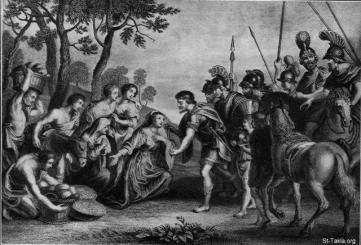 gotten what he deserved. But she stepped in because it was the right thing to do. It was right to obey God by providing for David and his men. It was even right to protect her husband from his own foolishness and bringing David’s wrath down upon himself. But even more, she did it because she loved God, and maybe even her husband, too.
She sent the gift on ahead (19) to appease David’s wrath, then presented herself to him on Nabal’s behalf. Notice that she got down off her donkey (23). Kings rode donkeys. Rich people and people of high standing rode donkeys. She left her wealth and position behind and got as low as she could get, bowing down, humbling herself, and submitting herself to David. For Nabal.
Then Abigail did something even more remarkable. She said (24-25), “On me alone, my lord, be the guilt. Please let your servant speak in your ears, and hear the words of your servant. Let not my lord regard this worthless fellow, Nabal, for as his name is, so is he.” She—a completely innocent party to Nabal’s sin (25)—voluntarily takes on the guilt and consequences of his sin. (Is this starting to sound familiar?) In v. 28, she asked David to “Please forgive the trespass of your servant.” It wasn’t her trespass, but Nabal’s. She was asking forgiveness for him.
The King’s Response (32-35)
David blessed Abigail, not just for her prudence and godliness, but also because she had satisfied his wrath and kept him from exercising it on Nabal. Her gift was sufficient, and David granted her petition to extend forgiveness to Nabal.
Happily Ever After (36-42)
Well, except for Nabal. Abigail had to tell Nabal what she had done. She’d been gone for a while and had taken quite a bit of food out of the house. No sense trying to cover it up. Hopefully Nabal would be grateful she saved him from certain death. When she told him, did he repent? Humble himself? The text doesn’t say that he did. It says “his heart died within him.” It’s generally believed this means that Nabal had a stroke (especially since it further says that he “became as stone” and lived for ten more days). Did he become enraged at what Abigail had done, and this physical exertion contributed to a stroke? We can’t know for certain. What seems unlikely is that he genuinely repented, because God “struck Nabal and he died.” As we’ll see later with David, while we usually do suffer the consequences of our sin, God shows mercy and forgiveness to the repentant.
David was thankful he had not taken matters into his own hands and that God had handled the situation. Justice had been served. And for her faithfulness, Abigail—who considered herself the lowliest of servants, only fit to wash the feet of other servants—ascended to the position of Queen. Back on her donkey where she belonged, exalted out of humility to sit at the right hand of the king.
The Backstage Gospel (Psalm 14:1, Philippians 2:6-8, 9-11)
Often, in stories like this, the characters aren’t just playing themselves, they’re playing out the parts of the gospel.
As with Nabal, God blessed His people richly with life, family, provisions, and all kinds of other blessings she wasn’t even aware of. The people didn’t ask God to do these things. God, the Good Shepherd, did these things for them out of the goodness of His own heart, the same way David had done for Nabal. But, as with Nabal the fool, “The fool says in his heart, ‘There is no God.’ They are corrupt, they do abominable deeds, there is none who does good.” (Ps. 14) The same way David presented himself to Nabal and told him what he had done for him, God, over and over, reminded Israel of the way He had protected and provided for them. But just as Nabal rejected David, so, Israel rejected God, and rebelled against Him in favor of their own sin and selfishness. And, like David, God’s wrath was inflamed.
Enter Jesus. Just as Abigail intervened on behalf of Nabal, Jesus intervened on behalf of Israel and all mankind. Just like Abigail, He laid down His life to save us. Before we ever knew Him. Before we ever knew we needed saving. Why? Why would He even want to save us Nabals? He could have let God exercise His wrath on us. We certainly deserve it. But in the same way that Abigail acted in love and in doing what was right, Jesus loved His Father and us enough to fulfill righteousness and to bring God glory by staying His hand of wrath.
In the same way that Abigail got down off her donkey, leaving behind all prestige and humbling herself to the lowest position possible—a servant only worthy of washing other  servants’ feet— Jesus “though he was in the form of God, did not count equality with God a thing to be grasped, but emptied himself, by taking the form of a servant [one who washed other servants’ feet], being born in the likeness of men. And being found in human form, he humbled himself by becoming obedient to the point of death, even death on a cross.” (Phil. 2:6-8) And for whom? Us Nabals. “On me alone, my Lord, be the guilt,” Jesus said, even though, like Abigail, He was completely innocent. He voluntarily took on the guilt and consequences of our sin when He died in our place on the cross, and He did it to win forgiveness for us.
Jesus sent this offering of His life for the atonement of our sin on ahead of Himself to the Father, and God’s wrath was satisfied. Jesus’ offering was sufficient, and God granted His petition to extend forgiveness to the likes of us. And just as David picked Abigail up from her humility and she ascended to the position of queen, Jesus ascended to sit at the right hand of the King, and “God has highly exalted him [Jesus] and bestowed on him the name that is above every name, so that at the name of Jesus every knee should bow, in heaven and on earth and under the earth, and every tongue confess that Jesus Christ is Lord, to the glory of God the Father.” (Phil. 2:9-11)
This story didn’t have a happy ending for Nabal, because Nabal didn’t repent and submit himself to God. Nabal ended up taking the guilt and consequences for his sin himself (death) instead of gratefully humbling himself and being thankful for the gift of Abigail’s intervention and David’s forgiveness. But the rest of us Nabals can have a happy ending. Jesus has paid the price for our sin with His death, burial, and the resurrection we celebrate today. He completely satisfied the wrath of God on our behalf. It is finished. Forgiveness has been purchased with His blood. If we will humble ourselves, repent of our sin, and accept the beautiful gift of forgiveness God is extending to us at the request of His Son, we can be reconciled to God now and live happily in the ever after.