Basic Training, Church

Basic Training: 7 Reasons Church is Not Optional and Non-Negotiable for Christians

For more in the Basic Training series, click here.
It’s a disturbing trend that’s spreading like the plague among evangelicals who claim to be Believers:

“I’m a Christian but I refuse to attend church.”

These aren’t people who can’t attend church due to health reasons, caring for an ill or disabled loved one, who have no other choice but to work some Sundays, or who live in an area with no reasonably doctrinally sound church to attend. They’re people who could get plugged in to a decent local church, but intentionally shun the body of Christ.

Usually, the decision to opt out of church boils down to one of two scenarios: a) a Believer who was hurt by a previous church and yet isn’t ready to risk being hurt again or b) someone (often a false convert) who doesn’t grasp the concept that being joyfully joined to a local body of believers is part of what defines someone as a Christian.

I can tell some of y’all have already fired up your e-mail programs or mentally formulated a corrective comment. Hang on, and please read what I’m about to say so we’re all on the same page here. I am not saying, have never said, and will never say that attending church, joining a church, serving at a church, or being baptized into a church is what saves a person, even in part. Going to church doesn’t make you a Christian. Everybody with me? Scripture is clear that salvation is by grace alone through faith alone in Christ alone, and that good works, such as church attendance, play zero part in a person’s salvation.

What I am saying is that one of the signs, or fruits, that someone is already saved is that she has a heartfelt love and affection for the things of God, which includes the gathering of the saints for fellowship, worship, encouragement, and edification. For a Believer, love for the bride of Christ is a natural extension of loving Christ, Himself. A Believer doesn’t have to be talked into attending church; there’s no place on earth he or she would rather be.

For a Believer, love for the bride of Christ is a natural extension of loving Christ, Himself. A Believer doesn’t have to be talked into attending church; there’s no place on earth he or she would rather be.

We’ve all been in difficult situations with difficult people at church that can hurt, sometimes deeply – believe me, I’ve been there – and can leave us in need of taking a few Sundays off to recover, or possibly the need to change to a healthier church. But if you’ve harbored antipathy toward the church, as a whole, for years, have never taken joy in fellowshipping and worshiping with fellow believers, don’t see any particular need for gathering with the Body, or are generally apathetic in your attitude toward church, you’re in a very dangerous place, spiritually, and you need to question your salvation. Those are symptoms of being lost, not fruit of being saved.

For Christians, being joined to a local church is not optional and non-negotiable. Why?

1. God Says So

Just in case the entirety of the Bible isn’t clear enough that God wants His people meeting together for fellowship, worship, and the Word, He says so very bluntly in Hebrews 10:24-25:

And let us consider how to stir up one another to love and good works, not neglecting to meet together, as is the habit of some, but encouraging one another, and all the more as you see the Day drawing near.

The HCSB puts it this way: “not staying away from our worship meetings, as some habitually do,” and NASB says: “not forsaking our own assembling together.” God says we are not to neglect, stay away from, or forsake, the meeting of the church body. For anyone who claims to be a Christian, that reason alone ought to be good enough. When God tells us to do something, we do it. Period.

2. The Church is God’s Plan for Christians

God doesn’t need or want your help devising the best methodology for your life and growth as a Christian. He already has a plan. He already established that plan. That plan is the church. There’s no plan B nor any cafeteria-style options. If you’re a Christian, God’s plan for you is to be a faithful part of a local body of Believers. The Bible never suggests that it’s OK for you to be a “Lone Ranger Christian.” There are no explicit statements to this effect, nor even one example of a New Testament Christian who lived life apart from the church. The New Testament assumes Christians will be part of a church. If not, the majority of Matthew through Revelation would be moot. If you reject membership in the local church, you’re rejecting God’s Word and His way in favor of your own way.

If you reject membership in the local church, you’re rejecting God’s Word and His way in favor of your own way.

3. Jesus Values the Church

You claim to love and follow Jesus, right? Well, Jesus founded the church. Jesus is the head of the church. Jesus loves the church. Jesus died for the church. Jesus is the Savior of the church. Jesus nourishes, cherishes, and sanctifies the church. How could anyone claim to love and follow Jesus and yet cavalierly toss aside something He values so much that He laid His life down for it? If you really love Jesus, you’ll value the things He values, and, clearly, He values the church.

If you really love Jesus, you’ll value the things He values, and, clearly, He values the church.

4. Being Joined to the Church Is an Indicator of Salvation

First John 2:18-19 makes no bones about it. Forsaking the church is an indicator that you’re not saved:

…now many antichrists have come…They went out from us, but they were not of us; for if they had been of us, they would have continued with us. But they went out, that it might become plain that they all are not of us.

Want to make it plain that you’re not of Christ? Step one is to leave the church.

5. The Church is the Dispensary for the Word and the Ordinances

The preaching and teaching of God’s Word. Baptism and the Lord’s Supper. In order to preserve their purity and sanctity, God established a hierarchical structure of ecclesiastical authority and placed the responsibility for administering Scripture and the ordinances with the church, not isolated individuals. Do we have women’s Bible studies and Sunday School classes? Of course. But only under the oversight of our pastors and elders, as an outflow of, and in keeping with, the preaching and teaching ministry of the church. Do we share the gospel with the lost we encounter during the week? You bet! Our churches enable us to do so by training us in the Word, and we bring new Believers back to our churches so that they may be discipled.

6. The “One Anothers”

Love one another. Comfort one another. Forgive one another. Serve one another. Bear one another’s burdens. Confess your sins to one another and pray for one another. Have you ever stopped to think which people “one another” is referring to? It’s easy to see when you look at these verses in context. It’s our brothers and sisters in Christ. All of the New Testament “one anothers” are written to the church. You need brothers and sisters to minister the “one anothers” to you, and your brothers and sisters need you to minister the “one anothers” to them. We cannot properly carry out the “one anothers” outside the church because they were meant to be practiced first and foremost within the church.

We cannot properly carry out the “one anothers” outside the church because they were meant to be practiced first and foremost within the church.

7. Sheep Need Shepherds

The Bible often uses sheep as a metaphor for God’s people. And since we know that God is the author of Scripture, we know God handpicked that metaphor to describe us. Ever notice that God never describes a sheep wandering off on its own as though that were a good thing?

All we like sheep have gone astray; we have turnedโ€”every oneโ€”to his own way;
Isaiah 53:6a

I have gone astray like a lost sheep; seek your servant,
Psalm 119:176a

When he saw the crowds, he had compassion for them, because they were harassed and helpless, like sheep without a shepherd.
Matthew 9:36

What do you think? If a man has a hundred sheep, and one of them has gone astray, does he not leave the ninety-nine on the mountains and go in search of the one that went astray?
Matthew 18:12

Sheep who leave the flock to make their own way in the world are in danger from wolves, the pitfalls of sin, and any number of other perils, especially the trials and tragedies of life. I can’t tell you how many e-mails I’ve received from distraught Christian women in dire personal circumstances who desperately need pastoral counsel. Sadly, when I tell them I’m not equipped to help them with such a complicated problem from so far away and that they need to make an appointment with their pastor for one on one, face to face counseling, the response is often, “I haven’t been going to church. I don’t have a pastor.”

We need the protection of the sheep pen, the brotherhood of the flock, and the leadership of our shepherds, our pastors, to help guide us. God knew we needed those things. That is one reason He established the church and created the position of pastor. Christ is our Good Shepherd, but until He returns, He has appointed godly men to watch over and protect the flock in His absence:

When they had finished breakfast, Jesus said to Simon Peter, โ€œSimon, son of John, do you love me more than these?โ€ He said to him, โ€œYes, Lord; you know that I love you.โ€ He said to him, โ€œFeed my lambs.โ€ He said to him a second time, โ€œSimon, son of John, do you love me?โ€ He said to him, โ€œYes, Lord; you know that I love you.โ€ He said to him, โ€œTend my sheep.โ€ He said to him the third time, โ€œSimon, son of John, do you love me?โ€ Peter was grieved because he said to him the third time, โ€œDo you love me?โ€ and he said to him, โ€œLord, you know everything; you know that I love you.โ€ Jesus said to him, โ€œFeed my sheep.
John 21:15-17

And he gave…the shepherds and teachers, to equip the saints for the work of ministry, for building up the body of Christ,
Ephesians 4:11-12

So I exhort the elders among you…shepherd the flock of God that is among you, exercising oversight, not under compulsion, but willingly, as God would have you; not for shameful gain, but eagerly; not domineering over those in your charge, but being examples to the flock. And when the chief Shepherd appears, you will receive the unfading crown of glory.
1 Peter 5:1-4

You can’t shepherd yourself. That internet pastor you listen to – even the most doctrinally sound one – can’t shepherd you. You need to be part of a flock led by a shepherd who knows you and cares for your soul.

Do you take joy in gathering regularly with your brothers and sisters in Christ for worship, the Word, the ordinances, building one another up, and serving one another? If not, the solution is not to leave the church altogether. The solution is to examine your heart against Scripture to discover whether or not you’re truly saved, and then to find a healthy church you can pour yourself into. Christ has given believers the local church as a blessing and a benefit, not a burden and a bore. Love and embrace this precious gift He has lavished on you.


Additional Resources

Searching for a new church?

What the Bible Says About Church Membership

Six Ways Not to Forsake the Assembly 

7 reasons worshipers need the church at The Cripplegate

Mailbag #49: Home Groups Over Church at 9Marks

My Jesus, I Love You; Your Bride I Despise! at Reformation21

Why You May Be Tempted To Neglect Your Church by Tim Challies

Five Essential Reasons for Christians to Gather in Public Worship at Ligonier

Prioritize Your Church by Tim Challies

Is a โ€œChurchless Christianโ€ an Oxymoron? at Ligonier

The Plight of Churchless Christians at The Cripplegate

40 reasons to be part of a local church at The Cripplegate

Church Attendance Is Not Optional on the G3 Podcast

Is it Necessary for Me to Join a Local Church? at G3 Ministries

Church, Throwback Thursday, Worship

Throwback Thursday ~ Rolling Out the Welcome Wagon

Originally published August 25, 2010

The LORD said to him, “I have heard your prayer and your supplication, which you have made before Me; I have consecrated this house which you have built by putting My name there forever, and My eyes and My heart will be there perpetually. I Kings 9:3

As Golden Girl Sophia would say, “Picture it:”

After church one Sunday, a friend says, “Why don’t you come over to my house tomorrow night for dinner?”

So, the appropriate time comes on Monday evening, and you drive over to her house. The door is standing open because she is expecting you, and you’re familiar enough with each other that you feel comfortable just walking on in.

As you’re walking in, you see your friend standing there, and you say to her, “I invite you into this house! You are welcome here!”

Anything seem a little off about that?

Well, of course that seems strange. It’s her house.

But that’s what is taking place in churches all over America every Sunday morning. I saw it in a televised local church service last week. The worship leader stood up to lead the first song and said, “God we welcome you into this place!” I’ve heard others say things like, “Lord, we invite you into this house this morning!” We sing songs like Holy Spirit, Thou art Welcome and Lord, we Invite You.

‘Scuse me? Isn’t the church God’s house?

Of course, it isn’t God’s house in the same way the temple was God’s house, in that there isn’t a holy of holies where the actual presence of God resides. On the other hand, I wouldn’t go so far as to say that it’s only a building, like the post office or a doughnut shop.

At some point, way back when, or maybe even recently, a body of Believers got together and asked God to give them a place where they could worship Him. God saw fit to answer that prayer. He provided the land, the permits, and every brick, nail, and piece of sheetrock. He allowed His name to be placed there when we decided to call it “Grace Fellowship”, “St. Luke’s”, or “First Baptist”. He protects that building and allows it to stand as a testimony to the community: God, and God’s people, can be found here.

It’s not your church. It’s not my church. It’s God’s church. And it exists for His glory.

But somewhere along the way, we’ve forgotten that. Somewhere along the way, we gave God an eviction notice and became squatters on His property. How arrogant have we become that we strut into church as though we own the place, and dare to invite Him, to welcome Him into His own house as though He were a guest? How dare we?

Maybe it’s partly because we no longer have a holy of holies that we don’t see God’s house as sacred. “Ah,” you may say, “but that’s Old Testament thinking. Now we know that where two or three are gathered in His name, He is there in their midst. (Matthew 18:20)”

Really?

When it’s my church, my comfort, my pew, my ministry that nobody else better touch, my style of music, my opinion about how long the sermon should be, my feelings that got hurt, my idea of how things should operate, what I got out of the service, are we really gathering in His name?

Welcome, Lord. Are You sure You want to come in?

Church

Church Leadership Qualifications: Biblical or Pragmatic?

leadership-1959544_1280

When it comes to leadership positions in the church we often get ourselves into unnecessarily sticky situations because we put practical considerations – who is available, who is most talented, who is willing, etc. – above biblical qualifications.
When we fill a position of leadership or responsibility at church we firstย go to Scripture to find out if the person we’re considering for the position is biblicallyย qualified to hold it. Practical considerations come second. A few examples:

1.

An elder or deacon just died and the church needs someone to replace him. The first place you go is 1 Timothy 3 and Titus 1, and you start by weeding out the men who don’t fit those qualifications. It doesn’t matter how willing they are or how great of a job they would do or what kind of connections they have or how much money they could bring into the church, they have to meet the biblical qualifications first.

2.

Your church is located near a neighborhood full of Chinese immigrants, most of whom don’t speak English. Someone comes up with the commendable, Great Commission-honoring idea to start a Bible study to reach out to the men and women of this community. The only person in your church who speaks Chinese is a woman, so she’s the natural choice to teach the class, right?

Wrong. We startย with the biblical qualifications for teachers, and one of them (1 Timothy 2:12) is that women are not to teach men. She could certainly teach (assuming she is able to teach – language alone doesn’t make someone a good teacher) a women’s class, or a male could teach the class in English and she could translate, or a man could take the time to learn Chinese before the church begins offering the class, or if there is a Chinese man in the class who is able to teach, he could teach the men and she could teach the women. But the woman doesn’t teach a co-ed class herself because Scripture forbids this.

3.

A young couple starts attending your church. After a few months, they step up and say they’d like to sing on the worship team. They’ve both got great voices and would radically improve the quality of the music on Sunday mornings. As you chat with them about joining the team, you find out they’re living together (unmarried). They’re both well aware that this is sin, but disagree with what the Bible says about adultery and fornication and have no intention of repenting, marrying, or moving out. Matthew 18:15-17 and 1 Corinthians 5:11-13 are quite clear that people who continue in rebellion after being called to repent are not even to be members of the church, let alone lead in worship.

Remember that the practical way is not always God’s way. Remember that God’s ways are higher than our ways (Isaiah 55:9). Remember that “There is a way that seems right to a man, but its end is the way to death.” (Proverbs 14:12). Remember when Saul did what was good in his own eyes instead of obeying God’s word (1 Samuel 15). Remember what happened to Nadab and Abihu when they conducted worship their own way instead of God’s way (Leviticus 10:1-6).

Obeying God’s word is not always easy, practical, or convenient, but it is always best, biblical, and blessed.

Christmas, Church

“If You Skip Church on Christmas You’re Probably Not Even Saved” and Other Holiday Nonsense

church-on-christmas

It happened in 2011, and it’s happening again this year in good old 2016. Christmas Day falls on a Sunday- and the spiritual lumps of coal are being lobbed all over the internet: If you’re a Christian who’s evenย thinking about taking the day off from church attendance or your church has decided to cancel services that day…well, you’ve firmly ensconced yourself on God’s “naughty” list.

So I’m innocently cruising around on social media, podcasts, and the blogosphere recently when what to my wondering eyes should appear, aspersions galore from those I hold dear. Seriously, scads of doctrinally sound Christians I love and respect have said things like, “Church attendance on Christmas will separate the wheat from the chaff,” and, “If your church is canceling services (or even modifying the regular Sunday schedule) on Christmas, it’s time to find a new church.”

Did I read that right? Are theologically-grounded Christiansย really questioning people’s salvation and the spiritual health of churches based solely on a once-every-five-to-eleven-years Christmas Day worship service?

I honestly don’t think I’m biblically out of bounds when I say that’s absurd and judgmental and it needs to stop. Like, yesterday.

Yes, probably a lot of the churches who are canceling services on Christmas are theologically wonky, but that’s because, statistically speaking, the majority of churches out there, period, are theologically wonky. Too many people areย post hoc ergo propter hocing thisย situation. Just because there are bad churches that are canceling services doesn’t mean every church that cancels services is a bad church. What about the rural church of 20 members (that hasn’t had a visitor since the last century) who have all informed the pastor they’ll be out of town for Christmas? Is he supposed to show up and preach to an empty room? What about churches who have moved their services to Christmas Eve so members can spend time with family on Christmas without missing weekly worship? Is there a passage of Scripture I’m not familiar with that prohibits a church from doing this every once in a blue moon?

Yes, there are doctrinally unsound churches out there, but they’re doctrinally unsound because they consistently teach unsound doctrine as measured by applicable Scripture, notย because they cancel a worship service or shift their normal schedule around for Christmas- an issue nowhere mentioned in Scripture.

As for judging people’s salvation (or love for Christ, love for the church, commitment, spiritual maturity, etc.) based on whether or not they attend church on Christmas- if you’re going to question a Christian’s salvation for skipping church that day, are you ready to pronounce a pagan saved if he shows up for services on Christmas Sunday?

Of course not. Because that’s not how this works. That’s not how any of this works.

The people who are using Christmas Day church attendance as a spiritual barometer would be the first to tell you – and rightly so – that going to church won’t save you. Neither will missing one service (or a dozen) “unsave” you. Salvation is determinedย onlyย by whether or not you’ve repented of your sin and placed your faith in the death, burial, and resurrection of Christ to redeem you. And sanctification (spiritual growth) is a lifelong process – a trajectory – of becoming more and more Christlike through the years. Church attendance on Christmas isn’t a make or break for your salvation or sanctification.

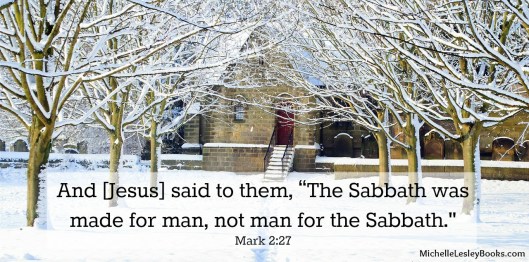
Earlier this week in The Ten,ย we studied the fourth Commandment: “Remember the Sabbath day and keep it holy.” We discovered that, while God’s intention for the Israelites was simply to abstain from working at their jobs, housework, and commerce in order to rest and worship Him, the Pharisees later came along and added all kinds of micro-managing rules defining “work.” So by the time Jesus came on the scene, things like picking (“harvesting,” according to the Pharisees) and eating grain as you walked along, and performing miracles of healing were considered “work”- thus breaking the Sabbath. But these were man-made laws, not God’s law. It was oppressive and robbed people of the joy of worship God intended His people to bask in each week. “The Sabbath was made for man,” Jesus said, “Not man for the Sabbath.”

mark-2-27

I can’t help but wonder if these “Real Christians will be at church on Christmas Day,” pronouncements aren’t similar. God has made no law for Christians that we must be at church on Christmas Day – or any other particular day – or we’re sinning. And, as for the churches who once every several years cancel services or shift their Sunday service to Christmas Eve, God has made no law that churchesย must meet on Sunday every single week or they’re in sin. What God has said for New Testament Christians is:

And let us consider how to stir up one another to love and good works, not neglecting to meet together, as is the habit of some, but encouraging one another, and all the more as you see the Day drawing near.
Hebrews 10:24-25

“Not neglecting to meet together.” Reminiscent of the paucity of Old Testament explanations of what constituted Sabbath work, God doesn’t give a definition of this phrase or quantify it with a specific number of allowable and acceptable missed Sundays per year. It is left to the conscience of each individual Christian and the agreement of each local body of believers (but I can scarcely believe that aย person who is at church every week unless Providentially hindered and opts to skip the Christmas service is “neglecting” to meet with the body by any stretch of the word). But when we by-pass issues of individual conscience and church agreement, make a law where no law exists in Scripture, and judge people’s relationships with God based on our own man-made law, are we not doing exactly what the Pharisees did?

What’s of far more concern than where your body is on Sunday, December 25, is where your heart is the other 364 days of the year. Do you love the body of Christ? Are you committed to serving the Lord and your brothers and sisters all year long at the church you’re a member of? Do you faithfully attend worship each week? Then deciding to spend Christmas Sunday at home with your family (especially if you’ve already attended the Christmas Eve service the night before) is not an indication that you’re backsliding or somehow “less” of a Christian than those decrying your absence.

But what if you answered “no” to those questions? What if you skip church as many or more Sundays as you attend because you just don’t feel like going, or you signed your kid up for a soccer team that plays on Sundays, or there’s a ball game on TV, or you’d rather go shopping, or you go out of town on pleasure trips a lot of weekends? What if your general attitude toward church is, “Meh, I’ll go when I feel like it and have nothing better to do.”?

That is much more problematic than skipping church the years Christmas falls on a Sunday. That’s an indicator that you need to examine your heartย to discover whether or not you’re in the faith. To love Christ is to love His bride, the church. People who are genuinely regenerated love the church. As a general rule, theyย want to be at church worshiping, serving, learning, growing, and fellowshipping with their brothers and sisters in Christ.

Why, between 2011 and 2016 haven’t I seen and heard these same folks who are judging Christians about Christmas church attendance speaking out equally as boldly, and in the same numbers, about people being sporadic in their attendance and uncommitted to the body the remaining Sundays of those years? As Christians, we celebrate Christ’s incarnationย every Sunday, not just when Christmas falls on a Sunday. Are those other Sundays somehow less important?

One day, out of the thousands that comprise your life span, is inconsequential. The Bible does not say that simply staying home from church on Sunday, December 25, is a sin. What’s important is pursuing Christ, hungering for holiness, and loving and serving the churchย every day, not just when Christmas Sunday rolls around.

Bible Study, Church

McBible Study and the Famine of God’s Word

“Why can’t we just be taught a book of the Bible?” I heard this again today from a Christian woman hungry for her church to teach her the truth of God’s word. It’s a cry being raised by women from all over, scrounging through the dumpster of “Bible” teaching their church currently offers, searching for something – anything – that will nourish their hearts, minds, and souls with biblical truth so that they might actually be able to grow in Christ.

What’s going on here, church? Pastors? Women’s ministries? Why are godly women starving for the word of God at their own churches? This is a problem. And it’s not a small one. And it’s not going away. It’s getting worse.

My family is a one income family. My husband works hard to provide for us, and we’ve made a lot of (completely worthwhile) sacrifices so I can stay home and raise and home school our children. One of those sacrifices is that we rarely get to eat out, even at a fast food restaurant. That means I cook. A lot. Fortunately, I happen to enjoy cooking, but it does take several hours of work a week. And sometimes, at the end of a long day, I’m tired and not particularly in the mood to spend a couple of hours on my feet chopping and mixing and sautรฉeing and stirring and roasting. I’d much rather chuck it and have my husband pick up McDonald’s on his way home. In fact, if we could afford it, and I couldn’t cook, and I thought it was healthy, my family would probably eat fast food for supper three or four times a week. I like fast food. My kids LOVE fast food. And why do all that work if you don’t have to and there’s an easier option, right?

But that’s no way to feed a family. It makes people obese and can lead to all kinds of other physical problems like heart disease, hypertension, and digestive ailments because the majority of fast food is high in the bad stuff (cholesterol, sodium, fat) and low in the good stuff (fiber, vitamins, minerals). Not to mention that having other people do the work God has assigned me is the lazy way out.

Yet while it’s easy to see how detrimental and unhealthy it is to feed a family a regular fare of fast food in the physical realm, this is exactly what most churches are doing in the spiritual realm when it comes to their Bible study menu.

“My pastor asked me to teach a women’s Bible study class. What’s a good book to use?”
“Why don’t you just teach them a book of the Bible?”
“Oh, I don’t feel equipped to do that.”

“Our Sunday School class is looking for a new curriculum. Any suggestions?”
“How about just working through a book of the Bible?”
“Our teacher works a lot of hours and doesn’t really have the time to study and prepare like that.”

screenshot-2016-11-10-at-12-31-44-pm-edited

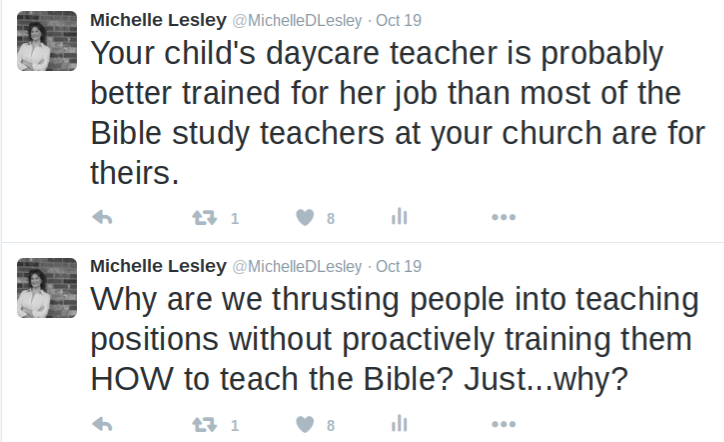
I hear this kind of thing over and over and over again. Churches aren’t even attempting to train people to properly teach the Bible, and Bible study “teachers,” (often through no fault of their own) either don’t know they need to be trained, or don’t have training available to them, or they’re unwilling or unable to put in the time and effort to be trained and to prepare lessons.

We have classes that need teachers, so we take whoever is available and willing, and we stick them in front of a group of people, hand them a take out bag of McBible Studies written by the celebrity Christian du jour and say, “Here. Feed the church family.”

That’s a problem in and of itself, first and foremost, because relying solely on pre-fab studies due to the fact that no one is trained to instruct the people of your church in the word of God isn’t biblical. The Bible says that pastors, elders, and teachers in the local church body should be “able to teach.” Not facilitate. Not read aloud what someone else wrote. Not “able to work a DVD player.” Teach.

But recruiting “teachers” who are unskilled in handling God’s word to lead a pre-packaged study often morphs into another dangerous problem, especially in the area of women’s Bible study: importing false doctrine into your church. Here’s a list of LifeWay’s top selling books for 2015. Every single non-fiction book on this list that’s likely to be used for a women’s group or individual Bible study (seven of the twelve by my count- which is a staggering proportion considering LifeWay also sells men’s studies, theology books, training manuals, “Christian living” books, and a wide variety of other non-fiction topics, but I digress) is written by a false teacher. Every. single.one.

screenshot-2016-11-10-at-12-31-31-pm

In my research of women’s Bible study authors and teachers, I estimate that approximately ninety-five per cent of the the female authors and teachers on the shelves at your local Christian retailer are false teachers. That goes way beyond a biblical “diet” laden with cholesterol and fat. Now, we’re talking about spiritual food tainted with E.coli. If you’ve got a woman in your church who’s facilitating a class using materials by one of these false teachers because she’s not competent enough in God’s word to teach the Bible, how in the world is she going to be able to catch and correct the false doctrine these Christian celebrities are teaching her class?

The answer is: she’s not. In fact, her awareness of her own incompetence in Scripture and her assumption that the Christian celebrity knows what she’s talking about (Because, after all, she’s a celebrity and LifeWay sells her materials, so she must know what she’s talking about, right?) will have the exact opposite effect. She will downplay and keep quiet about any nagging doubts – assuming she knows her Bible well enough to even have those doubts – in her own mind that the Christian celebrity is teaching things contrary to sound doctrine, and she will affirm the false doctrine that’s being taught. Then, this harmful bacteria of false doctrine will spread from woman to woman and class to class, and discerning women, knowing that the kitchen is contaminated, will grow emaciated from a lack of clean cuisine to feed on. We end up with a church full of “Bible” study and Sunday School classes that teach fluff and false doctrine instead of the unadulterated word of God. To borrow from Coleridge: “Food, food, every where, nor any bite to eat.” We’ve got a famine of God’s word, right in His very own house.

Church, pastors, women’s ministries- we’ve got to put a stop to this. People teaching Sunday School, Bible study classes, and, particularly, women’s Bible study classes must be trained in basic hermeneutics, the competent handling of God’s word in context, and the ability to teach sound doctrine as well as to refute the false. Do we not believe Scripture, or somehow think our church is exempt from it, when it says:

Do your best to present yourself to God as one approved, a worker who has no need to be ashamed, rightly handling the word of truth. 2 Timothy 2:15

or

Not many of you should become teachers, my brothers, for you know that we who teach will be judged with greater strictness. James 3:1

Where is our fear of God and our obedience to His word? We would never think of letting an untrained, incompetent teacher teach our children math or science in school when all that’s at stake is their academic education. Why are we satisfied to let untrained people teach the Bible at church when people’s eternities are at stake?

It doesn’t take years of seminary training. I never went to culinary school, but I’m still able to cook and feed my family a healthy diet because of what I’ve learned from others. Pastors can train teachers. Skilled Bible teachers can train others to teach. There are even great books and materials that can help as you teach people how to teach the Bible.

A doctrinally sound book study can be a fun, interesting, or useful supplement to the regular, straight teaching of Scripture in a Bible study class, but even these shouldn’t be used in place of training teachers. The best theologian out there isn’t a living and active member of that class. He doesn’t know the strengths and weaknesses of the class’s theology. He can’t address their current struggles and questions. He doesn’t love them, care about them, pray for them, and labor in the Word for them.

Only real life, trained, biblically competent teachers can do those things. They are vital and they are irreplaceable.

So let’s quit shoving Happy Meals into the hands of women who are starving for the pure milk and meat of God’s word. Let’s offer some cooking classes and set the table so the members of our churches can sit down to a healthy, home cooked diet of nourishing food that will help them grow to spiritual maturity in the grace and knowledge of the Lord Jesus Christ.

And, now, if you’ll excuse me, I’ve got to go start supper.