

Christian women, Faith, Old Testament, Salvation, Sunday School, Women

Rahab: From Floozy to Faithful ~ Sunday School Lesson ~ 3-30-14

sunday school

These are my notes from my ladies’ Sunday School class this morning. I’ll be posting the notes from my class here each week. Click here for last week’s lesson.

Through the Bible in 2014 ~ Week 13 ~ Mar. 23-29
Joshua 1-24
Rahab: From Floozy to Faithful
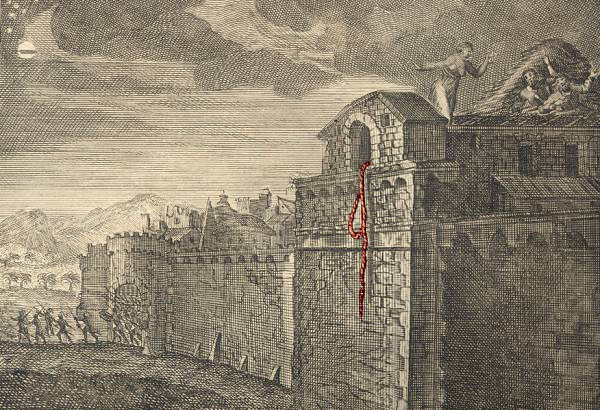
rahab-scarlet-thread

By faith Rahab the prostitute did not perish with those who were disobedient,
because she had given a friendly welcome to the spies.
Hebrews 11:31


Background- Joshua 1
Joshua 1 sets the stage for the story of Rahab and the spies. Moses had recently died, and God “promoted” Joshua to take his place. It was finally time for the Israelites to enter and take possession of the Promised Land. As God “installed” Joshua into his new position, He reminded Him:

  • Stay true to My word and you’ll be successful in what I command you to do.
  • Be strong and courageous (4 times in ch. 1); I will never leave you nor forsake you.
  • Here is the extent of the land I promised. I will keep my promise.

Cities had to be conquered, and first on the agenda was Jericho. Joshua began planning for the conquest by readying the people and by gathering intelligence about the city.

Joshua 2

Gathering Intel (1-2, 9-11, 24)
Do you remember one of the first stories we studied in which Joshua played a major role? He was one of the two spies in Numbers 13-14 who brought back a good report about taking the land of Canaan. I wonder if Joshua was thinking about that incident here, forty years later.

Joshua sent two spies, compared to the twelve who went to spy out Canaan, of which he was a part. Jericho was a much smaller area than Canaan, only two were needed, and a larger group would have been more easily discovered. Interestingly, unlike the story of Joshua and Caleb, we never discover the names of these brave spies who risked their lives and their reputations to bring back a good and faithful report. What did they find out and report back to Joshua about Jericho? (v. 9-11,24)

The Hiding Place (1-6)
Why would two nice, godly Jewish boys hide out in a prostitute’s house? Why not a nice, clean hotel? Well, first of all, they generally didn’t have hotels as we know them back then. When people traveled, they brought tents with them and camped out, stayed with friends or relatives, spent the night in the town square (Gen. 19:2), etc. And, sometimes, if it was immoral men traveling without their families, a prostitute’s house was a preferred option for a night’s lodging.

Rahab’s house would have been the perfect place for the spies 212wall_sketchto hide. They were foreigners, they were travelers, and it wouldn’t have been abnormal for them to be surreptitious (covering or disguising themselves) when entering and leaving her house. Plus, Rahab had men arriving and departing at all hours. Since she was a prostitute, many of the townspeople may have avoided her and her clientele, so it was probably the best option available for the spies.
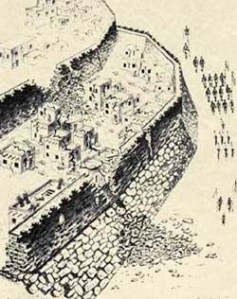
Rahab’s house was built into the city wall. At that time, kings of various cities/countries would regularly attack each other, so many cities were built like fortresses with tall, thick walls around them and gates that could be opened or closed. The back wall of Rahab’s house was also the city wall and had a window the spies could escape from. After the gates had been shut, there would have been no other way to get out of the city.

The Faith of the Spies (24)
The main focus of this story is, rightfully, on Rahab’s faith. But, what about the faith of the spies? These men, out of faithfulness to God, and loyalty to Joshua and Israel could have been tortured and killed had they been discovered. They stayed in the home of an unclean prostitute, which was a BIG deal. (Think back over all the clean/unclean laws we just studied.) They followed the instructions of someone who was: a) a woman, b) a prostitute, c) an enemy and an pagan, and d) had no military/spy experience of her own that we know of. (Although, perhaps, in her profession, she was skilled in hiding men who were being hunted down by people on the warpath). They found an impossibly heavily fortified city. There was no human way to successfully attack it. And still, they were confident in their trust that God would somehow keep them safe and give Israel the city.

The Faith of Rahab (9-13, Romans 1:19-20, 2:14-15)
Rahab was a pagan. How could she have had faith in God? How did she even know about Him? The Bible tells us that ALL human beings have a basic knowledge of God in two ways: through creation (Rom.1) and through our consciences (Rom.2).

But Rahab knew some other things, too. She knew how God treated His children and His enemies. She had heard what God had done at the Red Sea (10)—how God had protected His children and destroyed the Egyptians. She knew how God had defeated the kings of Sihon and Og (10). She knew that out of all the gods she had ever heard of, this One was the real thing- God of heaven and earth. She knew, and she was afraid. Her fear and her defection prove her faith. If she had not believed in who God was, and that He was able to do all these things she would have had no reason to be afraid, nor would she have helped the spies and aligned herself with them against her own people.

Rahab became so convinced in her mind that God was indeed who He had shown Himself to be that she gambled everything on it. Think of what the king would have done to her if she had turned out to be wrong and had gotten caught. At the very least, she would have been killed. but as a traitor, she certainly would have been made and example of. She probably would have been publicly tortured to death, and maybe her family too. This was no small thing she did. She bet her life on a God she didn’t know. That’s the faith that saved her and led her to hide the spies and her other actions. The actions did not save her, it was the overwhelming belief in God which drove those actions.

Two Different Faiths Then (John 4:22, Luke 10:21, Deuteronomy 32:39)
There is a qualitative difference between the faith of the spies and the faith of Rahab. As Jesus said to the woman at the well, “You worship what you do not know; we worship what we know, for salvation is from the Jews.” (John 4)

The spies were God’s people. They knew Him personally. They were born into God’s house and grew up as obedient sons. They were chosen by Him and belonged to Him. They had seen Him work as eyewitnesses. They had, and knew, His word. They would have been like the older brother in the prodigal son story if he had been faithful.

Rahab, on the other hand, had none of that. She was the prodigal. She did not know God personally, but only, as an outsider, by reputation. She likely knew nothing of God’s love and promised blessings for obedience, but only of His wrath towards sinners. She was not born into God’s house; she was a pagan. She was not an obedient son; she was a woman, and as sinful a woman as she could be. She was not chosen by God and did not belong to Him. She was an outcast. She had no idea what God might do next. All she knew was that she didn’t want to die.

The spies knew. God had laid it all out for them. They were obeying God, not out of fear, but out of love.

Two Different Faiths Now
Rahab’s faith versus the spies’ faith reminds me of unchurched people coming to Christ versus churched people coming to Christ. We “spies” who were raised in church by Christian families grew up knowing all the Bible Stories, all the whys and wherefores of Jesus and salvation. It is the blessing of a godly heritage.

Rahab, like the unchurched, lived her whole life not knowing God, just doing what sinners do. When she finally heard about Him, all she had was the basics, and, knowing only that He was “Lord of Heaven and earth” (Luke) and “able to kill and make alive” (Deut.), she flung herself unashamedly on His mercy—which, at the time, she probably wasn’t sure would catch a woman like her—all because she wanted to live instead of die.

The Object and Outcome of Our Faith (Joshua 6:17, 22-25, Matthew 1:5, James 2:25)
But no matter our background or how we come to faith in Christ—Rahab or spies, unchurched or churched—the object of our faith is what matters, and the object of our faith is Christ. And because the object of our faith is the same, the outcome of our faith is also the same.

What was the outcome of this whole scenario for the spies? For Rahab? They were saved despite the destruction all around them. After it was over, they all lived in the Promised Land together. Rahab and her family became part of God’s family just like the spies were. She even got to be one of Jesus’ great, great…grandmothers (Matt.), was commended in the “Hall of Faith” (Heb. 11, above), and was cited as an example of good works giving evidence of our faith (Jas.).

God loves the prostitute just like He loves the good little girls. He sent His precious Son to save both of us and to display us as trophies of His grace.

Additional Resources
The Walls of Jericho by Answers in Genesis

Faith, Obedience, Old Testament, Sunday School, Trust

Trust and Obey ~ Sunday School Lesson ~ 3-2-14

sunday school

These are my notes from my ladies’ Sunday School class this morning. I’ll be posting the notes from my class here each week. Click here for last week’s lesson.

Through the Bible in 2014 ~ Week 9 ~ Feb. 23-Mar. 1
Numbers 1-15, Psalm 90
Trust and Obey

Not a grief or a loss, not a frown or a cross, but is blest if we trust and obey.

Trust and obey, for there’s no other way to be happy in Jesus, but to trust and obey.

Dilemma → The People’s Response → Moses/Leadership’s Response ←→ God’s Response

Today, we’re taking a look at four incidents from this week’s reading which follow the paradigm above. All start out with a problem. We’ll look at how the people responded to that problem, how Moses and the other leaders responded, and how God responded, which will show us how we should respond to the dilemmas we face: with trust in, and obedience to, God.

 A Generic Gripe (Numbers 11:1-3)

The Dilemma (11:1):
This seems to have been a general discontent with the aggravations that come with marching around the desert. Various translations mention “hardships,” “adversity,” and “misfortunes.” We can’t tell from this verse whether these were hardships of their own making (as two of the subsequent problems were) or they were just things that came up outside their control.

Israel’s Response (11:1-2, Psalm 142:1-2):
Israel’s response was to gripe. How was this different from Psalm 142:2, where David said, “I pour out my complaint before him; I tell my trouble before him.”? Check out verse 1: David said, “I cry out to the Lord…I plead for mercy to the Lord.” David was crying out to the Lord. Israel was crying out against the Lord (“in the hearing of the Lord”).

God’s Response (11:1):
God’s anger was literally kindled. Why such a harsh response to a little complaining? We’ll see more clearly in the next incident.

Moses’ Response/God’s Response (11:2):
Moses intercedes in a picture of the way Christ intercedes for us. He gets between the sinful people and God’s wrath and pleads their case before Him. God’s wrath abates, not because there’s anything righteous in the people, but because of the righteousness of the one interceding.

 Where’s The Beef? (Numbers 11:4-35)

 The Dilemma (11:4-9):
“Waaah…we’re tired of the same old food day after day!” Notice, it wasn’t that they didn’t have food and were crying out to God to help them and keep them from starving. God had provided plenty of the food He thought best for them. He even delivered it right to their doorsteps—they didn’t have to go out and hunt! But that wasn’t good enough.

Israel’s Response (11:4-6,10, Philippians 3:19, Romans 1:25):
Israel’s response to this dilemma (which wasn’t really a dilemma at all—this was about what they preferred—it was a problem of their own making) was to turn their noses up at what God had provided for them and cry out against Him.

Their complaint was a disdain for all God had done for them in delivering them from Egypt. They didn’t want to do things God’s way anymore. They actually preferred going back to (and thought they had it better under) slavery! And for what? Food. The kind of food they missed and preferred. The food of their old way of life. The fruit of slavery.

Their complaint was essentially a contempt for and rejection of God’s salvation because they were willing to toss it all aside for something as paltry as a different kind of food. “They worshiped and served the creation rather than the creator.”

What are some ways we do the same thing? (Thinking we had it better when we were lost and longing for the things we had back then.)

Moses’ Response (11:10-15, Philippians 4:13, Matthew 11:28):
Moses had had it with these rebellious, childish people, and he cried out passionately to the Lord about it. This “friend of God” was not rejecting God or His ways. He was saying, “You’ve asked me to lead and care for this people, and I want to comply, but I can’t. It’s too hard. I need Your help!” His response was not to reject God (as was the case with the Israelites’ complaint), but to trust God and ask for His help in obeying Him.

When it is our desire to take up our cross daily, God has promised to either give us the strength to carry it (Phil. 4:13) or lift it off our backs permanently (Matt. 11:28).

God’s Response (11:16-35, Psalm 37:4):
Two different complaints. Two different motives. Two different responses: God showed kindness to Moses, but anger towards the Israelites.

Yet, in a way, the same response. God gave both Moses and the people what they asked for. (Actually, He gave the people much more than they asked for!) When Moses got what he wanted, it was a blessing because He was asking according to God’s will and out of a desire to obey Him. This is what Ps. 37:4 is talking about when it says, “Delight yourself in the Lord, and He will give you the desires of your heart.” When the people got what they wanted, it was a curse because God gave them what they never should have wanted in the first place.

Power Play (Numbers 12)

The Dilemma (12:1-2):
Miriam and Aaron were annoyed with Moses for some unclear-to-us reason having to do with Moses’ new wife. Whether they were opposed to her because she was a Cushite or because she had done something to tick them off, we don’t know.

Miriam and Aaron’s Response (12:1-2):
Their annoyance led Miriam and Aaron to grumble against Moses. And once they started grumbling against him- which was really grumbling against God, because God had called Moses, placed him in authority, and spoke through him- it was easy enough to convince themselves that they should be in charge, or at least equal to Moses. “And the Lord heard it,” indicates that they were implicating God in their complaint. Here is another incident that’s a problem of the complainant’s own making.

God’s Response (12:4-10, 14-15):
Again, God’s anger is “kindled.” He comes down personally, since they are denouncing Him personally by way of Moses, and sets them straight. “Yes, there is a difference between y’all and Moses. No, you’re not equal to him. Moses is the one I’ve put in this position, not either of you.” Miriam’s name being mentioned first (v.1) and the fact that God gave her leprosy but not Aaron, probably indicate that she was the instigator in this situation.

Moses’ Response (12:11-13):
Again, Moses intercedes between the sinner and the wrath of God and asks, trusting in God’s grace, for Miriam’s healing. God grants his petition, but not right away. God wants Miriam to understand how serious her disobedience is, so He allows her to experience His chastening for a week. But after her time of discipline is over, God’s grace allowed her back into the camp to be reconciled to Moses and the people.

Ten Were Bad, Two Were Good (Numbers 13:25-14:35)


The Dilemma (13:25-33):
The spies came back and gave an accurate report of what they saw. The land itself was awesome, but the people were strong, militarily, and the cities were strongly fortified. All of the spies and the people who heard their report were understandably afraid. This was not a problem of their own making.

Israel’s Response (14:1-4, Exodus 3:8):
Again, the people’s immediate response to fear was not to trust in the Lord and obey Him, but to rebel. Again, their response was to quickly abandon and disdain all God had done for them. They tossed aside His salvation in favor of slavery and what they thought would be safety. They knew what God had promised (Ex. 3:8- compare to 13:29) and called Him a liar (14:3- compare to Ex. 3:8). Again, they cried out against the Lord instead of crying out to Him.

Joshua and Caleb’s Response (14:5-9, 13:30):
Nowhere do we see Caleb and Joshua {13:30, 14:6-9} denying or minimizing the difficulty and scariness of the situation, but confirming it. They knew what people like the Hittites, et al, were capable of doing to their enemies. They were well aware of Israel’s military weakness and disadvantage.

Yet, instead of letting what they could see and experience determine reality, they trusted God’s word and promises to them to determine reality. They had seen what God was capable of doing to His enemies. They saw what He had done to Pharaoh’s army without their even having to fight, and trusted that, if He had promised them this land, He could do something like that again.

Moses’ Response (14:13-19):
Again, Moses stands between the sinful people and God’s wrath- just like Jesus does for us- pleading with God to forgive them so that God’s name will be glorified. He calls God to act in accordance with His own character: slow to anger, steadfast love, forgiving.

God’s Response (14:20-35):
Again, God grants the request of the intercessor (Moses), not because of the sinful people, but because of the righteousness of the one interceding, and because of His own character. Though they will still suffer the consequences of their sin, God pardons sinners.


What Can We Learn?

1. When we have a problem, need, or desire, God wants us to bring it to Him in prayer with a heart submissive to His will. He desires for us to cry out to him, not against Him.

2. Sometimes, we’re the problem. Sometimes we’re in anguish over a problem that’s not really a problem, but a selfish or ungodly desire we’re not even supposed to have.

3. When we face difficult situations, God wants us to calm down, trust His word and His promises, and obey Him, not reject Him in order to do things our own way. Like the song says, “there’s no other way to be happy in Jesus, but to trust and obey.”