Obedience, Prayer, Sanctification, Sin

Throwback Thursday ~ When God Answers the “Wrong” Prayer

Originally published July 27, 2018
“Lord, I’m just so frustrated!” I fussed, as I approached the time I had set aside for prayer this morning. Once again, the “I don’t want to” of my flesh was pulling against the “I know I need to” of my spirit like a heavy duty tow truck tugging on a kitten.

So I just ditched it. Well…sort of.

Prayer is pouring out your heart to God, right? Well, I turned on the water cannon. Reverently, of course…but with passion.

I told God how sick I was of this all-too-frequent stumbling block my flesh presented when it was time to pray, especially when I knew from experience that the feeling was fleeting and would go away after I had been praying for a few minutes. I told Him I was tired of a million other things I’d rather be doing, that I needed to do, coming to mind and further crowding out my desire to pray. I told Him I was sorry for all the times I had given in to the flesh and skipped my prayer time. I told Him I wanted Him to make this feeling go away and never come back.

As I poured out my complaint before Him, the Holy Spirit began leading me to examine the why of this whole situation. What was bringing about this pull of the flesh against prayer?

And that’s when it happened. God answered the “wrong¹” prayer.

You see, one of the things I pray every day is that God will reveal to me any sins I’m unaware I’m committing and lead me to repent of and forsake them.

And in that moment, that’s the prayer He chose to answer.

Not the prayer for the provision of an item my family needs. Not the prayer for healing of a loved one. Not the prayer that He would save all the lost people on my list.

Not the prayer I really wanted Him to answer.

God chose to reveal my sin to me.

You know why my flesh so often balks at prayer? Because in the dark, unsanctified recesses of my heart, I’m frustrated with God for not doing what I ask Him to do – now. I come to Him day after day, month after month, sometimes year after year, confessing the same sins, asking for the same provisions, and presenting the same requests, and I don’t see Him doing what I want Him to do when I want Him to do it.

Never mind that I could list hundreds of my prayers that He actually has answered, many of them in amazing ways. Never mind that I know what the Bible says about prayer well enough to teach on it and write articles about it. Never mind that I really do believe that God will answer my prayers for His glory and my good.

Uh uh. My flesh throws all of that right out the window and wants God to be my cosmic errand boy, delivering the goods on my timetable. I am selfish. I want everything to go my way immediately.

So that was pretty humiliating…but God didn’t stop there. No, there was more.

He opened my eyes to the fact that this sin problem I have relating to Him vertically is basically the same sin problem I have relating to people horizontally.

I yell at people in traffic to get out of my way. I get annoyed with my husband, irritated with my children, and impatient with fellow church members because I want them to do what I want, and I want them to do it now. I am selfish. I want everything to go my way immediately.

Oh, wretched man that I am! Who will deliver me from this body of death? 

Paul was really onto something there. Fortunately, he answers his own question in his very next sentence:

Thanks be to God through Jesus Christ our Lord!
Romans 7:25a

Jesus. Jesus can help me to mortify this sin. And I can obey Him as He does His good work in me. How?

assuming that you have heard about [Jesus] and were taught in him, as the truth is in Jesus, to put off your old self, which belongs to your former manner of life and is corrupt through deceitful desires, and to be renewed in the spirit of your minds, and to put on the new self, created after the likeness of God in true righteousness and holiness.
Ephesians 4:21-24

I stop doing the sin (put off the old self). I remember what God’s Word says about that sin and about the righteousness I’m supposed to do instead (be renewed in mind). I do the righteous thing instead of the sin (put on the new self).

Ephesians 4 goes on to give some examples of what this looks like when dealing with real life sin:

Therefore, having put away falsehood, let each one of you speak the truth with his neighbor, for we are members one of another. Be angry and do not sin; do not let the sun go down on your anger, and give no opportunity to the devil. Let the thief no longer steal, but rather let him labor, doing honest work with his own hands, so that he may have something to share with anyone in need. Let no corrupting talk come out of your mouths, but only such as is good for building up, as fits the occasion, that it may give grace to those who hear. And do not grieve the Holy Spirit of God, by whom you were sealed for the day of redemption. Let all bitterness and wrath and anger and clamor and slander be put away from you, along with all malice. Be kind to one another, tenderhearted, forgiving one another, as God in Christ forgave you.
Ephesians 4:25-32

See how that works?

Stop lying. Remember what God’s Word says about lying and truth. Speak truth instead of lying.

Stop stealing. Remember what God’s Word says about stealing and the godly way to acquire and steward material things. Work an honest job and share with others instead of stealing.

Seems pretty simple and logical, right? It’s pretty clear cut when we’re talking about sinful actions. I can keep my mouth shut so lies and corrupting talk don’t come out and choose kind and truthful words to speak instead. I can keep my hands in my pockets or avoid that tempting store so I won’t steal, and get a job and share with others instead. But how in the world do I “put off” a sinful attitude like bitterness, wrath, anger and malice (and in my case, selfishness) when it’s just a feeling that pops up in my heart unbidden?

The world will tell you that you can’t control your feelings. And for the world, that’s true. It’s part of the sin nature of a lost person, the “old self”, to live your life by your feelings, even to be controlled by them. But that’s not the case for someone who has been genuinely born again and is indwelt by the Holy Spirit.

Part of the Fruit of the Spirit (the evidence that the Spirit is indwelling you) is self-control. That doesn’t just mean saying no to that second piece of cake. It’s the idea that sin is not our master anymore. We do not have to listen to and be controlled by sin, we can say no to it because we want to say yes to our new Master – Christ – and be controlled by Him.

Let not sin therefore reign in your mortal body, to make you obey its passions. Do not present your members to sin as instruments for unrighteousness, but present yourselves to God as those who have been brought from death to life, and your members to God as instruments for righteousness. For sin will have no dominion over you, since you are not under law but under grace.
Romans 6:12-14

Notice the wording here. It’s not “do your best” or “try” not to let your old master control you. It’s an authoritative, weighty, no-nonsense command: “Let not sin reign…sin will have no dominion”. God would not command us to do something that we’re incapable of doing, or that the Holy Spirit will not empower us to do. We can control and put off sinful thoughts, feelings, and attitudes.

Martin Luther once helpfully said:

“You cannot keep birds from flying over your head, but you can keep them from building a nest in your hair.”

I think about that quote often when it comes to putting off ungodly thoughts that pop into my brain. Here’s how it works:

First, preemptively pray the “wrong” prayer – the one your flesh won’t want God to answer – that He will make you aware of and convict you of sinful thoughts, feelings, and attitudes.

Next, when one of those thoughts rears its ugly head, stop what you’re doing, repent, and kick that rotten vulture right out of your hair. Make a definitive, proactive, Holy Spirit empowered decision of the will that you are not going to think that way. It helps me to say it out loud: “No. That thought is wrong. The Bible says ____ about that. I am not going to think that.” You might get some weird looks if you’re in public, but, hey, mortifying sin is worth it, right?

I tend to combine the “put off” (stop it) and “renew your mind” (What does the Bible say?) steps because pulling the Sword out of its sheath is a good way to kill sin. It’s the way Jesus modeled for us.

But how can I “put on” a right thought, feeling, or attitude? I mean, you can’t just conjure up godly feelings, can you? No. But what you can do is gather up nest-building materials for that “sweet Heavenly dove²”, the Holy Spirit, so He can shape your thoughts, feelings, and attitudes in a godly way:

Finally, brothers, whatever is true, whatever is honorable, whatever is just, whatever is pure, whatever is lovely, whatever is commendable, if there is any excellence, if there is anything worthy of praise, think about these things. What you have learned and received and heard and seen in me—practice these things, and the God of peace will be with you.
Philippians 4:8-9

There are godly things we can think about and godly things we can do (“practice”) that cooperate with the work the Holy Spirit is doing in our hearts.

Instead of thinking about that prayer that God isn’t answering right now, I can think about the prayers He has answered. And I can do something too. I can thank Him for those answered prayers and all of His good attributes in answering prayer.

Instead of thinking about how and when I want God to do things, I can think about His sovereignty and how good that is for me and everyone else. I can also do something: I can recite Bible verses I’ve memorized about the situation and sing songs of praise to Him.

Instead of thinking about how someone else is frustrating me by not doing what I want her to do, I can think about how she is made in the image of God, valuable to Him, and precious in His sight. What can I do? I can stop and pray for her. I can speak a word of encouragement to her. I can bless her with a gift or by serving her.

Thinking and practicing ungodly things feeds and grows your ungodly thoughts, feelings, and attitudes. But thinking and practicing godly things feeds and develops your godly thoughts, feelings, and attitudes.

Back in the Stone Age when dinosaurs roamed the earth and computers were brand new, programmers used to have a saying: “Garbage in, garbage out.” In other words, if you fed faulty commands into the computer, the performance you got out of the computer was going to be faulty, too.

The Christian heart is very much the same. “Godly in, godly out.” If you feed godliness into your heart, godliness will start coming out in your thoughts, words, and actions.

We don’t have to be mastered by sinful thoughts, feelings, and attitudes. Through the power of the Holy Spirit and by putting off the old self, renewing our minds through God’s Word, and putting on the new self by thinking and practicing godly things, we can grow more and more obedient to our Lord and Master, Jesus Christ, in our thoughts, words, and actions.

I don’t know about you, but I’m going to try to remember that the next time God answers the “wrong” prayer.

¹Please note that the word “wrong” as it refers to God answering prayer refers to my having the wrong attitude or perspective. God is perfect and has never, and will never, do anything wrong.
²From the hymn Sweet, Sweet Spirit by Doris Akers
Politics, Prayer

Throwback Thursday ~ Not Gonna Bow: 5 Reasons Prayer in School Isn’t the Magic Bullet Christians Think It Is

Originally published August 29, 2014

Prayer In School

“We need to put prayer back in school!” It’s a well worn mantra that many Christians have been shouting from pulpits, in PTA meetings, and now on social media since the early 1960’s when it was outlawed. No, we don’t need to put prayer back in public schools, and I think if Christians who think that the United States would revert to some idyllic 1950’s utopia by re-instituting classroom prayer would give it five minutes of serious thought, they would run as far as they could from the idea of prayer in public schools.

Now, just so there are no misunderstandings, when I say “prayer in public schools,” I’m not talking about things like a child saying the blessing over his own lunch, or a group of kids who want to pray together during free time, or an after school club that wants to include prayer. Those are all voluntary, private things that should, by all means, be allowed. When I say “prayer in public schools,” I’m talking about a teacher or a student or someone over the loudspeaker leading the entire class in prayer during class time. And we definitely do not want that. Why?

1. What’s good for the Christian goose is good for the Muslim/Mormon/Atheist gander.
There is no way in the current cultural climate –none whatsoever- that any court in this land will re-institute Christian prayer, and only Christian prayer, in the classroom. And even if some well meaning judge did manage to do so, his decision would be overturned faster than you could say “amen.” You want prayer in the public school classroom? You might get Christian prayer, but you’re also going to get Muslim prayer, Mormon prayer, atheist prayer, Hindu prayer, Satanist prayer, and any other sect that comes along and wants to do prayer in the classroom. Do you really want your six year old faced with the choice of participating in a Satanic prayer or trying to get permission to abstain? Neither do I.

2. Why is it so important that we have prayer in schools?
Assuming you don’t work at a church or ministry, does your workplace gather all the employees at the beginning of the day and start with prayer? No? Has that been deeply detrimental to you personally or to your workplace? No? Then why is it so important that schools have prayer?

3. Post hoc ergo propter hoc.
This nifty little Latin phrase means “after this, therefore, because of this.” It refers to the faulty reasoning people sometimes use by assuming that because two events occurred near the same time or seem to be related, one of them must have caused the other.

Time and time again, I have heard Christians bemoan the moral state of this country and wail, “It all started when they took prayer out of schools!”

Post hoc ergo poppycock

If the moral state of this country was so perfect before 1962, then how in the world did prayer ever get taken out of schools in the first place? No, things started going downhill in this country long before prayer was removed from schools. It was as a result of that moral decay that prayer was taken out of schools.

Saying that the removal of prayer from public schools created the mess our country is in today would be like someone sixty years from now saying, “When the Supreme Court legalized gay marriage nationwide, that’s when things started going bad for America.”

Because things are just so morally peachy right now.

4. It isn’t biblical.
It is not the job of a secular governmental institution or employee to monitor or lead our children in prayer, and no one could make the case from God’s word that it is. Scripture tells us that leading in prayer is the job of Christian parents and the church.

Neither would it be biblical for the sake of unsaved children in your child’s class that you’re hoping will somehow get saved by someone leading a prayer every morning. That’s not how people get saved. If you’re concerned about lost children, teach your child how to share the gospel. Befriend the children’s parents and share the gospel with the parents yourself. It’s free, it can be done immediately, without waiting for court decisions (that won’t be coming anyway) and it’s biblical.

5. It’s hypocritical.
It is often Christians who exclaim the loudest, and rightly so, that the government should back off and stop trying to control, regulate, and meddle in every square inch of our lives. Yet with regard to prayer in schools, Christians talk out of the other side of their mouths and practically beg the government to insinuate itself into an issue it has no business touching. (Not to mention that the government does such a bang up job of handling things like this.)

Will those very Christians complain if the government re-institutes prayer and then tries to regulate it just like they do everything else? And what about depending on the government for a handout of prayer when we are the ones who should be doing the work of teaching prayer and sharing the gospel? Isn’t that a sort of prayer “welfare” system? Putting prayer back in public schools would be a nightmare of false religions and government regulations.

We don’t need prayer in schools. We need prayer in homes and in churches. We need people sharing the gospel with their friends, fellow students, neighbors, and co-workers. We need Christians to be the salt and light Jesus called us to be in the world we actually live in rather than pining away for an imaginary ideal that will never come to fruition.


¹I only wish I were clever enough to have come up with this. Kudos to CHRIS ROSEBROUGH’S wife who coined the Phrase.
Uncategorized

What’s Our Next Bible Study?


Ladies, as our study of 1 & 2 Timothy draws to a close over the next couple of weeks, I’ve been thinking about our next Bible study. I’ve narrowed it down to two options, but I wanted to get your input as to which one you’re up for. Or down with. Or whatever. The two options are:

A topical study on prayer
My thought here is to study about 5 to 10 prayers from various Bible characters, Old and New Testament, to learn more about prayer and how to strengthen our prayer lives. For example, the Lord’s Prayer, Solomon’s prayer for wisdom, etc.

An expositional study of a New Testament book
Similar to the 1 & 2 Timothy study, my study on Mark, and so on. I’m leaning toward Galatians or Philippians, but I’m not 100% settled on a particular book yet.

We will most likely do both of these studies, it’s just a question of which one to do next.

Here’s where y’all come in! Leave a comment below and let me know two things:

1. Which study would you like to do next?

2.a. If you prefer the prayer study, what are some prayers from the Old or New Testament that you’d like to see included?

2.b. If you prefer the expositional book study, which book of the New Testament would you like to study? (We have already done Mark, Colossians, 1&2 Timothy, 1, 2 & 3 John, Philemon, and Jude)

I’ll take everybody’s input into consideration, pray about it, and let you know soon what our next study will be!

Prayer

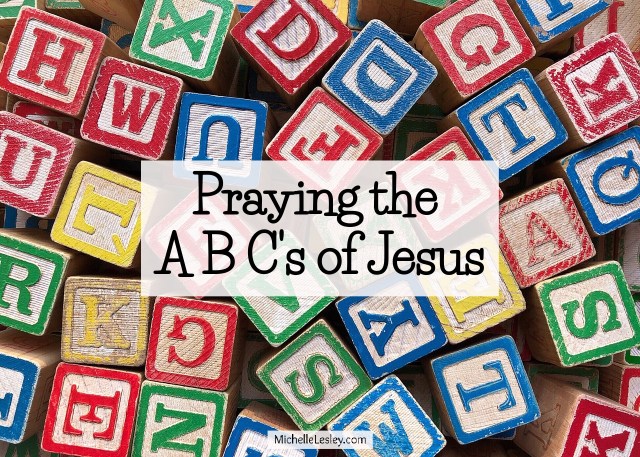
Praying the ABC’s of Jesus

A few weeks ago, I came across this lovely little article at Tim Challies’ blog, and it reminded me of something I have been meaning to share with y’all.

Do you ever have trouble falling asleep at night? Knowing what to pray? Leading your children in prayer? Expanding your vocabulary? Helping your children with their vocabulary words from school? Here’s something that can help in all of those areas, but, above all, it can draw you closer to Christ as you worship and commune with Him.

I don’t think it’s technically insomnia, but I have frequently had trouble falling asleep at night for as long as I can remember. It’s just hard for me to mentally settle down and turn my brain off. And for as long as I can remember, I’ve looked for little mental tricks and games to help lull my brain into unconsciousness. Counting. Spelling. Imagery. Sleep apps. (Right now what seems to work best is reciting in my head whatever passage of Scripture I’m working on memorizing.)

One of the things that has worked well for me is a little mental “game” I call “Praying the ABC’s of Jesus.” It’s a simple recitation of God’s names and attributes in alphabetical order. Here’s an example of what it might sound like:

Lord, You are Amazing.

You are my source of Blessing.

You are Creator.

You are my Delight.

From Everlasting to Everlasting, you are God.

You are my Father.

You are the Giver of life.

You are Holy.

You are Immanuel.

Thank you for being Just.

You are King of Kings…

…and Lord of Lords.

You are the Mighty One of Israel.

You are the Name above all names.

You are Omniscient.

You are the Prince of Peace.

You Quiet my soul.

You are Righteous.

You are my Sabbath rest.

You are Truth.

You are beyond all Understanding.

You reign Victorious over all.

Wondrous are your mighty works.

You are Xenodochial.

You are Yahweh.

You are Zealous for the glory of your Name.

This is also a great, simple way to start off your regular daily prayer time, or lead your children in prayer, as you take time to savor and meditate on each descriptor of God and His nature.

Now you might have to “cheat” a little on letters like Q and X. I usually say, “You are Quite lovely, awesome, beautiful, etc…the Quintessential judge, provider, etc.” or use an “ex-” word for X (eXcellent, eXceedingly gracious, etc.). But you can also build your vocabulary (not to mention your Scrabble score!) by searching out words that begin with those letters. I found the word xenodochial (“friendly to strangers”) by Googling “English adjectives starting with the letter X”. Just make sure the word is reverent and supported by Scripture.

You can also be on the lookout for words you can use as you study your Bible, and if your child has a vocabulary list to work on every week, you can integrate any of those words that would be biblically appropriate.

Good night and sweet dreams!

Mailbag

Throwback Thursday ~The Mailbag: How do I move on after God says “no”?

Originally published May 22, 2017


I loved your article, When God Says “No”. I have a question though: At what point do you move on from the hope or desire? I’m a single mother and feel that I will always have a natural desire for a spouse and I will always desire that for my young children, but the Lord has not provided this for me. At what point do you stop asking for the thing, weep deeply over the life you hoped would be, and move forward?

A dear reader asked this in the comments section of my article When God Says No, and I wanted to share my answer to her here on The Mailbag, because I think it’s something a lot of us struggle with.

When God seems to be saying no to a desire, I think there’s a sense in which moving forward is something you do over and over again every day until or unless God takes that desire away. Taking life “one day at a time” sounds cliché, but if you’ll look at the way Jesus teaches, that’s very much the mindset He wants us to have.

In the Lord’s Prayer, Jesus instructs us to ask for daily bread. This is an echo of the manna God provided in the wilderness on a daily basis. Later in the Sermon on the Mount, Jesus teaches us not to be anxious for the things we don’t have and not to worry about the future. “Therefore do not be anxious about tomorrow, for tomorrow will be anxious for itself. Sufficient for the day is its own trouble.” He says.

Those passages are hard for me because I’m a planner, and I don’t like surprises. I like to have everything mapped out and know in advance what’s going to happen so I can feel secure. But I’ve found that when I’m secure and everything is going well and I don’t really have any problems or unfulfilled desires, I tend to pray less. Depend on God less. Need Him less. And God knows that, more than anything we might desire, what we really need is to need Him. So God does the “daily” thing. God likes for us to get up every day and depend on Him for that day.

So I think what you – what all of us – need to do is get up tomorrow morning, spend time with the Lord, and ask Him to help us honor and glorify Him through our words, actions, decisions, etc., that day. Then, we get up the next day and the next and the next, and do the same thing. We put our hope in the Lord Himself, not in what He might or might not do in our lives, and we simply seek to walk with Him and be obedient to Him day by day.

If it would be something that would help you – sort of a “memorial stone” type of thing – you can set aside some time, maybe even in a special place, to hash everything out with the Lord about your situation. Pour out your heart to Him in prayer, cry, repent of anything you might need to repent of, study some applicable Scripture, commit your heart to trust Him, and, as the old gospel song says, “take your burden to the Lord and leave it there.” In the future, if you start feeling sad or frustrated with God about not having a husband, you can look back on that time as a reminder that you committed to trust God and leave this issue with Him.

Finally, (and I know this might sound silly, but I have to remind myself of this all the time) remember that God’s provision isn’t dependent on our prayers. He truly does know what we need before we ask. In other words, you could stop praying for a husband right this minute and never pray about it again and God is not going to forget that that’s what you want, or move it to a lower priority level on His prayer-answering list, or punish you by denying you a husband simply because you stopped praying about it. There are things God blesses us with that we’ve never spent a moment praying for. There are things we stop praying for that God finally gives us years later. And there are things we pray constantly for that God says “no” about. God is going to do what is best for you and what brings Him the most glory, and that doesn’t hinge on whether you pray about that specific thing every day or not. The purpose of prayer is not to get God to do what we want Him to do. The purpose of prayer is to get us on the same page He’s on- so that we want what He wants.

It can be really difficult and sad when God doesn’t grant our desires, especially when we know they don’t conflict with Scripture, but the blessing is that God can use these circumstances to increase our dependence on Him and conform our desires to His own.


If you have a question about: a Bible passage, an aspect of theology, a current issue in Christianity, or how to biblically handle a family, life, or church situation, comment below (I’ll hold all questions in queue {unpublished} for a future edition of The Mailbag) or send me an e-mail or private message. If your question is chosen for publication, your anonymity will be protected.