Evangelism, Gospel, Salvation, Sin, Throwback Thursday

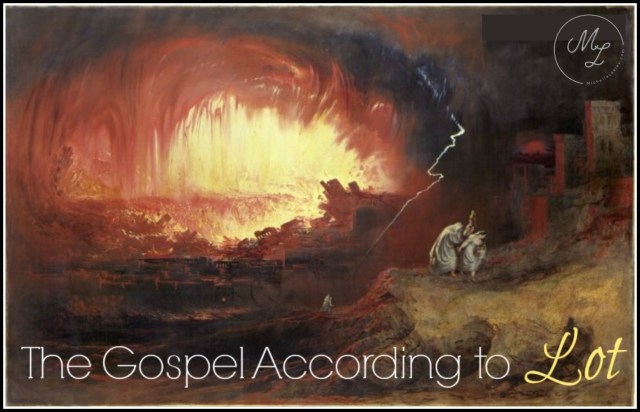
Wayback Wednesday ~ The Gospel According to Lot

Originally published February 26, 2013

Then the men said to Lot, “Have you anyone else here? Sons-in-law, sons, daughters, or anyone you have in the city, bring them out of the place. For we are about to destroy this place, because the outcry against its people has become great before the Lord, and the Lord has sent us to destroy it.” So Lot went out and said to his sons-in-law, who were to marry his daughters, “Up! Get out of this place, for the Lord is about to destroy the city.” But he seemed to his sons-in-law to be jesting.
Genesis 19:12-14

The story of the destruction of Sodom and Gomorrah would make an epic movie. You’ve got your good guys: Abraham, Lot, and the angels. Your bad guys: everybody else in town. Violence, dramatic tension, a narrow escape, major pyrotechnics, and the good guys take the day. Epic, I tell you.

But that’s just what’s happening on the surface.

If you look closely, you can see the light of the gospel casting a shadow over Sodom. A shadow that’s the size and shape of a cross.

If you look closely, you can see the light of the gospel casting a shadow over Sodom. A shadow that’s the size and shape of a cross.

The city of Sodom was so wicked that God personally came down to deal with it. Judgment was coming. There was hell to pay—quite literally.

God revealed His plan of destruction to Lot, His only follower in Sodom. But God didn’t stop there. Did Lot have anyone in town that needed to be rescued from the coming devastation? Hurry! Go get them and urge them to flee!

“My sons-in-law!” thought Lot. Perhaps he raced out the back door, slipped carefully past any of the blinded mob left on his front porch, and scurried surreptitiously through town to avoid other hostile neighbors. Arriving at the respective homes of the two men betrothed to his daughters, he must have pleaded with them to drop everything and come with him. It was the only way they could be saved.

But they wouldn’t go with him. They didn’t believe him.

hp-crossshadow

The next morning, judgment came. And that handful of people—righteous Lot, and those who believed with him that God would save them if they left everything behind and followed Him—were the only ones spared.

Is that shadow becoming clearer?

This world is a frightfully wicked place. And, one day, God is going to come down personally to deal with it. Judgment is coming. It will be swift, it will be terrible, and it will be final. God has revealed this to us in His word. He has also revealed to us, His followers, the plan of escape: Jesus.

But God doesn’t stop there. Do we have friends and loved ones who need to be rescued from the very real and eternal hellfire and brimstone that await them if they stay in the Sodom of their sin?

Jesus tells us to “go out and…compel them to come in” (Luke 14:23), and that they “must be born again” (John 3:7).

This isn’t some kind of “God loves you and has a wonderful plan for your life” game we’re playing here. It’s urgent, a matter of life and death.

This isn’t some kind of “God loves you and has a wonderful plan for your life” game we’re playing here. It’s urgent, a matter of life and death.

Eternal life. Eternal death.

And God’s way is the only way out.

God didn’t offer Lot’s sons-in-law the option of having their cake and eating it, too, by remaining in Sodom and being saved from His wrath. And it doesn’t work that way for us either. We don’t get to have Jesus and continue to rebel against Him by remaining in our sin.

Just as Lot’s sons-in-law could not survive God’s judgment any other way than fleeing the sin of Sodom and following God’s escape route, there is only one way we may escape. We must flee from our sin and into the forgiving arms of our crucified and risen Savior.

This is the gospel with which we must compel them. It is the only gospel that saves.

“If sinners will be damned, at least let them leap to hell over our bodies. And if they will perish, let them perish with our arms around their knees, imploring them to stay. If hell must be filled, at least let it be filled in the teeth of our exertions, and let not one go there unwarned and unprayed for. – C.H. Spurgeon.

Do you know Jesus as your Savior? Are you certain?

Faith, Gospel, Heaven, Hell, Salvation, Throwback Thursday

Throwback Thursday ~ From Here to Eternity

Originally published March 20, 2014here to eternityFred_Phelps_10-29-2002

Fred Phelps died last night. And I’m glad.

I’m glad there’s one less person on earth publicly sullying the name of Christ and dragging His holy Word through the mud.

What I’m not glad about is that, as far as we know, yesterday was the first day of his eternity in Hell.

Hell? But he claimed to be a Christian.

Fred Phelps and his kindred are a perfect example of the fact that you can claim whatever you want, but that doesn’t necessarily mean it’s true.


“Not everyone who says to me, ‘Lord, Lord,’ will enter the kingdom of heaven, but the one who does the will of my Father who is in heaven. On that day many will say to me, ‘Lord, Lord, did we not prophesy in your name, and cast out demons in your name, and do many mighty works in your name?’ And then will I declare to them, ‘I never knew you; depart from me, you workers of lawlessness.’
Matthew 7:21-23


And that’s not just the case for people like Fred Phelps whose lives seem to define the word “vile.” It’s also true for “nice” people. People you’d never put in the same category as Fred Phelps. People who volunteer at hospitals and run marathons to raise money for cancer research. Moms who’d do anything for their children. Men who are faithful to their wives. Your next door neighbor. Your brother. Your coworker.

Vile people don’t go to Heaven.

Nice people don’t go to Heaven.

Saved people go to Heaven.

The bad news is that you could never do enough good things to earn your way into Heaven. And, the good news is that you could never do enough bad things to forfeit Heaven.

Because being reconciled to God is not about what you do. It’s about what Christ has done.

We’re not always good. He was. We’re not always pleasing to God. He was. We don’t always do the right thing. He did. He lived the perfectly good, right, and pleasing-to-God life that we’d never be able to live. And then came the cross.

Some people refer to what happened at the cross as “the great exchange,” and, indeed it was the greatest exchange ever. At the cross, Christ suffered the execution that we deserve as the punishment for our crimes against God, and in exchange, we can have the perfect life He lived. His rap sheet for ours. Our guilty verdict for His innocent verdict. His death penalty for our exoneration. And it’s all ours if we’ll let go of the sin we cling to and throw ourselves on the mercy of the Judge.

Could someone as evil as Fred Phelps do that? Yes, and I hope he did before he died. Because no one who repents and trusts in Christ is beyond the reach of His saving grace. Not even a nice person like you.

Faith, Hell, Salvation, Sin, Throwback Thursday

Throwback Thursday ~ Are you a Bin Laden?

Originally published March 2, 2011bin laden

Osama Bin Laden is dead.  Across the globe, people are celebrating.  There’s a general sentiment, even among non-Christians, that he is in hell, because that’s what he deserves.

I’m guessing that, some of those people, if you had shared the Gospel with them two days ago, would have said they didn’t believe in hell.  Or that a loving God wouldn’t send people to hell.  Or that God just forgives everybody when they die, and everybody goes to heaven.

If you hold any of those beliefs, the law of non-contradiction requires that they be applied across the board to everybody.  In other words, you can’t say you don’t believe in hell and at the same time believe that Bin Laden is in hell.  If it doesn’t exist, he can’t be there.

So I’d like to pose two questions to people who hold the aforementioned beliefs:

1. If God decided not to send Bin Laden to hell, but rather allowed him into heaven, has justice been done?

2. Do you think it’s fair that you will have to spend your own eternity in heaven with Bin Laden?  And Hitler, and Nero, and Mussolini, and Caligula, and Jack the Ripper?

As broken and messed up as we are, even we humans demand that there be justice –punishment– for people who have committed such heinous crimes.  If God doesn’t punish these awful people, what does that make Him?  How could He be perfect in every way and let such people off scot free?

I can tell you how.  Because I used to be Bin Laden.  And Hitler, and all of those other people rolled into one.  Me.  A good little Sunday School girl.  Guilty.  James 2:10 tells us:

For whoever keeps the whole law and yet stumbles in one point, he has become guilty of all.

In God’s eyes, when I broke curfew to stay at Bible study just a little bit longer, I was as guilty as a serial murderer.  When I said, “Oh my G-d!” I was on par with a child molester.  When I refused to forgive someone, I might as well have flown one of those planes into the Twin Towers myself.  And I deserved the same punishment as all of those horrible people.  Hell.

God is perfect.  He’s perfectly holy and perfectly just.  And that’s why He can’t let any sin slide, no matter how small.  But He’s also perfectly loving and compassionate.  He knew none of us would measure up to his standard for us –perfection, no sin whatsoever– so He made a way for us to escape punishment, yet still serve justice: Jesus.

God Himself came here and lived out His perfection as a human being.  And when it was time, on the cross, He took the punishment for our crimes against God.  He got our sin and our punishment, and because of His death and resurrection, we can get His sinless perfection.

We can get it, but it’s not an automatic thing that just happens to everybody when they die.  As I said in a previous post, you can’t have it both ways.  If you decide to get married, you give up the single life.  If you decide to become a star athlete, you give up being a couch potato.  And when God enables you to turn from your sin to faith in Christ, He empowers you to give up a life of embracing sin, and, instead, embrace Christ and the new life He has for you.  Here.  Now.

Is Bin Laden in hell?  I can tell you with certainty that if he did not, in the last moments of his life, sorrowfully turn from his sin and bow his knee to the Lordship of Jesus Christ, yes, he is indeed in hell.

And there, but for the grace of God, go I.  And you.

Forgiveness, Hell, Justice, Old Testament, Salvation, Sin, Sunday School

Follow Up Week ~ Sunday School Lesson ~ 6-1-14

sunday school

These are my notes from my ladies’ Sunday School class this morning. I’ll be posting the notes from my class here each week. Click here for last week’s lesson.

Through the Bible in 2014 ~ Week 22 ~ May 25-31
Psalm 131, 138-139, 143-145, 127, 111-118, 37, 71-72, 94, 119:1-88; 1 Chronicles 26-29; 1 Kings 1-4; 2 Chronicles 1

Follow Up Week

Last week, we had a lot of great questions that I didn’t feel we had the opportunity to discuss thoroughly enough. This week we’re going to take an in depth look at three of those questions.

Follow Up: Zeruiah
Last week, we saw David repeatedly refer to Joab and Abishai as “sons of Zeruiah,” and a question arose as to what he meant by that. Was it an insult? An identifier? Here, briefly, is some clarifying information:

Zeruiah was David’s sister (1 Chronicles 2:15-16). Her sons were Abishai– one of the chiefs of David’s mighty men (1 Chronicles 11:20), Joab– commander of  David’s army, and Asahel (Asahel was murdered by Abner, commander of Saul’s army (2 Samuel 2:8), at the battle of Gibeon (2 Samuel 2:18-24). Abishai and Joab later took revenge on Abner for killing their brother (2 Samuel 3:24-30).)

images


Abishai, Joab, and Asahel were brothers and also David’s nephews. Therefore, calling them “sons of Zeruiah” may have had one of several meanings:

1. “Sons of Zeruiah” was just another way of saying “my nephews.” It is possible that this was to distinguish them from other men close to David who had the same names. (For example, in this week’s reading, we saw a man named Shimei (1 Kings 1:8, 4:18) who was a different person from the Shimei we studied about last week.) Adding such an identifier to someone’s name was common in biblical times before surnames were in general use (eg. Joshua son of Nun, Joseph of Arimathea, Jesus of Nazareth, etc.)

2. It is possible David had a close relationship with Zeruiah and had great respect for her. Perhaps when David called his nephews “sons of Zeruiah” he was reminding them to live up to their mother’s good character.

3. It is possible David had a contentious relationship with his sister and had little respect for her. Perhaps when David called his nephews “sonsof Zeruiah” when annoyed with them, he was implicitly saying, “What else can you expect when they had a mother like that?”

Since the Bible provides very little information on Zeruiah, we can’t definitively say why David would use this phrase; we can only speculate. Click here for more information on Zeruiah.

 

scales of justice

Follow Up: Shimei, David, and Solomon
Last week, we studied the story of Shemei cursing David, and David’s subsequent sparing of his life (2 Samuel 16, 19). This week, we saw the death of David and Solomon’s accession to the throne (1 Kings 1-2). We also saw David, from his deathbed, give instructions to Solomon regarding Shimei, and we saw how Solomon carried them out (1 Kings 2). Was David sinning by going back on his word to Shimei? Let’s take a look.

Two Different Justice Systems
In order to understand the dynamics of the situation between Shimei and David and Shimei and Solomon, we first have to step outside our 21st century United States understanding of “the justice system” and step back in time into the Old Testament monarchial justice system.

The American System:
In the American justice system, justice supersedes leadership and is a separate entity from leadership. We have the judicial branch of government (courts, judges, jails, lawyers, etc.) and the executive branch of government (the President, state governors, etc.). They each have their own powers and responsibilities, and, for the most part, are separate from, and not dependent on, one another. For example, if someone is acquitted of a crime during one person’s presidency, he cannot later be convicted of that same crime solely because someone else becomes President and thinks he should be convicted. (Obviously, there are exceptions and corruptions to this system, but, generally speaking, in a nutshell, this is how it is supposed to work.)

Old Testament Israel’s System: 
In Israel (and other monarchial or dictatorial nations), there was no separation of powers. Legislative (making the laws), judicial, and executive powers all resided in one man: the king. And, the rules could change every time a new king took over. Your verdict, conviction, and sentence lasted only as long as the reign of the king who handed them down unless the next king chose to honor those decisions. This is one of the reasons the death penalty and maiming (cutting off someone’s had for stealing, for example) were more prevalent during those times. If you were the king and wanted to make sure someone was punished long term and that your verdict would not be overturned, death or maiming were your main options.

Shimei’s Sentence (1 Kings 2:8-9, 2 Samuel 19:23, 1 Kings 2:36-46)
As we saw in this week’s reading in 1 Kings 2:8-9, David did not put Shimei to death himself or during his own reign. Additionally, because of the way Israel’s justice system worked, it would have been impossible for David to swear to Shimei that he would never be put to death, because David had no control over what the next king would do. David’s oath was only good for the duration of his own reign. Thus, he did not break the oath he made to Shimei in 2 Samuel 19:23.

David did, however, take full advantage of Israel’s system of justice, the fact that Solomon had made no such oath to Shimei and the fact that Solomon was his son and would be likely to do as he asked. In 1 Kings 2:8-9, David didn’t come right out and tell Solomon to execute Shimei, but he hinted pretty strongly at it.

Solomon, perhaps wishing to honor the spirit of David’s oath to Shimei in 2 Samuel 19, while still carrying out David’s desire in 1 Kings 2 that Shimei be punished, did not condemn Shimei to immediate death, but, rather, put him under “house arrest” (1 Kings 2:36-37). Shimei could not leave Jerusalem or he would be executed, but as long as he stayed in Jerusalem, he was free to live his life as he wished. Shimei agreed to this (2:38) and made an oath to the Lord that he would obey (2:43). Shimei could have lived out the rest of his life peacefully in Jerusalem if he had just abided by the rules of his sentence. He broke the rules; he knew the consequences (2:39-46).

 

deathbed-2

Follow Up: Can a Christian be forgiven for a sin he commits on his deathbed and doesn’t have the opportunity to repent for before dying? Will he go to hell for this? 
This question arose last week as we briefly touched on David’s deathbed instructions to Solomon regarding Shimei. Although it doesn’t appear that David was actually sinning in that particular case, this question is a very good one that I wanted to address more fully because it has application for all of us since we all sin and will all die one day. In order to answer this question, we need to take a look at several things regarding sin, forgiveness, and salvation.

The soteriology of the question (John 10:26-29, Romans 8:1-2, 33-39, 1 John 2:1-2) 
Soteriology is the field of theological study that deals with salvation: what it is, what it isn’t, and how it happens. We know that in order for a person to be saved and spend eternity in Heaven he must turn from his sin (repent), and place his faith in the death, burial, and resurrection of Christ on his behalf as payment for his sin.

John tells us that, for those who have truly been born again, no one is able to snatch them out of Christ’s or the Father’s hand. This includes Satan. Romans tells us (8:33-34) no one has the authority to condemn or to bring charges against God’s elect, because God is the one who has justified them and He has already said there is no condemnation for those who are in Christ Jesus (8:1-2). Satan no longer has the authority even if we sin, to drag us off to hell, and God has promised that he will not condemn us to hell if we are in Christ. And if/when we do sin, 1 John tells us that Christ has already stepped in between us and the wrath of God as our advocate, offering His righteousness on our behalf.

Bottom line: If you have truly been born again, God’s got you and there’s not anyone or anything that has the authority to change that.

The hamartiology of the question (Hebrews 10:11-14): 
Hamartiology is the study of sin. We sin before we’re Christians. We sin after we’re Christians. We will never be completely free from temptation and the effects of sin this side of Heaven. The truth is, unless you are capable of knowing every single sin in your life (Remember all those sins you committed when you were three? Neither do I.) and you die immediately after repenting of the last one, you’re going to die with unconfessed sin in your life. That’s pretty much every Christian. We sin so much that there are sins we don’t even realize or remember we’ve committed. How can you repent of something you’re not even aware of? So, no, a true Christian will not go to hell for failing to repent of an individual sin committed right before death.

As the old hymn says, “Jesus paid it ALL.” Hebrews tells us that Jesus died “once for all”– one time to pay for all sin, from the creation of the world until its destruction at the end of time. When we come to Christ for salvation, while we may repent of individual sins that are heavy on our hearts, what we are really doing is confessing that we are, and repenting for being, a sinner. If we had to repent of every individual sin no one could ever be saved because no one could remember all the sins he’s ever committed. For those who are in Christ, every sin in our entire lives, from birth to death, is forgiven.

Daily repentance and forgiveness:
So, if the sins we have forgotten about, and the sins we aren’t aware of, and the sins we don’t have a chance to repent for before dying are all forgiven anyway, why is any other sin any different? Why do we need to repent of our sin and ask for forgiveness every day when we pray?

Obedience (Matthew 6:12):
We do it out of obedience. Jesus tells us in the Lord’s Prayer to daily ask God to forgive us for sinning. So, we do.

Awareness and thankfulness (Psalm 32:1-2)
When we spend time in prayer daily repenting of our sin it reminds us of the greatness of God and His grace in forgiving our sin. It humbles us by reminding us of the great cost of our sin. It reassures us of God’s love and mercy towards us. It gives us an opportunity to give Him praise and thanks for forgiving us.

Restored relationship (1 John 1:6-9)
When we have unconfessed sin in our lives, it creates a rift (of our own making) between us and God. When we confess our sin to God and ask Him to cleanse us from it, that sin is no longer a hindrance to clean, unfettered communion with God.

If we say we have fellowship with him while we walk in darkness, we lie and do not practice the truth. But if we walk in the light, as he is in the light, we have fellowship with one another, and the blood of Jesus his Son cleanses us from all sin. If we say we have no sin, we deceive ourselves, and the truth is not in us. If we confess our sins, he is faithful and just to forgive us our sins and to cleanse us from all unrighteousness.

Faith, Gospel, Heaven, Hell, Salvation

From Here to Eternity

here to eternityFred_Phelps_10-29-2002Fred Phelps died last night. And I’m glad.

I’m glad there’s one less person on earth publicly sullying the name of Christ and dragging His holy Word through the mud.

What I’m not glad about is that, as far as we know, yesterday was the first day of his eternity in Hell.

Hell? But he claimed to be a Christian.

Fred Phelps and his kindred are a perfect example of the fact that you can claim whatever you want, but that doesn’t necessarily mean it’s true.


“Not everyone who says to me, ‘Lord, Lord,’ will enter the kingdom of heaven, but the one who does the will of my Father who is in heaven. On that day many will say to me, ‘Lord, Lord, did we not prophesy in your name, and cast out demons in your name, and do many mighty works in your name?’ And then will I declare to them, ‘I never knew you; depart from me, you workers of lawlessness.’
Matthew 7:21-23


And that’s not just the case for people like Fred Phelps whose lives seem to define the word “vile.” It’s also true for “nice” people. People you’d never put in the same category as Fred Phelps. People who volunteer at hospitals and run marathons to raise money for cancer research. Moms who’d do anything for their children. Men who are faithful to their wives. Your next door neighbor. Your brother. Your coworker.

Vile people don’t go to Heaven.

Nice people don’t go to Heaven.

Saved people go to Heaven.

The bad news is that you could never do enough good things to earn your way into Heaven. And, the good news is that you could never do enough bad things to forfeit Heaven.

Because being reconciled to God is not about what you do. It’s about what Christ has done.

We’re not always good. He was. We’re not always pleasing to God. He was. We don’t always do the right thing. He did. He lived the perfectly good, right, and pleasing-to-God life that we’d never be able to live. And then came the cross.

Some people refer to what happened at the cross as “the great exchange,” and, indeed it was the greatest exchange ever. At the cross, Christ suffered the execution that we deserve as the punishment for our crimes against God, and in exchange, we can have the perfect life He lived. His rap sheet for ours. Our guilty verdict for His innocent verdict. His death penalty for our exoneration. And it’s all ours if we’ll let go of the sin we cling to and throw ourselves on the mercy of the Judge.



Could someone as evil as Fred Phelps do that? Yes, and I hope he did before he died. Because no one who repents and trusts in Christ is beyond the reach of His saving grace. Not even a nice person like you.