Christmas

Nativity Scenes and the Second Commandment

Originally published December 10, 2019
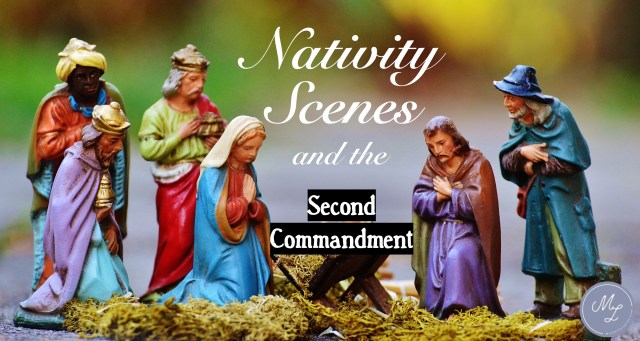
Have you ever heard someone say that nativity scenes, Christmas ornaments, Christmas pageants, and other Christmas items or activities which portray the baby Jesus (with a figurine, a doll, a live baby, pictures, etc.) break the second Commandment even though the portrayal of the baby Jesus isn’t being worshiped?

Some of my brothers and sisters in Christ believe that any representation of Jesus – be it in a manger scene, a painting, a movie, pictures of Jesus in children’s Bibles, flannelgraphs, Bible story pictures used for teaching children or on the mission field, etc. – violates the second Commandment…

You shall not make for yourself a carved image, or any likeness of anything that is in heaven above, or that is in the earth beneath, or that is in the water under the earth. You shall not bow down to them or serve them, for I the Lord your God am a jealous God, visiting the iniquity of the fathers on the children to the third and the fourth generation of those who hate me, but showing steadfast love to thousands of those who love me and keep my commandments.

Exodus 20:4-6

…whether or not that representation of Jesus is being worshiped. It is the mere act of making or displaying the representation which breaks the Commandment.

This is not something any church I’ve ever been a member of has taught, but because I’ve heard this point of doctrine from theologically sound friends I respect, I wanted to take a closer look at the pertinent Scriptures to make sure I wasn’t doing something wrong. I’ve had nativity scenes and children’s Bibles and used flannelgraphs and been in Christmas musicals that depict Jesus all my life and never gave it a second thought. But if having and doing those things conflicts with Scripture, I want to stop.

But, having examined the Scriptures in context, while I respect and admire my friends’ desire to honor the Lord by not using representations of Him, I simply don’t find that the Bible prohibits occasionally depicting Jesus in reverent, not-for-the-purpose-of-worship ways. Here’s why:

Having examined the Scriptures in context, I simply don’t find that the Bible prohibits occasionally depicting Jesus in reverent, not-for-the-purpose-of-worship ways. Here’s why…

1.

Consider the macro-context of Exodus 20. What was going on in the history and culture of Israel at that time? God was setting Israel apart from other nations as His own special possession and establishing Israel as a nation. And what was the preeminent characteristic that was to set Israel apart from the pagan nations? Israel was to be a witness to all the nations of the one true God. They were not to worship idols (which, at that time, were generally carved figures of created things). Not instead of God. Not in addition to God. Not at all. The second Commandment is a command not to worship carved figures as idols.

2.

Examine the immediate context of Exodus 20:4-6. It follows verses 1-3, which establish the supremacy of God above all other gods, and specifically state that Israel is not to worship any other gods.

3.

Take a close look at the content of Exodus 20:4-6. The passage doesn’t say anything about making a representation of God Himself. Jesus had not yet been born when this was written, so this passage could not have been talking about making a representation of Jesus. It talks about making representations of created things in the sky (planets, the sun, etc.), on the earth, and in the water, and worshiping them. And certainly, calling any graven images “God” and worshiping them as God would also be prohibited (Remember the golden calf incidents?)

4.

It would seem to me that to be consistent in saying “no representations of Jesus” folks who hold to this belief would also have to say “no representations of anything” because what Exodus 20:4 plainly says is “you shall not make for yourself…any likeness of anything.” No photographs of anything, no drawings, paintings, or sculpture of anything, no Xeroxing anything, nothing. In fact, I think that would be closer to the actual wording of the passage than “no representations of Jesus,” which, again, this passage does not mention.

5.

The cross references I found for Exodus 20:4 are Leviticus 26:1, Deuteronomy 27:15, and Psalm 97:7. All of them refer to idol worship.

6.

There are at least two occasions in the Old Testament in which God instructs Moses to make a graven figure, and both of these instances are far more conducive to actual worship of the figures than a nativity scene or a Sunday School flannelgraph.

There are at least two occasions in the Old Testament in which God instructs Moses to make a graven figure, and both of these instances are far more conducive to actual worship of the figures than a nativity scene.


The first instance – just five chapters after the second Commandment – is found in God’s instructions for the Ark of the Covenant. God instructs Moses to have the people make two cherubim (angels) for the mercy seat (lid) of the Ark. They were not to worship the cherubim (or the Ark), but the Ark was the holiest object used in Israel’s worship ceremonies. It would have been easy for the people to cross the line and worship it or the cherubim, yet God commanded the making of these not-for-worship figures to point the people to Him. (And guess what was put into the Ark right underneath those graven figures? The two tablets of the 10 Commandments, including the second Commandment.)

The second instance was when God instructed Moses to make the bronze serpent. Anyone who had been fatally snake-bitten could look up at the serpent and his life would be spared. How much more likely would an Israelite have been to worship the bronze serpent, commissioned by God and instrumental in saving his life than we are to worship a picture of Jesus in a children’s Bible? Jesus Himself said that this graven figure pointed ahead to His death on the cross, using it as an illustration of His crucifixion. Much like a nativity scene is an illustration of His incarnation.

Now, if God Himself commissioned the casting of these figures of created things, not to be worshiped, but as tools to point people to Himself, would it stand to reason that He would prohibit reverent representations of Christ that point to or teach about Him? Comparing the second Commandment with these two instances of graven figures demonstrates to us that God expects His people to be able to distinguish between using objects as tools or illustrations that point to Him and worshiping those objects.

God expects His people to be able to distinguish between using objects as tools or illustrations that point to Him and worshiping those objects.

“But if you see pictorial representations of Jesus, you’ll have those images in your mind, and they’ll pop up in your head while you’re worshiping or praying, and then you’ll be worshiping those mental pictures of Jesus, and that’s a violation of the second Commandment.”

If that’s an issue for you, then you definitely shouldn’t view representations of Jesus. But you need to understand that not everyone’s brain works that way. Sometimes when we’re singing in church, an image of my husband, or children, or a beautiful sunset, or whatever the lyrics evoke will pop up in my head. Does that mean I’m worshiping any of those things? Of course not. And for me – and others, I’m sure – any representation I’ve seen of Jesus that happens to pop into my brain is on the same level as those other things. It’s just some random thing I’ve been reminded of, not something I’m worshiping, and it flits out just as quickly as it flitted in.

“But having a pictorial representation of Jesus in your head is worshiping that image.”

No, that is definitionally not the case. Thinking of something is not the same thing as worshiping it. If it were, we’d be guilty of idol worship every time a picture of anything popped up in our brains. There’s a difference between a picture of something randomly popping up in your mind and intentional, purposeful worship.

“But depicting Jesus pictorially, in a nativity scene, or otherwise, could cause a brother or sister who does believe it’s a second Commandment violation to stumble.”

That’s absolutely true, and for that reason, those of us who have the freedom of conscience to use representations of Jesus ought to fulfill our responsibility to those brothers and sisters in Christ. As I’ve learned more about their side of the issue, I have all but eliminated using pictorial representations of Jesus on my blog, social media, etc. I don’t normally display any representations of Jesus in my home, but if I had a friend coming over at Christmas who was sensitive to this, I would certainly remove the baby Jesuses from all of my nativity scenes until she went home. My freedom of conscience comes with a responsibility of love and concern for my brothers and sisters in Christ.

My freedom of conscience comes with a responsibility of love and concern for my brothers and sisters in Christ.

In the end, this issue is an issue of Christian liberty. It is not a sin nor a violation of the second Commandment to use occasional reverent representations of Christ to point people to Him. It is also not a sin to desire to honor the Lord by refraining from using representations of Christ and finding other ways to point people to Him. Whichever side of the issue we come down on, let us make sure we are respectful and loving to those on the other side, not making a law for them where no law exists, nor accusing one side of sin or the other of legalism.


Additional Resources:

When We Understand the Text Podcast (at the 13:36 mark) with Pastor Gabriel Hughes

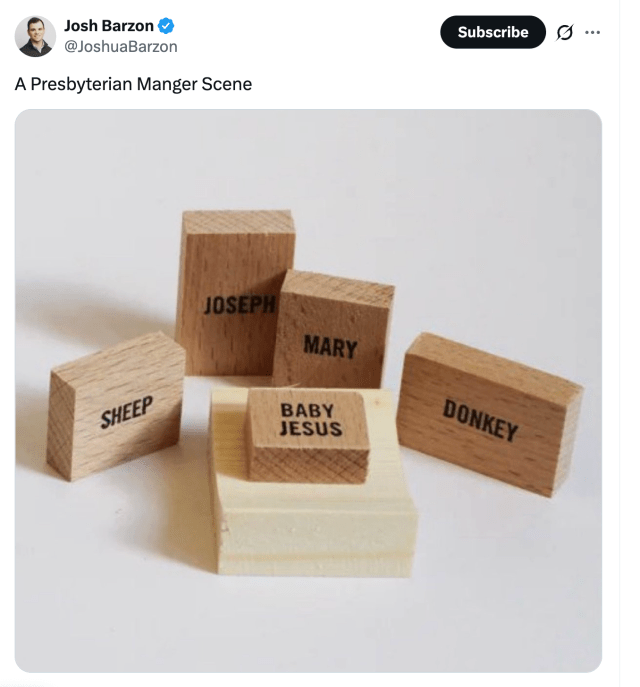
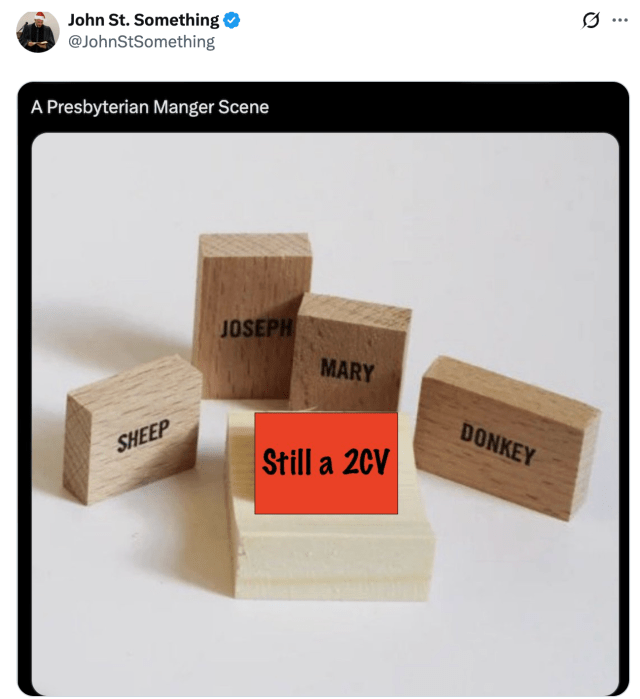
OK, I just thought this was hilarious. Josh is Baptist. John is Presbyterian. And these two images capture the essence of this article really well. John made a great point about his own theology using humor. I love that.โ™ฅ๏ธ

Christmas

The Worst Christmas Songs of All Time

For me, part of the reason Christmas is the “most wonderful time of the year” is the music. There are the old favorites as well as some great new songs that have come out over the years. Unfortunately, there are some stinkers out there, too.

Everybody has her own taste, so the songs that give you the Christmas crazies are probably different from the ones that get on my nerves, but, here, in no particular order, are my (and your!) picks for the worst Christmas songs of all time.

I’ll keep adding those Christmas songs you love to hate to the list every year (Could there possibly be any more?), so feel free to nominate your choice for the worst of the worst in the comments. And, while I can’t imagine why you would want it, if you need a playlist of all of these horrid songs, here you go: The Worst Christmas Songs of All Time.

1. The Christmas Shoes– Hi, we’re going to write a song that’s a blatant attempt at emotional manipulation, and then if you say you don’t like it, people will think you’re heartless. Merry Christmas.

2. Last Christmas– Really? We have to listen to co-dependent whining about a break up in a Christmas song? And from Wham?

3. Grandma Got Run Over By a Reindeer– This has such a catchy tune. It’s too bad the family in this song belongs on a reality TV show.

4. Same Old Lang Syne– This is my pick for the absolute worst “Christmas” song (it really has nothing to do with Christmas) of all time. The only good thing I can say about this is, at least the people in the song didn’t actually have an affair. It’s bleak, it’s immoral, it’s depressing, and it’s the same four bars of melody over. and. over. and. over.

5. Must Have Been Old Santa Claus– “Happy ho, ho, ho to you.” Four. million. times. Kill me. Kill me now.

6. Baby, It’s Cold Outside– Because nothing says “Merry Christmas” like attempted date rape by a drink drugging letch.*

*(Baby, It’s Cold Outside was added to my original article Top 10 Worst Christmas Songs of All Time in 2014, long before the #MeToo movement, and long before the explanation of what the composer of Baby, It’s Cold Outside purportedly meant by it was in general circulation. My brief evaluation of this song is based solely on the impression I was left with by the lyrics, much the same way people took umbrage with Reckless Love based on the lyrics alone, despite Corey Asbury’s explanation of what he supposedly meant when he wrote it. I am not a liberal, a feminist, or on the #MeToo bandwagon. I’m confident my track record bears this out, and I’m appalled by accusations to the contrary based solely on my one sentence reaction to this song. Don’t go there.)

7. Santa Baby– They could have named this song “Sugar Daddy” or “Implied Sexual Favors in Exchange for Obscenely Expensive Gifts.” Same thing.

8. Mistletoe– I’m just going to make a rule right here, right now: no Christmas songs that force middle-aged people to go to Urban Dictionary to understand the lyrics. My kids had to explain to me what “shawty” means. Apparently, it’s similar to a “bae.”

9. Do They Know It’s Christmas?– Stop having Christmasy fun RIGHT NOW. Just STOP IT. Don’t you know there are people starving in Africa, you soulless oaf? And, seriously, who puts the word “doom” in a Christmas song?

10. Trans-Siberian Orchestra’s Christmas Canon– It pains me to list this one because I love TSO, I love children’s choirs, I love Pachelbel’s Canon in D, and I love the idea of trying to Christmas it up. But I would rather eat a ten year old fruitcake than listen to this.

11. Please, Daddy, Don’t Get Drunk this Christmas – I can just picture the artistic meetings that took place on this one: “We need a new Christmas song for your next album, John. Any ideas?” “How about a potential domestic violence case set to country music? That’ll fill everybody’s heart with Christmas cheer!” 

12. Dominick the Donkey
Dear Italy,
Please stick with what you do best – food
and opera.

13. Happy X-Mas, War is Over (So This Is Christmas) – Excuse me, but I think you’re looking for Woodstock. Go back several decades and hang a left.

14. I Want a Hippopotamus for Christmas– Why not? I wanted a monkey for Christmas when I was a kid. I stand in solidarity with this kid and every other kid who wanted a ridiculous animal for Christmas and never got one. (To be honest, I think this song is kinda cute. I include it on behalf of all my readers who said it’s driving them to the loony bin.)

15. Hard Candy Christmas – Maybe I’ll wallpaper my bathroom. Maybe I’ll get a mohawk. Maybe I’ll eat cold Spaghettios right out of the can. MAKE๐Ÿ‘UP๐Ÿ‘YOUR๐Ÿ‘MIND๐Ÿ‘

16. Simply Having a Wonderful Christmas Time – There’s good 80’s synthesizer and there’s bad 80’s synthesizer. I’ll let you guess which one earned this song a spot on the list.

17. White Winter Hymnal – “It’s lyrically fairly meaningless.” That’s what the songwriter had to say about this song. Dude, lemme ‘splain you something about songwriting. When you have a cool piece of music like this, don’t waste it on meaningless lyrics. Collaborate with a good writer and make it an awesome song with meaning. (Let me also take this opportunity for my annual reminder: Pentatonix is not a Christian group, regardless of the songs they record. According to Pride magazine, “Two of Pentatonix’s members, Scott Hoying and Mitch Grassi, are openly gay, and the group vocally supports the LGBT community.”)

18. Driving Home for Christmas – This song is the musical equivalent of driving across west Texas. And by that, I mean – monotonous. (Sorry west Texas, but you know it’s true.) At least he didn’t regale us with the number of each mile marker as he passed it. Thank the Lord for small favors.

19. I’m Gettin’ Nuttin for Christmas – Quick! Somebody get the rod of correction – this kid is out of control! Cute, but not your best work, Shirl.

20. I Saw Mommy Kissing Santa Claus – Kid witnesses Mom stepping out on Dad and is traumatized for life. Just one more reason not to lie to your kids about Santa Claus. (Tell them it’s Dad, ladies, and you can kiss him all you want! :0)

21. All I Want for Christmas Is You – I don’t know what kind of deal Mariah Carey made with every single one of the eleventy two million FM stations in the country to play this song every time anyone turns on the radio between November and January, but it was a doozy. Are you hearing it in your sleep yet? Is your dog singing the doo-wop parts?

(Full disclosure – This one made the list because you overwhelmingly demanded it. I actually dig it. It’s exactly the kind of mid-’50’s – early ’60’s flavor I love. Just not every time I turn around. Please don’t hate me. :0)

22. Mary, Did You Know? – I know, I know, some of y’all are going to unfollow me over this one. You love this song. I did too … the first nine thousand times I heard it or had to sing it in choir. And I think that’s probably the main reason so many of my followers requested that I put this one on the list. It’s been beaten to death like a too-stiff meringue.

Did she know? Did she not know? Let’s settle that argument once and for all:

Mary, did you know that your baby boy would one day walk on water?
No.

…would calm a storm with His hand?
No.

There are no Old Testament prophecies which predicted that the Messiah would walk on water or calm a storm.

give sight to the blind man?

The blind will see
The deaf will hear;
The dead will live again!
The lame will leap
The dumb will speak
The praises of the Lamb!

If Mary knew her Bible (and if you’ll check the cross-references to the Magnificat, it certainly seems she did), she most likely knew the Messiah (i.e. her “baby boy”) would do these things. However, she wasn’t omniscient and wouldn’t have known the specific timing or circumstances surrounding these healings and resurrections.

Everything else in the song (He would deliver her, He is Lord of all Creation, etc.) is either stated or implied in Old Testament prophecy about the Messiah (which Mary would probably have known), in Gabriel’s announcements to Mary and Joseph, or both.

So, yeah, except for the walking on water and calming the storm parts, she knew.

Debate over.

23. The Little Drummer Boy (Carol of the Drum) – You just know some man came up with the idea for this song, right? No mother in her right mind who’s just given birth – even Mary – would welcome some kid banging on a drum with the little Lord Jesus asleep on the hay. You would think that … but you would be wrong, because this song was written by one Katherine Kennicott Davis. I guess her kids were heavy sleepers.

(If you actually like drums, just not the song, check out this drumline version that partly drowns out the song. And, did you know they made a kids’ movie out of this cacophonous carol?)

24. Santa Claus is Comin’ to Town (the Bruce Springsteen version) He sees you when you sing flat. He knows when you’re off key. He’s only leaving coal for you – naughty, naughty, naughty.

25. Do You Hear What I Hear? – Is the tail of the star as big as a kite, or as long as a kite’s tail? If the song had a voice as big as the sea, how could the shepherd boy help but hear it? In fact, how could he even hear the lamb asking him the question? And wouldn’t a talking lamb be more impressive than a song with the volume on high? How does a shepherd get an audience with the king? And why would he suggest silver and gold for a freezing baby instead of blankets or a nice snow suit? (Guess that’s why he’s a shepherd, not a king.)

I have questions.

26. The Cherry Tree Carol – This is called “writing under the influence,” kids. Mary’s a queen, Joseph’s got anger management issues, and Jesus speaks while in utero. Uh huh. Don’t tell me chemicals weren’t involved in that composition.

27. My Favorite ThingsTHIS IS NOT A CHRISTMAS SONG. You can put jingle bells behind it all the livelong day and it will still. never. be. a. Christmas. song. N-E-V-E-R. Only Julie Andrews is allowed to sing this song, and only in war-torn Austria. Did I mention it’s not a Christmas song? I said what I said.

28. Mary Was the First One to Carry the Gospel – Everything about this song is great but the hook. That is just ๐Ÿคข.

This is why we can’t have nice things, fellow Southern gospel lovers.

29. The Most Inconvenient Christmas – Oh no. NoNoNoNoNoNoNoNoNO. Are you KIDDING me? These guys are professing Christians and they churn out this theological cataclysm? When something is “inconvenient,” that means it clashes with our previous plans, or it’s difficult to get done, or it doesn’t fit with our timetable, or we had to go out of our way to do it. And because of all that, it’s an unpleasant task that we’re reluctant to do.

Say it with me, sisters: NOTHING IS “INCONVENIENT” TO GOD. Nothing. He is the God who upholds the universe by the word of His power. He is omnipotent, omniscient, everlasting to everlasting, God Almighty, King of kings and Lord of lords who spoke all of Creation into existence. Sending His only Son into the world to live a perfect life and die a horrible, agonizing, bloody death for your sin and for mine was not “inconvenient” for God. It was His plan from eternity past. And it wasn’t difficult for Him. And He didn’t do it begrudgingly or reluctantly. He did it because He loves you that much, and He rightfully loves His own glory even more.

I’ve been an Oak Ridge Boys fan since I was a kid, but this is one of the most offensive songs I’ve ever heard. It impugns the very nature and character of God. It’s the Reckless Love of country Christmas music.

30. I Never Knew the Meaning of Christmas – I hate to break it to you guys, but you still don’t know the meaning of Christmas.

Dear Santa- Please bring these boys a Bible for Christmas.

31. Christmas Time Is Here– I have loved A Charlie Brown Christmas since I was a child, and the lyrics of the song are great, but this 1960’s piano lounge slow jazz is the musical equivalent of a 6 year old engulfed in ennui whining, “I’m boooooooooooooooored,” on a grey, drizzly winter day. It’s minor. It’s dissonant. It makes me want to open the back door and toss a kid out into a snow bank head first.

32. A Marshmallow World– This is another one I added simply due to reader demand, but I really think y’all are wrong on this one. This is a cute song. Who doesn’t love marshmallows, whipped cream, and sugar dates with your sweetie? (“People who live in Wisconsin and spend their winters shoveling those mounds of marshmallows off the driveway, Michelle!”)

33. Grown Up Christmas List– “…and my greatest desire is world peace,” you can almost hear the beauty pageant contestant gushing. My grown up Christmas list includes a new toaster and a gift certificate for having my carpets cleaned. Am I supposed to feel guilty about that?

(I’m posting the Amy Grant version because it gets extra “worst” points for the schmaltzy synthesizer and tug-at-your-heartstrings kiddies with candles, but also because, as she’s a professing Believer who – among other things – is perversion-affirming, I wanted to let you know, if you didn’t already, Amy is one to be avoided.)

34. Redneck 12 Days of Christmas– I’m all for tacky and twangy, but … yeah, that’s just annoying.

35. Dogs Barking Jingle Bells– I wouldn’t want to listen to it more than once every few years, but I just think this one is funny. Listed by popular demand. (Plus, when you search for this song on YouTube, you wind up with a bunch of hilarious videos of animals “singing” Christmas songs.)

36. Silent Night by the TemptationsSilent Night makes nearly everybody’s list of favorite Christmas carols, but honey. Come on. This is a really bad rendition of a really good song. I happen to like the Temptations, so I was a little surprised when this song was nominated, but what they did to this lovely song … well let’s just say “temptation” is apropos. You’ll face all sorts of temptation listening to this… the temptation to stuff your ears with cotton … the temptation to flee screaming … the temptation to throw your phone across the room to just. for. the. love. MAKE IT STOP.

37. It Was A… (Masked Christmas)– A Christmas song about COVID-19 lockdowns. Is there any Christmas we’d like to remember LESS? And what’s an Ariana Grande? Sounds like something you’d order at Starbucks. (Honestly, I wanted to put the first Ariana Grande Christmas song I came across on this list, but the lyrics were too perverse to share with you. In a Christmas song. Let that sink in.)

38. Santa Tell Me– I don’t have any funny little quips for this one because it’s just sad. This young lady needs Jesus so badly. If you have a few seconds, please pray for Ariana Grande’s salvation. The lyrics of this song sound like a prayer to Santa Claus. Santa doesn’t exist, isn’t omniscient, and can’t tell you whether you’ll still be with that same guy next year.

I had to post the lyric video of this song because, although the lyrics are fairly innocuous, the official music video contained some inappropriate material. Don’t watch it.

39. Jingle Bells? by Barbra Streisand– Nominated by my dear sister, Amy Spreeman, in our 2023 Christmas episode A (Word Fitly Spoken) Christmas Carol (see below). Can she call ’em or can she call ’em? As I said in the episode, this is a perfect musical illustration of what bi-polar disorder is like. (The video is awfully cute, though. Peep the titles of many of Babs’ films on signage, sweaters, etc.)

40. Hallelujah– Another fairly meaningless song from Pentatonix. (Did I mention this is not a Christian group? Oh yeah, I did, in #17.). It has nothing to do with Christmas; best I can tell, the lyricist has confused David with Samson in the second verse; he threw in some random phraseology (which I guess he thinks is metaphorical imagery, but it’s really just literary gibberish) about relationships; and then he peppered the whole mess with the word “Hallelujah,” which literally means “Praise the Lord”. I don’t get it, and I don’t think the songwriter or Pentatonix get it either.

Listen in to A (Word Fitly Spoken) Christmas Carol, and hear both Amy’s and my nominations for the worst (and best) Christmas songs!


 Agree? Disagree?
What do you think is the
worst Christmas song of all time?


Christmas, Mailbag

The Mailbag: My kid knows the truth about Santa. What if he tells his friends who don’t?

Originally published December 3, 2018

We have raised our five year old to know that Santa Claus isn’t real. Now that he’s getting old enough to have conversations with his little friends, how do we explain to him what to say to them when they talk about believing in Santa? I don’t want him to crush their dreams but I also don’t want to teach him to perpetuate the lie for his friends.

This is a great question, and one my husband and I also had to address with our own children, since we raised them to know that Santa Claus isn’t real.

Before I tackle your question, I’d like to address Christian parents who tell their children Santa Claus is real, that he is the one who brings their presents, etc.:

I’m sure you have the best of intentions and only want to make Christmas fun for your children, but when you tell them these things about Santa Claus, you are lying.

Santa Claus isnโ€™t real. If you tell your children he is, or that he is the one who brings their presents, or that he knows whether theyโ€™ve been naughty or nice, youโ€™re lying. The Bible says that lying is a sin, period. Thereโ€™s no exception for jolly old elves who pass out toys (or for tooth fairies or Easter bunnies, either, for that matter). And not only is lying a sin, it is extraordinarily hypocritical to lie to your children about Santa Claus and then turn around later and punish them when they lie about something. Lying to your children about Santa Claus teaches them that itโ€™s OK to lie (i.e. sin) when you want to or when it would be to your advantage.
Excerpted from: The Mailbag: What should we tell our kids (and grandkids) about Santa Claus?

And this reader has raised another ripple effect of your sin of lying. You’ve now put your brothers and sisters in Christ in the difficult position of figuring out how not to blow your cover when their child (who knows the truth) interacts with yours. Do they teach their child to take part in your lie, or do they risk their child telling the truth, disappointing your child and possibly angering you? And think about the pressure on a five year old child to try to keep something like that a secret, knowing someone will be disappointed if he doesn’t. You’ve created a no-win situation for people you are supposed to self-sacrificially love, encourage, and edify.

Our sin always negatively affects others.

Our sin always negatively affects others.

We did our best to thread the needle by teaching our children to stay out of it. Every year, we reminded our kids – before family gatherings, play dates, etc. – that some kids believe Santa is real. If a friend inquired, “What did you ask Santa for this year?”, our kids could reply, “I asked my parents for a bike.” If any of their friends asked them if Santa was real, we told our kids to tell their friends to ask their parents.

You might want to give something like that a try, or maybe you can come up with a different solution that’s helpful to the situation. Don’t fret about it, though. Most kids learn the truth about Santa between ages 5 to 10, and most of them learn it from their friends. If you have a friend who freaks out at you because your five year old told the truth about something, it could be time to reevaluate that friendship, or at least the level of intimacy of that friendship. (And if it’s a family member, well…this, too, shall pass.)

If you have a friend who freaks out at you because your five year old told the truth about something, it could be time to reevaluate that friendship

However you teach your child to handle the situation, be sure you’re not conveying the idea that we cover up the sin (the lie that Santa is real) of others. We tried to go at it from the angle of our kids telling the other kids, “That’s a topic that should stay between you and your parents.” It’s pretty much the same way we later handled the situation of what to do if your friends ask you where babies come from (“You need to ask your parents about that.”)

Also keep in mind that, even though it may feel like you’re the Grinch if your child spills the beans about Santa, you’re not, despite the fact that others may treat you that way. If you’re humbly doing what is right in God’s eyes and the other person is doing what is wrong, you’re not the problem in that situation.

Even though it may feel like you’re the Grinch if your child spills the beans about Santa, you’re not. If you’re humbly doing what is right in God’s eyes and the other person is doing what is wrong, you’re not the problem.


If you have a question about: a Bible passage, an aspect of theology, a current issue in Christianity, or how to biblically handle a family, life, or church situation, comment below (Iโ€™ll hold all questions in queue {unpublished} for a future edition of The Mailbag) or send me an e-mail or private message. If your question is chosen for publication, your anonymity will be protected.

Christmas

Is Christmas Pagan?

Originally published December 5, 2019

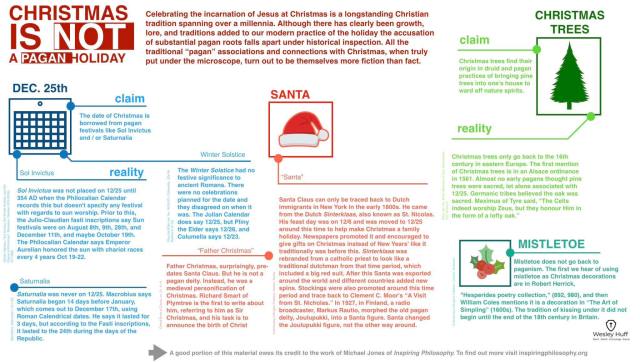
If you’re a Christian, you might have heard the anti-Christmas rumblings on social media, or maybe even in real life: Christmas has pagan origins…Santa’s elves started out as demons…the Roman winter solstice celebration of Saturnalia morphed into Christmas…Mithras…Krampus…the “naughty list” about the origins of Christmas goes on and on. Are these things true? Should Christians celebrate Christmas?

There’s an old story about a woman who made a ham every year for Christmas dinner. As she was preparing it one year, her daughter asked, “Mom, why do you cut off the end of the ham before you put it in the oven?” The woman answered, “That’s the way my mom taught me to do it.” The woman thought about her daughter’s question all day long, and finally decided to call her own mother to ask about it. When the woman got her mother on the phone, she asked, “Mom, why did you teach me to cut off the end of the ham before putting it in the oven?” The woman’s mother said, “That’s the way my mom taught me to do it.” Intrigued, the woman called her grandmother and asked once again, “Grandma, why did you cut off the end of the ham before putting it in the oven?”. Her grandmother replied, “Because I didn’t have a roasting pan large enough for a whole ham.”

Human beings are creatures of habit and tradition, so it’s always important to examine why we do the things we do. As Christians, whether it’s putting up a tree every year, a beloved hymn we’ve been singing since we could talk, or the annual church picnic, our brains should never be on autopilot, unquestioningly taking part in activities by rote.

Do some aspects of the celebration of Christmas find their origin in millennia-old paganism? Possibly. But are you participating in that paganism if you put up a tree or give gifts at Christmas? Probably not. The “Christmas is pagan” lore is so ancient and uncertain that most people aren’t even aware of it. How could you possibly be participating in paganism if you’re not even aware of its existence, you have no intention of participating in it, and it has nothing to do with your reasons for celebrating?

Did you know that many of our days of the week and months of the year were originally named for pagan idols and gods? “Sun”day was originally a pagan Roman holiday, and the sun was an object of worship for many ancient peoples. Should we stop having church on Sunday because of that? Are we somehow participating in paganism by holding the Christian day of worship on an ancient pagan feast day? Of course not. Ancient pagans don’t own certain days on the calendar or any particular object or symbol. The Bible tells us, “The earth is the Lord‘s and the fullness thereof.” When godless people take a day or an object God has created and use it for evil, they are the ones in the wrong, not godly people who come after them and want to use that same day or object for a godly purpose. To say that Christians can’t use a certain day or object for celebrating Christmas because pagans used that day or object for pagan purposes is to give those ancient pagans power over Christians. Power they have no business holding.

To say that Christians can’t use a certain day or object for celebrating Christmas because pagans used that day or object for pagan purposes is to give those ancient pagans power over Christians. Power they have no business holding.

Furthermore, just because pagans used a day, an object, or a symbol for their wicked practices hundreds or thousands of years ago does not mean those days, objects, or symbols carry the same meaning today. Think about the way a mere word can change meanings in such a short time. The 1890’s were known as the “Gay Nineties.” The song, “Deck the Halls” contains the phrase “don we now our gay apparel.” The primary meaning of the word “gay” – just 100-150 years ago in our own country – was “happy, merry, or festive.” Now it means “homosexual.” But the “Christmas is pagan” folks would have us believe we’re supposed to attach centuries old definitions and foreign cultural practices surrounding Christmas and other winter observances to our 21st century American celebrations? Santa may have had demon elves hundreds of years ago in another country and culture, but in our culture today, they’re just his happy little helpers – no demonic strings attached. The meanings of cultural practices and symbols change over time.

And if anyone should understand that, it ought to be Christians. We took the cross – “the emblem of suffering and shame” to everyone in the known world at the time of its use – and turned it into a symbol of victory and triumph. The Romans wanted people to look at the cross and think, “criminal.” Today we look at the cross and think “Christ.” They wanted the cross to evoke fear. To us it means freedom. The cross used to mean humiliation. Now it reminds us to honor our glorious Savior.

The Romans wanted people to look at the cross and think, “criminal.” Today we look at the cross and think “Christ.”

Certainly, there’s no biblical requirement for Christians to observe Christmas in any way, so anyone who doesn’t want to observe the holiday doesn’t have to. Conversely, there’s nothing in the Bible that says we can’t celebrate Christmas, so Christians are free to do so as long as we aren’t violating any of the clear commands and principles of Scripture. But whatever conclusion we come to, it’s crucial that we base everything we do on God’s Word correctly applied to our actions and motivations, not supposed connections between Christmas and paganism. There are probably dozens of objects in our homes, traditions we observe, and days on the calendar that can, if we go back far enough and look hard enough, be traced back to one pagan religion or another. Don’t be ruled by that. Christians are ruled by God’s Word, not fears and superstitions.

Christians are ruled by God’s Word, not fears and superstitions.

So let’s be sure we take some time to examine our Christmastime traditions. Why do we put up a Christmas tree every year? What do we tell our children about Santa Claus? What do the words of those Christmas carols mean? Are we doing anything that conflicts with Scripture? If so, it’s incumbent upon us to stop, repent, and make sure “whether [we] eat or drink, or whatever [we] do, do all to the glory of God.” Because it’s not about what pagans did centuries ago a world away, it’s about what we’re doing today, why we’re doing it, and whether or not it glorifies God.

It’s not about what pagans did centuries ago a world away, it’s about what we’re doing today, why we’re doing it, and whether or not it glorifies God.

Scriptures to Consider:

Romans 14

1 Corinthians 10:23-33

Colossians 2:16-23

Additional Resources:

Should Christians Celebrate Christmas at Truth Be Known Podcast

No, Christmas is NOT PAGAN with Keith Foskey

Photo credit: Keith Foskey

Is Christmas Sinful to Celebrate? by Chris Rosebrough

Myths on the Myths of Santa Claus at When We Understand the Text

Other Christmas Myths at When We Understand the Text

Christmas at Got Questions

The Bible reveals Xmas day on the 25th-not from paganism by Agustin Astacio

Christmas Is Not Pagan at Christian Answers for the New Age

Christmas, Mailbag

The Mailbag: What should we tell our kids (and grandkids) about Santa Claus?

Originally published December 4, 2017

Merry Christmas! Starting today, we’re back to Monday through Friday blog articles for the holidays!

As Christian parents, is it OK for us to tell our children about Santa Claus?

As Christian parents, is it OK for us to tell our children about Santa Claus?

Christmastime can be so much fun when you have children. Many of us remember the excitement of Santa, the Christmas tree, and presents from our own childhood. They’re happy memories, and we want to recreate those for our children.

But as Christian parents, our first priority isn’t fun, it’s obedience to Scripture. Yet, is there a way to make Christmas merry for our children while still upholding God’s Word? Is Santa patently unbiblical?

No, he doesn’t have to be, as long as he keeps his sleigh parked inside the parameters of Scripture. Let’s take a look at some of the ways Santa can be unscripturally naughty, and how godly parents can keep him nice and biblical.

Santa Claus isn’t real. If you tell your children he is, or that he is the one who brings their presents, or that he knows whether they’ve been naughty or nice, you’re lying. The Bible says that lying is a sin, period. Thereโ€™s no exception for jolly old elves who pass out toys (or for tooth fairies or Easter bunnies, either, for that matter). And not only is lying a sin, it is extraordinarily hypocritical to lie to your children about Santa Claus and then turn around later and punish them when they lie about something. Lying to your children about Santa Claus teaches them that it’s OK to lie (i.e. sin) when you want to or when it would be to your advantage.

The Bible says that lying is a sin, period. Thereโ€™s no exception for jolly old elves who pass out toys (or for tooth fairies or Easter bunnies, either, for that matter).

Don’t lie to your children about Santa Claus. Tell them the truth: he’s a fun, fictional character that we can enjoy reading stories and singing songs about, just like Goldilocks or Superman or Old MacDonald. As for the presents, maybe you’d like to handle it similarly to the way my husband and I did with our children. When they were very small, my husband or I would don a Santa hat on Christmas Eve and say something like: โ€œYou know how you like to play pretend? Well, mommies and daddies like to play pretend, too, especially at Christmas! Now itโ€™s time for you to go to bed so we can pretend to be Santa Claus.โ€

Santa Claus isn’t omniscient. 

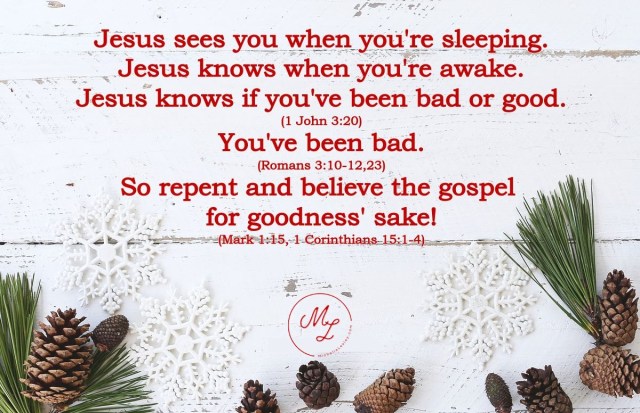
He sees you when you’re sleeping
He knows when you’re awake
He knows if you’ve been bad or good
So be good, for goodness’ sake!ยน

Uh uh. No way. Omniscience is an incommunicable attribute of God. He is the only One who has the power to see and know all things, and it is an insult and an affront to Him to even suggest that a mere mortal – let alone a fictional character – has the same power and knowledge that He has. In reverence and awe for God’s preeminence, we should never ascribe to others the things that belong to God alone.

Teach your children about the attributes of God. When you read your children stories about Santa Claus or hear Santa Claus Is Comin’ to Town on the radio, it’s a perfect opportunity to teach them about God’s omniscience and power. “Did y’all just hear that? That song said Santa Claus can see you and knows how you’re behaving. Is that true? Who is the only One who always sees you, cares for you, and knows what you’re doing and thinking? Can anybody else besides God do that?”

Santa Claus teaches works righteousness. In St. Nick’s economy, good behavior earns a reward (presents). Bad behavior earns punishment (coal). If you’ve ever shared the gospel with anybody, that will probably sound familiar. Most lost people think that’s what Christianity is. If you’re a “good person” God is happy with you and you’ll go to Heaven. Hell is the punishment for “bad people”: Hitler, murderers, and rapists. This is not what the Bible teaches, either about salvation, or about why children should obey their parents.

Teach your children the gospel. Again, this whole “naughty or nice” part of the Santa Claus narrative is a perfect gospel-teaching opportunity. Take advantage of it! Ask your child to be “nice” for one whole day. At bed time, take a few minutes to talk about the times she messed up and was “naughty” when she was supposed to be trying to be “nice.” Nobody can be nice and obedient all the time, no matter how hard we try. We are all naughty – sinners with coal black hearts deserving the punishment of Hell. Jesus came and lived a life of perfect “niceness” (obedience), died on the cross to take the punishment for our naughtiness, was buried, and rose again. He did that, not because we earned it with good behavior, but because of His mercy and grace. And then He gave us the greatest gift ever. A gift we naughty people don’t deserve: salvation and eternal life in Heaven. And it is because of our love and gratitude to Christ for saving us that we obey Him, not so that He will give us what we want. Indeed, the Bible tells us that the more obedient to Christ we are, the more persecution we will face.

Santa Claus doesn’t automatically have to be on the Christian parent’s naughty list. There are lots of ways to enjoy the fun of Santa and even turn him into an opportunity to teach your child biblical truth, all while being obedient to Scripture. But if Santa makes you biblically uncomfortable in some way, then by all means, don’t go against your conscience. Whichever way you decide – after prayer, study of the Scriptures, and discussing it with your spouse – do not judge other Christian parents by your personal convictions about Santa Claus.

Any advice for grandparents about Santa? Our son wants our grandchildren to believe in Santa. How do we respond to a grandchild who asks of the reality of Santa? I will not lie, but I want to keep peace with my son.

Thank you for being a godly grandma!

I think the solution to this dilemma is going to start with being a godly mom. Is your son a Believer? If so, you might want to show him all of the information above and talk to him about any Scriptures he’s violating. Let’s pray that will be convicting to him and he’ll decide to handle Santa in a godly way with your grandchildren.

But if he’s not convinced, or if he’s not a Believer, talk to him about your convictions about not lying to his children. Explain the difficult position he’s putting you in. He’s essentially asking you to choose between pleasing him by sinning (lying) or pleasing God by not sinning.

If he still won’t relent, the only solution I can see that keeps you from sinning yet doesn’t go against your son’s wishes is to put it back on him. When your grandchild comes to you and asks, “Grandma, is Santa Claus real?” you reply, “That’s a great question, but I think you should ask your mom and dad about that. How about some hot chocolate?”.

Your son made this bed. You shouldn’t have to lie in it.

Additional Resources:

Santa Pause with Justin Peters at A Word Fitly Spoken


ยนSanta Claus Is Comin’ to Town. John Frederick Coots and Haven Gillespie, 1934.

If you have a question about: a Bible passage, an aspect of theology, a current issue in Christianity, or how to biblically handle a family, life, or church situation, comment below (Iโ€™ll hold all questions in queue {unpublished} for a future edition of The Mailbag) or send me an e-mail or private message. If your question is chosen for publication, your anonymity will be protected.