
Mailbag

The Mailbag: Potpourri (Narnia, Michelsen, Faith healing…)


Todayโ€™s edition ofย The Mailbagย is a tad different in format. Usually, I answer one readerโ€™s question in a long form article. Today, Iโ€™m addressing various questions from several readers in a โ€œshort answerโ€ format.

Just a reminder- I changed my comments/e-mail/messages policy a few months ago, so Iโ€™m not responding individually to most e-mails and messages. Here are some helpful hintsย for getting your questions answered more quickly. Remember, the search bar can be a helpful tool!


Why are witchcraft and magic OK to most Christians in C.S. Lewis’sย The Chronicles of Narnia books, but not in secular books such as the Harry Potter books? Should my children be reading the Narnia books?

Obviously, I can’t answer for every individual Christian who finds Narnia OK but Harry Potter objectionable. Many perfectly godly Christians find both objectionable or neither objectionable. But generally, I think it’s the same reason most Christians assume Beth Moore, Andy Stanley, Lysa TerKeurst, Christine Caine, Hillsong, etc., are biblically legit-ย most Christians aren’t very discerning. They naรฏvely trust that if a person has gained notoriety as a “Christian” celebrity and his stuff is sold in Christian bookstores, he’s teaching sound biblical doctrine.

I’m not saying that Lewis teachesย unbiblical doctrine in the Narnia books (none sticks in my memory, but it’s been at least 8-10 years since I read them) I’m just saying if you put a Narnia book and a Harry Potter book side by side on the table in front of the average Christian she’s going to say, “Narnia- good. Harry Potter- bad.” and that’s going to be the extent of her thought process because she knows Lewis is a famous evangelical and J.K. Rowling is not.

Witchcraft and the occult are not things to be taken lightly. You should also know that there is credible evidence that C.S. Lewis held some very unbiblical beliefs, some of which, if true, would put him outside the camp of Christianity (particularly his rejection of penal substitutionary atonement). With regard to whether or not your children should read the Narnia books, my counsel would be to study what the Bible has to say about witchcraft, the occult, and the things Christians should focus their thoughts on, examine the books for yourself, pray for wisdom, and make what you determine to be the most God-honoring decision for your family. You may wish to get some guidance from your pastor or a mature Christian friend, too.


What are your thoughts on Johanna Michaelsen?

In the last “potpourri” edition ofย The Mailbagย I said I had heard Johanna Michaelsen’s name but didn’t really know anything about her. Since that time a couple more people have asked me about her and I’ve found out a tad more about her (It’s not that there’s no information available, just that I haven’t had time to research her much.).

Johanna is recommended by my friend Amy Spreeman of Berean Research. Amy also serves on Johanna’s ministry advisory board. So it sounds like Johanna is someone worth looking into as a trustworthy resource. However, as Amy and Johanna (assuming she is like-minded) would probably agree, youย cannot simply trust someone else’s endorsement. You must do the work of a goodย Berean and examine everything you take in against Scripture to discover whether it is doctrinally sound. I’m hoping you’ll find Johanna easily passes that test.

Not sure where to start? My article Is She a False Teacher? 7 Steps to Figuring It Out on Your Own may help.


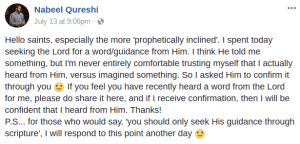
How do you reconcile passages such as Luke 2:22-35 (Simeon awaiting Jesus at the temple) with the principle that God only speaks to us through Scripture?

I would classify it in the same Hebrews 1:1-2 category as God speaking to Moses through the burning bush, or Ezekiel’s vision of the dry bones, or Jeremiah’s prophecy at the potter’s house. God spoke to Simeon in the same Old Testament sense as any of the other Old Testament prophets He spoke to before Jesus came. (In fact, you might even say John the Baptist, who came after Simeon, was the last “Old Testament” prophet.)

It’s a little confusing to us because weย read about Simeon in the New Testament after the intertestamental period, and after Jesus had actually been born, but at the time he spoke these words, he was effectivelyย living in “Old Testament times.” (Which is why we also see in this passage that the reason Simeon encountered Jesus is that Mary and Joseph were presenting Him at the temple to “fulfill the law of Moses.”) Jesus had not yet fulfilled His earthly mission of living a sinless life, teaching, preaching and miracles, founding the church, dying on the cross, resurrecting from the grave, and ascending into Heaven. Until those things were accomplished, Simeon, Jesus, and all of the other Jews living at that time were still under the Mosaic (Old Testament) Covenant.

You might find my article Basic Training: The Bible is Sufficientย to be helpful.


Do you believe that supernatural healing still occurs today?

Yes. I believe that God can heal miraculously, through doctors and medicine, and through the way He designed the body to heal itself when ill or injured.

What I do not believe in is “faith healing” as it is commonly understood and practiced today. I’ve never encountered a person who teaches and practices faith healing who also adheres to sound biblical doctrine, and I’ve never encountered a person who adheres to sound biblical doctrine who teaches and practices faith healing.

If what you’re really asking is whether I’m a continuationist or a cessationist, I’m a cessationist.


What are your thoughts on Francis Chan?

When Francis Chan first became popular, he had a reputation for being a doctrinally sound Reformed pastor and author. I never read any of his books or followed him closely, but I have godly friends who did.

In 2013 Francis spoke at International House of Prayer’s (IHOP)ย One Thing conference where he praised Mike Bickle, embraced him as a Christian brother, and tacitly accused discerning Christians who had wisely, and biblically, discouraged him from participating in the conference of dissension and division.

If you are unaware of the theological problems with IHOP, you should know that it (along with Bethel Church in Redding, California) is basically ground zero for the heretical New Apostolic Reformation movement. Chan spoke atย One Thing again in 2015,ย demonstratingย a shocking lack of awareness of the unbiblical theology of Catholicism, and called for evangelical unity with Catholics saying, “And I think itโ€™s time for us to get beyond, okay, Iโ€™ll sing with them, okay, Iโ€™ll worship with them, yโ€™know, okay, Iโ€™ll admit that theyโ€™re Christians, and go to a biblical stance which says I canโ€™t live without them. I need them. Theyโ€™re indispensable.โ€

I don’t know whether or not Chan’s early books and materials were doctrinally sound, but I would definitely not recommend him now. Someone who is a pastor has no excuse for being so undiscerning and ignorant of errant theology.


I am wondering if a Christian believes in speaking in tongues is for today would you recommend that people shouldnโ€™t follow them just as you have recommended people not follow other people for different reasons?

I don’t usually proactively recommend – share their articles, quotes, etc. on social media or the blog, suggest people attend their churches or conferences, read their books, and so forth – continuationists who are otherwise doctrinally sound, but I don’t warn against them either. I just tend to be silent about them.

There are many false teachers I do warn against, and most of them are continuationists, but continuationism is not the central reason I warn against them. When I warn against a teacher, it is because he or she is teaching demonstrably false doctrine and/or walking in unrepentant sin.

My articleย Is She a False Teacher? 7 Steps to Figuring It Out on Your Ownย explains the criteria I use when deciding whether or not to recommend a particular teacher.


If you have a question about: a Bible passage, an aspect of theology, a current issue in Christianity, or how to biblically handle a family, life, or church situation, comment below (Iโ€™ll hold all questions in queue {unpublished} for a future edition of The Mailbag) or send me an e-mail or private message. If your question is chosen for publication, your anonymity will be protected.


Mailbag

The Mailbag: Did Jesus Really Teach Karen Ehman’s 3 Step Life Plan?

ย Have you read Karen Ehman’s new book? She takes Matthew 22:36-40 and says this:

Jesus asserts that the entire teaching of God-all the law and the prophets – hinge upon these commands which can be summed up in this 3 step life plan:
1. Love God
2. Love others
3. Love yourself

Is this a biblical way of looking at this passage?

It’s great that you’re being a good Berean and examining this teaching (as we should with all teaching) “to see if these things [are] so.”

I’ve never heard of Karen Ehman before and haven’t read any of her books. The quote above is a very brief excerpt and – in the same way we don’t rip Bible verses out of context and try to interpret them – I’m hesitant to try to extract deep meaning from it without a broader grasp of what she’s trying to teach (i.e. more context), so I’ll be limiting myself to the quote you’ve sent and not trying to speculate on her theology in general.

However, there are a few problems with the quote itself that could be as minor as sloppy wording that needs cleaning up or as major as false doctrine. Without more context I just can’t tell.

1. To say that “the entire teaching of God” equals “all the law and the prophets” isn’t too problematic if you’re a first century Jew, but it’s going to be confusing to the 21st century reader. At the moment in history when Jesus spoke this passage, all the law and the prophets was the entire written teaching of God. But remember, Jesus, at this point in Matthew, is nearing the end of His earthly ministry. He has been teaching for about three years, so that’s three years’ worth of God’s teaching that hasn’t been written down yet- the gospels.

And what was Jesus teaching during those three years- keep the commandments? No. He was introducing the new covenant: โ€œThe time is fulfilled, and the kingdom of God is at hand; repent and believe in the gospel.โ€ (Mark 1:15) If you’re going to use a phrase like “the entire teaching of God” for New Testament Christians, you really need to be talking about Christ and the gospel, which will include all of the New Testament as well as the Old. Jesus did not teach a three step life plan of commandment-keeping, He taught that all of the Old Testament points to, and is fulfilled in, Christ and the gospel.

2. As I mentioned, context is indispensible when it comes to understanding Scripture. I don’t know if this quote was lifted out of a chapter in which Karen is exegeting the entirety of Matthew 22 (in which case the quote wouldn’t be completely inaccurate) or if she is making her own point about Christians following this “three step life plan” and flying in verses 36-40 to try to support it. If it’s the latter, she has taken these verses out of context and incorrectly interpreted and applied them.

If you back up and read 21:45-22:46, looking particularly at 21:45, 22:15, 18, 23, 34-35, 41, 46, it’s easy to see that most of the things Jesus is saying here are in direct response to (or at least within earshot of) the scribes, Pharisees, and Sadducees, who are asking Him questions- not because they’re genuinely trying to learn and looking for a life plan to follow, but because they’re trying to trap Him and find some grounds for discrediting or arresting Him. If Karen had at least included verses 34-35 in her quote (and she may have addressed these verses outside of this quote, I just don’t know), this would have been much clearer.

Jesus is not saying – either to the Pharisees He was talking to then or to us now – “Here are the three guidelines by which I want you to live your life.” They’re asking Him a question on a point of Old Testament law and He’s answering them according to Old Testament law. They weren’t sincerely asking Jesus how He wanted them to live, and He knew that. And that’s probably the reason He answered briefly and didn’t continue teaching them. He knew they weren’t interested in believing in and following Him- they were out to get Him. Why give what is holy to dogs or cast His pearls before swine, right?

3. We need to understand that the commands Jesus refers to in this passage are just that: commands. Old Testament law. Christians are neither saved nor do we grow in Christ (sanctification) by striving to keep Old Testament law. Galatians 3 is very clear about this:

O foolish Galatians! Who has bewitched you? It was before your eyes that Jesus Christ was publicly portrayed as crucified. 2 Let me ask you only this: Did you receive the Spirit by works of the law or by hearing with faith? 3 Are you so foolish? Having begun by the Spirit, are you now being perfected by the flesh?

As Christians our singular focus is to love Christ. That’s the engine that pulls the train. Obedience to commands, growth in holiness, evangelism, fruit, faith, knowledge of God’s word, all of those things are the train cars that follow, and are propelled by, the engine. When we make obeying commands (especially Old Testament commands) our primary focus, we’ve got things backwards. The caboose is trying to pull the engine. Christians are led by the gospel, not Old Testament commands.

4. The most glaring problem with this quote, and one that no additional context can justify, is number 3: “Love yourself.” You will search long and hard, and you will not find a single verse of Scripture that tells us to love ourselves. This passage of Matthew doesn’t teach that, nor does any other book of the Bible.

Want to know why?

Because man’s entire problem – the essence of what separates us from God – is that we already love ourselves too much. And the solution to that problem is to stop loving ourselves, die to self, kick self off the throne, and love Jesus supremely instead.

But understand this, that in the last days there will come times of difficulty. 2 For people will be lovers of self, lovers of money, proud, arrogant, abusive, disobedient to their parents, ungrateful, unholy, 3 heartless, unappeasable, slanderous, without self-control, brutal, not loving good, 4 treacherous, reckless, swollen with conceit, lovers of pleasure rather than lovers of God, 5 having the appearance of godliness, but denying its power. Avoid such people. 6 For among them are those who creep into households and capture weak women, burdened with sins and led astray by various passions, 7 always learning and never able to arrive at a knowledge of the truth. 8 Just as Jannes and Jambres opposed Moses, so these men also oppose the truth, men corrupted in mind and disqualified regarding the faith.
2 Timothy 3:1-8

Lots of people look at “love your neighbor as yourself” and think it means, “You can’t love your neighbor unless you first know how to love yourself.” Uh uh. That’s not what that verse means, and it’s a very self-centered, rather than Christ-centered, way to read it. Jesus – who knows the hearts of men, who said that those hearts are wicked and deceitful – would never tell us we need to love ourselves more. His point was that we are by nature already so self-centered, self-focused, and selfish that we need to put self aside and love and prioritize others that much instead.

Do nothing from selfish ambition or conceit, but in humility count others more significant than yourselves. Let each of you look not only to his own interests, but also to the interests of others.
Philippians 2:3-4

And he said to all, โ€œIf anyone would come after me, let him deny himself and take up his cross daily and follow me.
Luke 9:23

“Love yourself” is the antithesis of the gospel.


As I said, this is a very brief quote, and I haven’t read the book, so I’m hoping what Karen is saying here is just an innocent vocabulary fumble or that, perhaps, I’ve misunderstood her point due to lack of context.

However, once I finished writing my answer, I did a quick Google search in hopes of finding out more about Karen and gaining some insight as to where she’s coming from. Unfortunately, I found out that Karen works for Proverbs 31 Ministries as a speaker, “the Speaker Track Director of the Proverbs 31 She Speaks Conference and a teaching staff member of their writers’ training site COMPEL.”

As you may already know, Proverbs 31 is the ministry of Lysa TerKeurst who is a false teacherยน. Because Scripture tells us that we’re not to partner with false teachers, because partnering with a false teacher demonstrates a lack of discernment and either disobedience to, or a failure to understand, Scripture, and because of what, at best, seems to be a misunderstanding of Scripture in the quote cited here, I would recommend that you not follow or receive teaching from Karen Ehman.


ยนIf you are considering commenting or sending me an e-mail objecting to the fact that I warn against false teachers, please click here and read this article first. Your objection is most likely answered here. I wonโ€™t be publishing comments or answering emails that are answered by this article.


If you have a question about: a Bible passage, an aspect of theology, a current issue in Christianity, or how to biblically handle a family, life, or church situation, comment below (Iโ€™ll hold all questions in queue {unpublished} for a future edition of The Mailbag) or send me an e-mail or private message. If your question is chosen for publication, your anonymity will be protected.

Mailbag

The Mailbag: Remarriage After Salvation

Prior to getting saved, I had married and then divorced. Once I became a Christian, I married my second husband. God has blessed us with children and we have been married nearly twenty years. What is your take on a second marriage when your first is before becoming a Christian?

Whew, this is a tough question! It’s a really good one to ask, too, because the simple act of wondering about it indicates a desire to be obedient to God and an understanding that, in most cases, divorce is a sin- one that God takes just as seriously as other sins. And I think we forget that sometimes because divorce has become so prevalent in our culture and, sadly, even the church.

The reason this is a tough question is that there’s no particular Bible verse that specifically says, “Yes, it’s OK for you to marry again if your divorce was prior to your salvation,” or “No, it’s not OK.” So, we have to glean what we can from the Scriptures we have.

There are two main topics we need to examine here: what the Bible says about divorce and what the Bible says about salvation. We need to work backwards a little bit, so let’s start with divorce.

It is helpful to start off by reading what Scripture says about marriage and divorce. The central passages are Genesis 2:18-25, Malachi 2:13-16, Matthew 5:31-32, Matthew 19:3-9, and 1 Corinthians 7:10-16. The Bible specifically cites twoยน biblically allowable grounds for divorce in the New Testament: adultery and abandonment by an unsaved spouse.

God does not require divorce in these situations. Indeed, as far as it depends on the Christian spouse who has been sinned against, and is possible, forgiveness and reconciliation – especially in light of how much Christ has forgiven us and reconciled us to Himself – should be the goal. I personally know of marriages that survived these situations and have brought much glory to God and hope to other couples as a result. Yes, it’s excruciatingly hard. No, it’s not fair. It was hard and unfair for Jesus to go to the cross for our sin, too, but He was willing because of His love for us and for the Father.

Seeking a divorce for reasonsยน other than these two – such as irreconcilable differences, “falling out of love,” etc. – are not allowed by Scripture for Christians.

But our sister asking the question wasn’t a Christian when she got divorced. How does that factor in?

Here, we need to recall the nature of salvation- the foundational differences between a lost person and a saved person. First Corinthians 2:12-14, John 14:23-24, Hebrews 11:6, and Romans 3:9-20 help us understand that – while a lost person might sometimes be able to outwardly behave in a way which appears to comply with Scripture – that’s not obedience to God. Obedience is an action of the heart that is made possible only by the transformation and indwelling of the Holy Spirit. Only saved people are transformed and indwelt by the Holy Spirit, which means only saved people can obey God and His word. So, not to over-simplify, but, basically, everything lost people do is sin because they are in a spiritual state (devoid of the Holy Spirit) that renders them unable to be obedient to God. This means that our reader’s divorce was sinful – regardless of whether or not it was for one of the two biblical reasons – because all of her behavior prior to salvation – divorce, driving a car, giving money to charity, eating breakfast – sprang from a heart that belonged to her father, the Devil.

(I know that’s pretty heavy, so if you’re not grasping it, or find yourself in disagreement, I’d encourage you to go back and read over the Scriptures I’ve hyperlinked above.)

But when someone repents and trusts Christ as Savior, all of that sin gets wiped out instantaneously. The old has gone, 2 Corinthians 5:17 tells us. Salvation is more than just new life, it’s also a death. It’s a death to sin. Death to the old man, the old desires, the old ways, the old thoughts. That whole sinful ball of wax gets crucified – nailed to the tree – with Christ, and dies. Including that divorce.

And when Christ resurrects us from that death, we are born into a new life. Baptism is a beautiful, visible picture of this invisible spiritual truth: we are buried with Christ in baptism and raised to walk with Him in newness of life. The old has gone. The new has come. A new life. A clean slate. Life has just started for this sister. There is no biblical reason she should not have married a godly husband.

In closing, there are a few things that don’t pertain to this particular reader’s question (since her divorce, salvation, and remarriage are already a done deal), but which might be pertinent to others in similar situations.

1. This reader did not ask whether or not she should leave her second husband (nor does she want to- she is happily married). She already knows that would be wrong, and she’s correct about that. We don’t fix one sin by committing another.

2. If this reader had asked me this question prior to marrying her second husband. I would have urged her to first explore the possibility – depending on the circumstancesยน and with intense pastoral counseling – of reconciliation with her first husband. That is what 1 Corinthians 7:10-16 is all about.

3. Marriage is a huge thing. Divorce is a huge thing. Remarriage is a huge thing. Whatever your particular situation might be, search the Scriptures about it, ask God for wisdom and direction, and get wise counsel from your pastor.

4. This was a challenging question to answer. I’d like to thank my husband and two of my pastor buddies for their help. Thanks, guys. Y’all are awesome!


ยนPhysical and sexual abuse within marriage is a serious issue, but it was not a factor in this particular reader’s question, so I am keeping the scope narrow and not addressing the issue of abuse in this article. If you are being abused, please get yourself and your children to safety and seek help. If you know someone who is being abused, help her.

If you have a question about: a Bible passage, an aspect of theology, a current issue in Christianity, or how to biblically handle a family, life, or church situation, comment below (Iโ€™ll hold all questions in queue {unpublished} for a future edition of The Mailbag) or send me an e-mail or private message. If your question is chosen for publication, your anonymity will be protected.
Mailbag

The Mailbag: Should Christians Participate in Boycotts?

Originally published September 19, 2014

Should Christians boycott businesses or charities that financially support abortion, homosexual marriage, or other unbiblical things?

This question has gotten a lot of attention lately because of the ice bucket challenge and the ALS charity that funds embryonic stem cell research. I think whether or not to boycott a business or charity is something every Christian needs to decide for herself based on Scripture and her own conscience. Some good Scriptures to study to help with your decision are 1 Corinthians 8 and 10:23ff, and Romans 14:5-12.

Since there’s no one right answer to this question, I’d like to just share with you how I have come to handle it in my life, in case it might be helpful.

I used to do boycotts (I was on an e-mail list that was basically a constant call to boycott this or that business), but it got to the point where there were so many companies and subsidiaries of those companies that donate here and there to unacceptable causes that it was impossible to track all of them down and keep up with them all. Since I would have felt like a hypocrite for boycotting one company but not another, I amended my “policy” on boycotting:

1. I don’t boycott places where I get necessities for my family–phone company, grocery stores, gas stations, etc. If there were a very big public splash about one of these places supporting something unacceptable and I had another option, I might reconsider a boycott.

2. If there’s an alternative to a “boycottable” business, I take it. For example, I would not donate to Komen because they support Planned Parenthood, but I might donate to another cancer/breast cancer charity that doesn’t.

3. If it’s not a necessity and there’s no alternative, I probably wouldn’t donate/buy/shop there. For example, within the last 5 years, Starbucks has, among other very publicized pro-homosexuality actions, filed a brief against DOMA (the Defense of Marriage Act) and worked to support legislation in Washington state to legalize same sex “marriage.” Starbucks isn’t a necessity, and if there weren’t an alternative coffee place in my area, I would just do without. (Full disclosure- Starbucks is expensive and several miles from my house. My coffee maker is cheap and only several yards from my bed. So, I don’t go to Starbucks, but it’s because I’m broke and lazy, not because I’m boycotting.)

My way isn’t the perfect way, and there’s probably still some hypocrisy in it that I can’t see or reconcile, but it works for me.

For further reading:
Should Christians boycott companies that support anti-Christian policies? from Got Questions
Should Christians Boycott Boycotting? from The Gospel Coalition

Do you boycott any businesses for certain reasons?
How did you arrive at your decision to boycott?

Mailbag

The Mailbag: How do I move on after God says “no”?

I loved your article, When God Says “No”. I have a question though: At what point do you move on from the hope or desire? Iโ€™m a single mother and feel that I will always have a natural desire for a spouse and I will always desire that for my young children, but the Lord has not provided this for me. At what point do you stop asking for the thing, weep deeply over the life you hoped would be, and move forward?

A dear reader asked this in the comments section of my article When God Says No, and I wanted to share my answer to her here on The Mailbag, because I think it’s something a lot of us struggle with.

When God seems to be saying no to a desire, I think thereโ€™s a sense in which moving forward is something you do over and over again every day until or unless God takes that desire away. Taking life โ€œone day at a timeโ€ sounds clichรฉ, but if youโ€™ll look at the way Jesus teaches, thatโ€™s very much the mindset He wants us to have.

In the Lordโ€™s Prayer, Jesus instructs us to ask for daily bread. This is an echo of the manna God provided in the wilderness on a daily basis. Later in the Sermon on the Mount, Jesus teaches us not to be anxious for the things we donโ€™t have and not to worry about the future. โ€œTherefore do not be anxious about tomorrow, for tomorrow will be anxious for itself. Sufficient for the day is its own trouble.โ€ He says.

Those passages are hard for me because Iโ€™m a planner, and I donโ€™t like surprises. I like to have everything mapped out and know in advance whatโ€™s going to happen so I can feel secure. But I’ve found that when I’m secure and everything is going well and I don’t really have any problems or unfulfilled desires, I tend to pray less. Depend on God less. Need Him less. And God knows that, more than anything we might desire, what we really need is to need Him. So God does the “daily” thing. God likes for us to get up every day and depend on Him for that day.

So I think what you โ€“ what all of us โ€“ need to do is get up tomorrow morning, spend time with the Lord, and ask Him to help us honor and glorify Him through our words, actions, decisions, etc., that day. Then, we get up the next day and the next and the next, and do the same thing. We put our hope in the Lord Himself, not in what He might or might not do in our lives, and we simply seek to walk with Him and be obedient to Him day by day.

If it would be something that would help you – sort of a โ€œmemorial stoneโ€ type of thing – you can set aside some time, maybe even in a special place, to hash everything out with the Lord about your situation. Pour out your heart to Him in prayer, cry, repent of anything you might need to repent of, study some applicable Scripture, commit your heart to trust Him, and, as the old gospel song says, โ€œtake your burden to the Lord and leave it there.โ€ In the future, if you start feeling sad or frustrated with God about not having a husband, you can look back on that time as a reminder that you committed to trust God and leave this issue with Him.

Finally, (and I know this might sound silly, but I have to remind myself of this all the time) remember that Godโ€™s provision isnโ€™t dependent on our prayers. He truly does know what we need before we ask. In other words, you could stop praying for a husband right this minute and never pray about it again and God is not going to forget that thatโ€™s what you want, or move it to a lower priority level on His prayer-answering list, or punish you by denying you a husband simply because you stopped praying about it. There are things God blesses us with that weโ€™ve never spent a moment praying for. There are things we stop praying for that God finally gives us years later. And there are things we pray constantly for that God says โ€œnoโ€ about. God is going to do what is best for you and what brings Him the most glory, and that doesnโ€™t hinge on whether you pray about that specific thing every day or not. The purpose of prayer is not to get God to do what we want Him to do. The purpose of prayer is to get us on the same page Heโ€™s on- so that we want what He wants.

It can be really difficult and sad when God doesn’t grant our desires, especially when we know they don’t conflict with Scripture, but the blessing is that God can use these circumstances to increase our dependence on Him and conform our desires to His own.


If you have a question about: a Bible passage, an aspect of theology, a current issue in Christianity, or how to biblically handle a family, life, or church situation, comment below (Iโ€™ll hold all questions in queue {unpublished} for a future edition of The Mailbag) or send me an e-mail or private message. If your question is chosen for publication, your anonymity will be protected.