Faith, Gospel, Salvation, Throwback Thursday

Throwback Thursday ~ Risque Business: Or, How an Adult Product Company Provided Some Very Interesting Content for my Blog

Originally Published July 21, 201210900047_932153883492213_7491827866857274193_o

I received a hilarious e-mail today. Was it a video of a cute and bumbling puppy? No. A clever joke or anecdote? No. A funny political cartoon? No.

It was actually a piece of spam from an up and coming …shall we say… “adult” products company.

Normally, I would just roll my eyes that my spam filter didn’t catch it and simultaneously click delete, but due to the fact that there were no pictures in it nor a subject line that would raise a red flag, I didn’t realize what it was until I started reading it.

This company wasn’t trying to sell me one of their products, they wanted me to review one of their products.

On my blog.

Which sent me into hysterical fits of laughter.

The company wants to provide me “with the opportunity to write interesting content for [my] site.” And, “If this project goes smoothly, there are probably other ways we could work together as well.”

Do tell.

No, on second thought, don’t.

Sorry, my friend, I’ve already got the most interesting content on the planet for my site.

I’ve got a God-man who came to earth, lived for three decades without ever committing a single sin in thought, word, or behavior, turned water into wine, healed blind eyes, deaf ears, crippled limbs, and broken minds, fed tens of thousands of people from one plate of food, and spoke the wisest words that have ever been uttered.

And to top that all off, He willingly let His own community butcher him. Why? For billions of rebellious people who hate Him. So that He might set them free and rescue them from an excruciating eternity.

Oh, and then there’s that bit about Him coming back to life.

My reply to the spam e-mail I received was this:

I’m just curious, have you actually read my blog? Take a look and let me know whether you still think it’s a fit for your product: (web address)

I truly hope my e-mail makes it through and is actually read by someone. Because it turns out that “Brian” at the adult product company was right. They did give me the opportunity to write interesting content for my site: the Gospel.

And, Brian, if you want to discuss this interesting content more, get in touch and we’ll chat. I believe you have my e-mail address :0) “If this project goes smoothly, there are probably other ways we could work together as well.”

Faith, Gospel, Salvation, Sin, Throwback Thursday, Tragedy

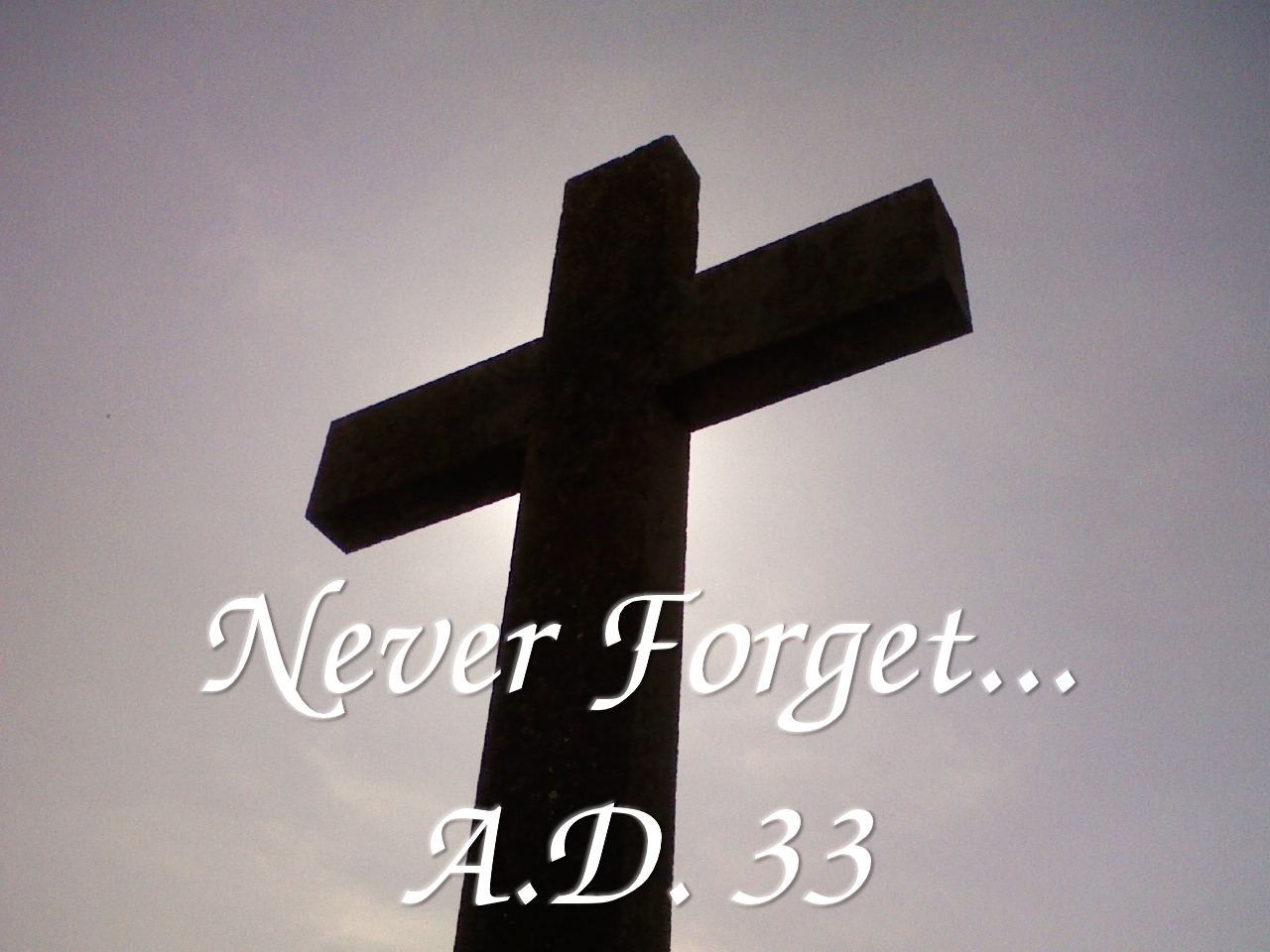
Throwback Thursday ~ Never Forget…

Originally Published September 11, 2013

9-11neverforgetNever forget.

We will remember.

The words jump off the page, off the screen, from our lips. A haunting breath whispering of unspeakable tragedy and heart rending grief.

The terrorist attacks of September 11, 2001 did something to this country. It changed our history. It changed us.

It was a despicable act of cruelty. People innocent of any crime against their executioners were brutally slaughtered in service to a god who demands the death of infidels.

It was egregious. Horrific. Abominable. And we will never forget. Nor should we.

Do this in remembrance of Me.

The words lie quietly on the page, beckoning us back to another day. A day dusty with the passing of centuries. But it changed our history. It changed us.

It was a despicable act of cruelty. Jesus, innocent of any crime, was brutally slaughtered by executioners serving a God who demands the death of infidels.

But this was no infidel. This was no innocent victim dying needlessly and for no one. This was God Himself laying down His life to take the place of the infidel. You. Me. He satisfied His own wrath against us by pouring it out on His Son.

The cross drove a stake into the heart of sin and death that day and shouted across the expanse of creation, “NO MORE.”

It was egregiously beautiful. A horrific triumph. Abominably liberating. And we will never forget. Nor should we.

cross_phixr

Evangelism, Gospel, Old Testament, Sunday School

Watching and Warning with Ezekiel ~ Sunday School Lesson ~ 9-7-14

EzekielThese are my notes from my ladies’ Sunday School class this morning. I’ll be posting the notes from my class here each week. Click here for last week’s lesson.

Through the Bible in 2014 ~ Week 36 ~ Aug. 31- Sep. 6
Ezekiel 16-34
Watching and Warning with Ezekiel

Well, Ezekiel is still prophesying (and he’ll still be prophesying until Saturday :0) God is still sending out the same message through him. Again and again, God chastises His people, trying to shake some sense into them so they will repent and turn back to Him. Not because He wants to exercise judgment on them but so “they will know that I am the Lord.” (That phrase is used 74 times in the book of Ezekiel.) No one could say God was unfair because He didn’t warn them of His coming judgment or that He hadn’t given them enough time or that he hadn’t been clear.

Ezekiel 33:1-16

What’s a Watchman?
As we’ve talked about in the past, large or important cities normally fortified themselves against their enemies by constructing a tall, thick wall (sometimes an inner and an outer wall as we saw with Jericho) around the perimeter. These are great for keeping the enemy out once they get there, but not so great for being able to see whether or not the enemy is coming in the first place. We’re talking low visibility. So they would often build high watchtowers at various intervals around the city wall (sometimes outside the wall in a field or on a hill, but fairly close to the city). A watchman would be stationed in the watchtower, and it was his job to alert the higher ups that the enemy was approaching, a messenger was arriving, etc. To be good at his job, he needed good eyes. He needed to be able to discern a messenger from an enemy. He needed to stay alert and vigilant. He needed to act quickly and decisively. He needed to be able to rapidly and clearly convey an urgent message to the right person at the right time. And if he failed even once in any of these duties, he could likely kiss his life goodbye.

33:1-9- Ezekiel: Israel’s Spiritual Watchman (Matthew 23:37a)

If we’ve learned anything from studying these prophetic books, we’ve learned that being a prophet was not some cushy job. Most of the time, God did not have good news for His people, and most of the time, the people did not want to hear it. Jesus even said,

“O Jerusalem, Jerusalem, the city that kills the prophets and stones those who are sent to it!” (Matt.)

But Israel needed a watchman, and God said, “Ezekiel, you’re it.” (7)

Every time God had a message of warning for the people, Ezekiel was to faithfully proclaim it without delay. He was not to hold back from speaking harsh truths to scary people just because he was afraid. If the person Ezekiel was speaking to chose to reject God’s message, that was on that person’s head (9). But if Ezekiel kept his mouth shut, he was being just like that watchman on the wall who didn’t do his job right, and God would hold him accountable for the death of the intended hearers, who would still die in their sin (8).

33:10- What Was the Warning? (Ezekiel 18:4)
What was the warning? It was the warning to repent before God’s coming judgment. Verse 10 gives us a small glimmer of hope that maybe, just maybe God’s message was getting through to a few people:

“Surely our transgressions and our sins are upon us, and we rot away because of them.”

EXACTLY. Israel’s sin and transgressions are bringing God’s wrath upon her. That is what has caused all this calamity and the continuing sermons of doom from His prophets. As God had already told the people back in chapter 18, “The soul that sins shall die.” (18:4). But the story doesn’t end there.

33:10-16- Good News!
Look at the people’s hopelessness in verse 10:

How then can we live?

Their sin has done them in, and now they’re coming to grips with a horrifying reality: they have transgressed a holy God. They recognize that they deserve any punishment God wants to dole out and that He will be justified in pouring out His wrath upon them. What hope could they possibly have?

They have the hope of a God who is not only perfectly just, but rich in mercy and forgiveness and grace. A God who has “no pleasure in the death of the wicked, but that the wicked turn from his way and live.” (11)

“Turn back, turn back from your evil ways, for why will you die, O house of Israel?” (11) He pleads with them. This God who pleads with them now, and has been for nearly 800 years, is not the cruel, selfish, and vindictive god some portray Him as, but the tender, compassionate Father who will move heaven and earth to keep His children from destroying themselves.

Turn away from your evil ways and turn to My mercy and forgiveness, and you will live, He says. “None of the sins that he has committed shall be remembered against him.”

But remember, it’s your repentance and reliance on my mercy that saves you, God tells them. Don’t think you can get by on your past good deeds. “…if he trusts in his righteousness and does injustice, none of his righteous deeds shall be remembered, but in his injustice that he has done he shall die.”

None of the people are so bad that God won’t save them and none of them are so good that they don’t need God to save them.

Following in Ezekiel’s Footsteps
Although we’re not prophets, God has given us a similar charge to the one he gave Ezekiel. We, too, who have the good news of the gospel are to be spiritual watchmen for all those in our circle of influence. We have God’s word, we know what it says, and He has commissioned us to carry that message to people. Like the watchman, we need to stay alert and vigilant for opportunities to share the gospel. We often need to act quickly and decisively to share the gospel before the moment slips away. We need to be able to clearly convey the urgent message of salvation to the right person at the right time. And we need to take this duty deadly seriously.

What? A Warning?
Sometimes when people present the gospel, they do it by using what salesmen call a “hook,” a promise of what the product will do for the person or how it will make his life better. “Want to go to Heaven when you die?” “Jesus will make your life awesome!” But that’s not our message. Jesus isn’t a product we’re trying to convince people to buy.

Like Ezekiel, our first job is to warn people that they have broken God’s law, and that the penalty for breaking His law is God’s wrath, an eternity in hell. God doesn’t just automatically forgive everybody when they die (that’s a false teaching called Universalism). And, just like Ezekiel told the people, you can’t get by on your own good deeds. The warning always has to come first. People don’t know they need to flee to safety if they don’t know they’re in danger.

Our Good News
But as soon as the person we’re sharing with begins to feel like the Israelites– Surely our transgressions and our sins are upon us, and we rot away because of them. How then can we live? (10) –we have the unbelievable privilege of telling them the beautiful news of God’s mercy and grace for sinners like you and me:

As I live, declares the Lord God, I have no pleasure in the death of the wicked, but that the wicked turn from his way and live; turn back, turn back from your evil ways, for why will you die? (11)

None of the sins that he has committed shall be remembered against him. He has done what is just and right; he shall surely live. (16)

How could we ever keep such wonderful news to ourselves?

Gospel, Old Testament, Salvation, Sin, Sunday School, Types and Shadows

Boldly Approaching the Throne: Shimei ~ Sunday School Lesson ~ 5-25-14

sunday school

These are my notes from my ladies’ Sunday School class this morning. I’ll be posting the notes from my class here each week. Click here for last week’s lesson.

Through the Bible in 2014 ~ Week 21 ~ May 18-24
1 Chronicles 21-22, 2 Samuel 19-24, Psalm 26, 40-42, 57-58, 61-62, 64, 5, 38, 95, 97-99, 30, 108-110
Boldly Approaching the Throne: Shimei

Background:
As we read last week in 2 Samuel 12, while David repented of his sin with Bathsheba and God forgave him and did not punish him with death, there were still many consequences that naturally followed as a result of his sin. God said to David in 12:11, “Behold, I will raise up evil against you out of your own house.” We have seen that vividly fulfilled through the actions of two of his sons: Amnon, who raped his sister Tamar, and Absalom, who murdered Amnon and then attempted a coup. In chapters 13-19, we saw Absalom endear himself to the people and begin trying to take David’s throne by force. David gathered those who were loyal to him and fled Jerusalem. Finally, Joab, commander of the army, killed Absalom, and David returned to Jerusalem and was restored to the kingship. Today, we are taking a look at Shimei, the two very different ways he approached the throne (David), and the types and shadows in his story that show us Jesus and ourselves.

2 Samuel 16:5-13

The First Bold Approach: Curses!
Shimei was a member of Saul’s extended family. Even though Saul had repented to David a few times, he was ultimately David’s enemy. Saul had tried to murder David several times, and David had spent years on the run from him. Shemei took this family enmity upon himself and also considered David to be an enemy of Israel since David had taken Saul’s place as king, and because of the sins Shemei perceived David to have committed.

Notice that, while some of the things Shemei said were swearing-294391_640 (1)accurate [“you are a man of blood” (7-8- God Himself had said this. It was the reason He gave for David not building the temple. But God was referring to David being a warrior, not a murderer, as Shemei implied.), “the Lord has avenged you” (8- probably referring to the deaths of Abner, Ishbosheth, and Uriah- we know that what was happening was due to the Bathsheba incident), and “the Lord has given the kingdom into the hand of your son Absalom” (8- they didn’t yet know that this was only true temporarily)], the way and context in which he said these things was twisted, and didn’t correctly represent everything that had happened.

It’s not a coincidence that Shimei was throwing rocks at David and his men (sometimes you’re in danger just because of who you’re hanging around with!), nor were the rocks primarily a weapon of convenience. David was guilty of adultery and murder. What was the penalty for these crimes? Death. How was it usually carried out? Stoning.

Shemei only spoke and acted only from his own viewpoint and opinions. Though he claimed to understand what God was doing with David, Shimei did not know God and never brought out what God had said in His word about David rightfully being king, or God’s forgiveness, or God’s rejection of Saul. In Shemei’s eyes, he was right and David was wrong. As a result, he rejected and rebelled against David. It was treason– a crime, ironically, worthy of the death penalty.

Son of David
Can you think of another King, established by God, who was rejected and cursed by His enemies–enemies who thought they knew what God was really up to? How about Jesus? Let’s take a look at some of the things in this story that foreshadow the life of Christ.

v.5- Who’s your daddy? (John 8:44)
Shimei was of the house of the enemy, Saul, who had tried numerous times to murder David. When the Pharisees were plotting to kill Jesus, He said to them, “You are of your father the devil, and your will is to do your father’s desires. He was a murderer from the beginning,”

v. 5-8- Haters gonna hate (Isaiah 53:3, Matthew 27:38-44)
Shemei cursed David continually and leveled false and twisted accusations against David. Isaiah tells us, Jesus “was despised and rejected by men.” We see throughout the gospels that the Pharisees ignored what Scripture said about the Messiah and falsely accused Jesus of things like breaking the Sabbath, breaking Levitical laws (such as touching lepers and dead bodies), and blasphemy (claiming to be God). Finally, at the cross, we see them (much like Shimei did to David) hurling abuse at Jesus.

v. 6-
Stoned
Shemei attempted to execute David for a capital crime. The Pharisees, via the Roman government, executed Jesus for a capital crime (blasphemy). Interesting fact: if it had not been against Roman law for the Jews to execute criminals themselves, Jesus would have been executed by stoning. The important difference to remember here between David and Jesus is that David was guilty. Jesus was not.

fog-258224_640Left and Right (Luke 23:33, John 15:18-20)
Shimei was not just trying to execute David, but also the criminals (in his eyes – guilty by association) on his right and on his left. Jesus was executed between two criminals, “one on His right, and one on his left.

We can also look at David’s mighty men as Jesus’ disciples, and, by extension, us. As I mentioned earlier, sometimes you can be in danger just because of who you hang out with, and Jesus made this clear in John 15. He said that if the world hates us or persecutes us to remember that it is because of Him.

v.9-10- Off with his head (John 18:10)
Abishai wanted to take off the head of David’s enemy. Peter, less of a swordsman than Abishai, I’m sure, attempted to take off the head of one of Jesus’ enemies. Neither David nor Jesus allowed his enemy to be beheaded.

v. 10-11- God’s will (Isaiah 53:10, Matthew 26:39, Galatians 3:13)
David wasn’t sure whether or not God was cursing him through Shimei. Jesus knew “it was the will of the Lord to crush him; he has put him to grief.” When Jesus asked in the garden for God to “let this cup pass” from Him, God said no. “Cursed is everyone who hangs on a tree,” Galatians tells us. It was God’s will for Christ to be cursed for us.

v. 12- The reward (Philippians 2:8-10)
David hoped God (lit.) “will look upon my affliction” and repay him with good for this cursing. God did repay Jesus with good for being cursed on the tree of Calvary for our sake:

And being found in human form, he humbled himself by becoming obedient to the point of death, even death on a cross. Therefore God has highly exalted him and bestowed on him the name that is above every name, so that at the name of Jesus every knee should bow, in heaven and on earth and under the earth, and every tongue confess that Jesus Christ is Lord, to the glory of God the Father.

v. 13- Forbearance (Isaiah 53:7)
David did not retaliate or even speak to Shimei, but bore his cursing patiently as he walked along the road. Jesus did the same with those who lashed out at Him as He walked the road to the cross:

“He was oppressed, and he was afflicted, yet he opened not his mouth; like a lamb that is led to the slaughter, and like a sheep that before its shearers is silent, so he opened not his mouth.”

v.14- Crossing over Jordan (Luke 23:43)
The Jordan River was the last hurdle the Israelites had to conquer before entering the Promised Land. “Crossing over Jordan” is often used as a metaphor in songs (especially spirituals, e.g. “Wayfaring Stranger”) for dying. After David’s “near death experience” he wearily came to the Jordan and refreshed himself. King Jesus reached the “Jordan” weary from the cross, and “refreshed Himself” later that day in Paradise.

She-you, She-me, Shemei
If David represents Jesus in this story, who does Shimei represent? Us. Before we were saved, we were Shemei, born into the house of the enemy. We only saw things from our own sinful perspective. Even though we might have thought we had this God thing all figured out, we didn’t know Him and were unable to see or understand His ways. While we might not ever have literally said anything bad about the Lord as Shimei did with David, our sin rained curses down on Christ and made false accusations against Him. We lived our lives in rebellion against, and rejection of, the King. It was treason– a crime worthy of the eternal death penalty. But Jesus, in His kindness, mercy, and grace, bore it patiently and did not strike back at us.

2 Samuel 19:16-17a, 18b-23

The Second Bold Approach: Taking His Life in His Hands
The first time Shimei approached David, it was in arrogance and self-righteousness. This time, he humbles himself. The first time he approached David, Shimei didn’t see him as king. This time, Shimei knows David is the king. Shimei knows all about a king’s power, the power over life and death. Shimei isn’t throwing stones now; he’s throwing himself at David’s feet. He isn’t cursing; he’s repenting. Pleading, even. “Please don’t hold me guilty. Please don’t take what I did and said to heart.” He’s no longer accusing David of sin, he’s confessing and taking responsibility for his own sin without making excuses. All he can hope for is David’s mercy.

Abishai is right in wanting to put Shimei to death. He deserves it. The law demands it. Abishai knows it. David knows it. Shimei knows it. But even though Shimei– the one worthy of death—had tried to kill David (whom God had said would not die 12:13)—David extends mercy, grace, and pardon to him. David knows he’s king and knows the extent of his power, and he uses that power to forgive.

David and Shimei, Jesus and Me
As with Shimei, God awakens us to the fact that we have sinned against an all powerful King, the holy God of the universe. Now we know He’s the King. We know about God’s power—the power over life and death, and eternal life and death. Instead of approaching Him in arrogance and self-prayerrighteousness as Shimei did with David at first, we humble ourselves. We throw ourselves at Christ’s feet in repentance. “Please don’t hold me guilty. Please don’t take what I did and said to heart.” We confess our sin and take responsibility for it with no excuses. All we can hope for is Christ’s mercy. We deserve death. God’s law demands it. We know it, and God knows it. But even though we—the ones worthy of death—put Jesus on the cross with our sin, He extends mercy, grace, and pardon to us. Jesus knows He’s the King and knows the extent of His power, and He uses that power to forgive.

Easter, Forgiveness, Gospel, Old Testament, Salvation, Sunday School, Types and Shadows, Women

Easter with the King: The Story of Nabal, Abigail and David ~ Sunday School Lesson ~ 4-20-14

sunday school

These are my notes from my ladies’ Sunday School class this morning. I’ll be posting the notes from my class here each week. Click here for last week’s lesson.

Through the Bible in 2014 ~ Week 15 ~ Apr. 13-19
1 Samuel 18-31, Psalm 11, 59,7,27,31,34,52,56,120,140-142,17,35,54,63,18
Easter with the King: The Story of Nabal, Abigail and David


Since the whole Bible points to Jesus, the whole Bible tells the story of the gospel. Even the Old Testament. Even the story of David, Abigail, and Nabal.

1 Samuel 25:2-42
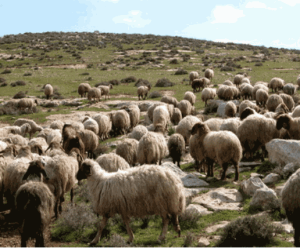
flock of sheep in israelFilthy Rich (2)
3000 sheep/1000 goats was definitely rich (even today it wouldn’t be too shabby). While cattle are more valued in our culture for their meat, milk, and leather, sheep and goats were more valued in Israel for these, and also for sacrifices. Sheep and goats were Israel’s “pantry on the hoof.”

I Pity the Fool (3)
The name “Nabal” means “fool.” As we have seen throughout the OT, names weren’t just random labels. They told something about the person’s character or life, where he was from, who he was related to, etc. Sometimes names were changed to reflect life circumstances: Ben-oni (son of my sorrow) to Benjamin (son of the right hand- Genesis 35:18), Naomi (pleasant) to Mara (bitter- Ruth 1:20), Simon (God has heard) to Peter (rock- Matthew 16:18).

It seems odd, even by Israel’s standards, to name an infant “fool,” but we have no way of knowing whether this was the case or whether he acquired this name later in life after earning it by his behavior.

“Abigail” means “My father is joy.”

An Offer You Can’t Refuse? (4-13, Deuteronomy 22:1-4, 18:7, 21:11, 15:7-8, Leviticus 19:10, 23:22)
This incident hits our Western ears as odd or inappropriate, even presumptuous or akin to extortion, but Middle Eastern hospitality etiquette and neighborliness, not to mention God’s Law was, and still is, much different from ours in many cases.

Nabal did not ask David to guard his shepherds and flocks. Indeed, he probably didn’t even know David was doing so unless the shepherds told him when they brought the sheep in for shearing. (And since “one cannot speak to him” {17} maybe they didn’t.) David, however, when he met up with the shepherds, took it upon himself, out of his own good will, to look out for them. Maybe he had sympathy for them because he had also been a shepherd.

michael-corleoneDavid and his men likely put their lives on the line numerous times protecting Nabal’s livelihood. And he didn’t do it with an “I scratch your back; you scratch mine” attitude, thinking he would later demand pay from Nabal. He also didn’t take advantage of the shepherds (such as extorting sheep/goats in exchange for protection) while they were with him. David was obeying the spirit of all those “good neighbor laws” we read about (ex: Deuteronomy 22:1-4). The law is not just “don’t harm your neighbor,” but also, “do good to your neighbor.”

Remember, these shepherds were alone out in the wilderness with the flocks. There was no police force or army to protect them from raiding bands of Philistines. If the Philistines saw a thousand goats and 3000 sheep and wanted them, they just took them and captured or killed the shepherds. No legal redress, no sheep insurance. Nabal’s entire portfolio was at stake. You would think once he found out what David had done –for free and out of the goodness of his heart—Nabal would be extremely grateful. But was he? Nope.

David’s men arrived, explained themselves, and asked politely for whatever food Nabal could spare (kind of hard to make groceries when you’re on the run living in caves). They did not demand his best, and they did not demand he provide enough for their entire company of 600 men. They had even come on a feast day when Nabal was celebrating his wealth, should have been in a good mood, and should have had plenty of extra food on hand. And notice this telling little phrase, “they said all this to Nabal in the name of David, and then they waited.” (9) Now here’s one way Middle Eastern culture is similar to Southern culture. If someone was standing there telling you about all those nice things he had done for you, how long would it take before you gleefully interrupted him and offered him everything under the sun in thanks? Well, Middle Easterners aren’t as shy about interrupting as we are, and furthermore, they would take it as the highest insult if you didn’t take everything they offered.

Not Nabal, though. First, he pretended not to know who David was. Pretty ridiculous, since David’s conquests were well known throughout Israel (18:7, 21:11- even outside Israel), not to mention the fact that he was next in line for the throne. Next, he insulted David’s men by accusing them of lying about working for David. Of course, if he had been interested in finding out whether or not that was true, he could have brought his shepherds in and asked them if these were the guys who had protected them.

David’s men went back and reported what had happened. David’s immediate response was for everyone to “strap on his sword.” It seems like kind of an extreme response to us, but we have to keep a few things in mind. First, the Law. Nabal was breaking both the letter and the spirit of it. While there was no specific law covering a band of mighty men coming to you and asking for food on a feast day, there were laws about taking care of people who were hungry and poor, such as the gleaning laws (Leviticus 19:10, 23:22).

Deuteronomy 15:7-8 says: “If among you, one of your brothers should become poor, in any of your towns within your land that the Lord your God is giving you, you shall not harden your heart or shut your hand against your poor brother, but you shall open your hand to him and lend him sufficient for his need, whatever it may be.”

When we read through Ruth, we saw Boaz doing a great job of fulfilling this law for Ruth and Naomi. Here, Nabal is showing the exact opposite of Boaz’s kindness and generosity.

Second, Nabal’s actions showed disregard and ingratitude for God’s provision and blessing. God blessed Nabal with wealth and protected that wealth (through David) without Nabal even knowing about it. Do we see any evidence that Nabal was humbled that God should do such a thing for him, or thankfulness to God for what He had provided? No. We see only selfishness, stinginess, and a blatant disregard for God as sovereign provider.

Finally, David’s response was likely an answer to Nabal’s accusations. “He wants to know who David is? He wants to know whether or not my men are lying? Well, let’s go show him the answer to his questions and see if he changes his tune.”

The Go-Between (14-31, John 12:14-15)
Abigail was quite a remarkable woman. This was not the first time Nabal had acted this way. He had a long standing history of being harsh and worthless (“son of Belial” is also applied to Satan in 2 Corinthians). And here, Abigail was going behind his back and defying him. This was no small thing for any wife in Israel. But for Abigail, it could have meant a beating or worse when Nabal found out. It’s possible she was even risking her life. And for what? To save him. Without his knowledge that she was saving him. Without his knowledge that he even needed saving.

Why in the world would Abigail want to save someone who was probably making her life a living hell? She could have just let David and his men handle Nabal. Certainly he would have www-St-Takla-org--abigail-entreats-mercygotten what he deserved. But she stepped in because it was the right thing to do. It was right to obey God by providing for David and his men. It was even right to protect her husband from his own foolishness and bringing David’s wrath down upon himself. But even more, she did it because she loved God, and maybe even her husband, too.
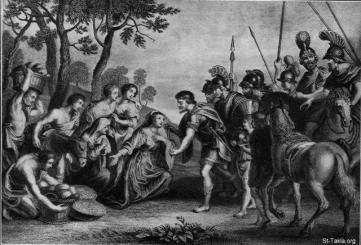
She sent the gift on ahead (19) to appease David’s wrath, then presented herself to him on Nabal’s behalf. Notice that she got down off her donkey (23). Kings rode donkeys. Rich people and people of high standing rode donkeys. She left her wealth and position behind and got as low as she could get, bowing down, humbling herself, and submitting herself to David. For Nabal.

Then Abigail did something even more remarkable. She said (24-25), “On me alone, my lord, be the guilt. Please let your servant speak in your ears, and hear the words of your servant. Let not my lord regard this worthless fellow, Nabal, for as his name is, so is he.” She—a completely innocent party to Nabal’s sin (25)—voluntarily takes on the guilt and consequences of his sin. (Is this starting to sound familiar?) In v. 28, she asked David to “Please forgive the trespass of your servant.” It wasn’t her trespass, but Nabal’s. She was asking forgiveness for him.

The King’s Response (32-35)
David blessed Abigail, not just for her prudence and godliness, but also because she had satisfied his wrath and kept him from exercising it on Nabal. Her gift was sufficient, and David granted her petition to extend forgiveness to Nabal.

Happily Ever After (36-42)
Well, except for Nabal. Abigail had to tell Nabal what she had done. She’d been gone for a while and had taken quite a bit of food out of the house. No sense trying to cover it up. Hopefully Nabal would be grateful she saved him from certain death. When she told him, did he repent? Humble himself? The text doesn’t say that he did. It says “his heart died within him.” It’s generally believed this means that Nabal had a stroke (especially since it further says that he “became as stone” and lived for ten more days). Did he become enraged at what Abigail had done, and this physical exertion contributed to a stroke? We can’t know for certain. What seems unlikely is that he genuinely repented, because God “struck Nabal and he died.” As we’ll see later with David, while we usually do suffer the consequences of our sin, God shows mercy and forgiveness to the repentant.

David was thankful he had not taken matters into his own hands and that God had handled the situation. Justice had been served. And for her faithfulness, Abigail—who considered herself the lowliest of servants, only fit to wash the feet of other servants—ascended to the position of Queen. Back on her donkey where she belonged, exalted out of humility to sit at the right hand of the king.

The Backstage Gospel (Psalm 14:1, Philippians 2:6-8, 9-11)
Often, in stories like this, the characters aren’t just playing themselves, they’re playing out the parts of the gospel.

As with Nabal, God blessed His people richly with life, family, provisions, and all kinds of other blessings she wasn’t even aware of. The people didn’t ask God to do these things. God, the Good Shepherd, did these things for them out of the goodness of His own heart, the same way David had done for Nabal. But, as with Nabal the fool, “The fool says in his heart, ‘There is no God.’ They are corrupt, they do abominable deeds, there is none who does good.” (Ps. 14) The same way David presented himself to Nabal and told him what he had done for him, God, over and over, reminded Israel of the way He had protected and provided for them. But just as Nabal rejected David, so, Israel rejected God, and rebelled against Him in favor of their own sin and selfishness. And, like David, God’s wrath was inflamed.

Enter Jesus. Just as Abigail intervened on behalf of Nabal, Jesus intervened on behalf of Israel and all mankind. Just like Abigail, He laid down His life to save us. Before we ever knew Him. Before we ever knew we needed saving. Why? Why would He even want to save us Nabals? He could have let God exercise His wrath on us. We certainly deserve it. But in the same way that Abigail acted in love and in doing what was right, Jesus loved His Father and us enough to fulfill righteousness and to bring God glory by staying His hand of wrath.

In the same way that Abigail got down off her donkey, leaving behind all prestige and humbling herself to the lowest position possible—a servant only worthy of washing other hp-crossshadowservants’ feet— Jesus “though he was in the form of God, did not count equality with God a thing to be grasped, but emptied himself, by taking the form of a servant [one who washed other servants’ feet], being born in the likeness of men. And being found in human form, he humbled himself by becoming obedient to the point of death, even death on a cross.” (Phil. 2:6-8) And for whom? Us Nabals. “On me alone, my Lord, be the guilt,” Jesus said, even though, like Abigail, He was completely innocent. He voluntarily took on the guilt and consequences of our sin when He died in our place on the cross, and He did it to win forgiveness for us.

Jesus sent this offering of His life for the atonement of our sin on ahead of Himself to the Father, and God’s wrath was satisfied. Jesus’ offering was sufficient, and God granted His petition to extend forgiveness to the likes of us. And just as David picked Abigail up from her humility and she ascended to the position of queen, Jesus ascended to sit at the right hand of the King, and “God has highly exalted him [Jesus] and bestowed on him the name that is above every name, so that at the name of Jesus every knee should bow, in heaven and on earth and under the earth, and every tongue confess that Jesus Christ is Lord, to the glory of God the Father.” (Phil. 2:9-11)

This story didn’t have a happy ending for Nabal, because Nabal didn’t repent and submit himself to God. Nabal ended up taking the guilt and consequences for his sin himself (death) instead of gratefully humbling himself and being thankful for the gift of Abigail’s intervention and David’s forgiveness. But the rest of us Nabals can have a happy ending. Jesus has paid the price for our sin with His death, burial, and the resurrection we celebrate today. He completely satisfied the wrath of God on our behalf. It is finished. Forgiveness has been purchased with His blood. If we will humble ourselves, repent of our sin, and accept the beautiful gift of forgiveness God is extending to us at the request of His Son, we can be reconciled to God now and live happily in the ever after.