False Doctrine, Movies, New Apostolic Reformation

Throwback Thursday ~ Movie Time: Miracles for Sale

Originally published August 7, 2018

“You are about to see a world where greed and deceit raise their ugly heads. Where lives have been needlessly lost. And where hope, the most precious gift of all, is peddled at a price. This is the wickedness in the world of faith healing.”

No, Derren Brown, the man behind the documentary Miracles for Sale, isn’t a watchblogger and he doesn’t head up a discernment ministry. He’s an atheist. And this project is proof in living color that – to our shame – lost people often see right through these types of blasphemies better than some so-called Christians do.

Several years ago, Derren Brown set out to expose the chicanery of faith healing. He chose to do so by taking an average man off the streets, teaching him the tricks of the trade, and passing him off as a legitimate faith healer, proving that God isn’t behind this movement – it’s all sleight of hand, fakery, and deceit.

Have you ever wondered how faith healers make it appear as though someone has actually been healed? Or how they can know personal things about someone in their audience whom they’ve never met? Miracles for Sale will show you.

WARNING: This movie contains a smattering of profanity (I tried counting. I believe it was about 5-6 words). It was made by an atheist and other non-Christians, and that’s how atheists and non-Christians talk sometimes (which, of course, is not to excuse this sin, merely to explain it). Additionally, since this movie was made by non-Christians, it does not contain a doctrinally sound theological response to the evil of faith healing. If these things would cause you to stumble or make you uncomfortable in any way, PLEASE DO NOT WATCH THIS VIDEO.


Mailbag

The Mailbag: Is It OK for Christian Women to Wear Bikinis?

It’s that time of year again, ladies. :0)

Originally published February 27, 2017


Foreword: I re-run this article every year in late winter / early spring. And every year, there are a handful of my followers who get mad that I don’t simply say, “No. It is not OK for Christian women to wear bikinis.”

If you’re one of those people, you’re missing the point of this article.

It’s easy to throw out a hard and fast law. It’s not so easy – especially for new Christians and those who come from a background of legalism – to practice biblical decision-making, a skill all Christians need to hone and implement in every area of our lives.

This article is a teaching moment. It’s an opportunity for women to take a fairly easy question that they pretty much already know the answer to and learn how to go through the steps to arriving at a biblical answer.

Remember back in school when your math teacher would make you show your work? She did that because getting the right answer is only a part of problem solving. Understanding and correctly doing all the steps – in order – to arrive at the right answer is the bulk of what she was trying to teach you. This is a “show your work” kind of article.


Summer is just around the corner, so a lot of women will soon be shopping for swimwear. With regard to modesty- do you think it’s OK for Christian women to wear bikinis?

I’m trying to remember back to the days when I might have actually considered – without doubling over in laughter – wearing a bikini. It was a really long time ago. Young, svelte sisters, if I may bring you a bit of comfort- you won’t have to grapple with this question for the rest of your life. As your other older sisters and I can attest, one day, age-appropriateness, your figure, sun exposure, and the desire not to frighten people will make this decision for you long before you have to consider modesty as part of the equation. It’s one of the blessings of getting older.

Just to make sure we’re all on the same page here, let’s quickly define our terms. When I say “bikini,” I’m talking about the fabric equivalent of a bra and panties, not swimwear that covers a lot more yet comes in two pieces.

bikini

not bikinis

Generally speaking, I don’t think bikinis are wise in public unless you’re wearing a shirt or some kind of cover up over it. I’m reluctant to make a hard and fast law about it, though, because, as I’m sure you’re aware, the Bible doesn’t say “Thou shalt not wear a bikini.” (My husband would like to chime in here and says, “However, if you and your husband have a private place for just the two of you to swim or sunbathe, go for it!” You’re welcome, guys.)

A law is a fast and easy “yes” or “no” answer to our question- which is often what our flesh wants, because our flesh is lazy.

As with various other issues, the Bible gives us a general principle (in this case about dressing modestly) and we work out our own salvation in our own cultural context according to all pertinent biblical principles and our own consciences. A law is a fast and easy “yes” or “no” answer to our question- which is often what our flesh wants, because our flesh is lazy. But what God wants Christians to do is study His Word about the issue, pray, and ask Him for wisdom to make a godly decision. When we work through this process, it helps us to develop a greater desire to be conformed to the image of Christ and to be obedient to Him.

What God wants Christians to do is study His Word about the issue, pray, and ask Him for wisdom to make a godly decision.

Let’s take a look at just one passage of Scripture that could be helpful in this regard:

3Do nothing from selfish ambition or conceit, but in humility count others more significant than yourselves. 4Let each of you look not only to his own interests, but also to the interests of others. 5Have this mind among yourselves, which is yours in Christ Jesus, 6who, though he was in the form of God, did not count equality with God a thing to be grasped, 7but emptied himself, by taking the form of a servant, being born in the likeness of men. 8And being found in human form, he humbled himself by becoming obedient to the point of death, even death on a cross.
Philippians 2:3-8 

So, at first glance, you might wonder, “What in the world does this passage have to do with wearing a bikini?” It doesn’t have anything to do with the bikini itself, it zeros in on your heart (Why do you want to wear a bikini?) and your sanctification (Will wearing a bikini make me more Christlike?).

Verse 3a:
Examine your heart- could your motive for wearing a bikini be classified as selfish ambition or vain conceit? Is it possible you want to show your body off to men to appear desirable, or to women to make them jealous?

Verse 3b-4:
Is this a situation in which you should humble yourself and put the interests of those men who might be tempted to lust or those women who might be tempted to covet ahead of your own desire to appear attractive?

Verse 5:
Do you truly desire to have the same mindset as Christ- about this issue and all others?

Verse 6-8:
How did Jesus approach life, according to these verses? He set aside His own rights and privileges (6), He took on the role of a servant (7), He humbled Himself and was obedient to the point of death (8).

When it comes to wearing a bikini, are you willing to have the same mindset as Christ? To set aside your own rights and privileges, be a servant to others, humble yourself, and obey Christ even to the point of death?

These are not questions God wants me to answer for you. These are questions He wants you to come to Him and answer, because He wants your heart. And He wants you to examine your heart and see if it belongs to Him in this area.

Additional Resources:

Is it Okay for Christian Women to Wear Bikinis? at When We Understand the Text

Modesty, parts 1, 2, & 3 at A Word Fitly Spoken

If you’re looking for modest swimwear – even swim dresses – there are several online companies, such as Calypsa, that may have what you’re looking for. Try searching “modest swimwear”. Have you already found a great company you love? Suggest it in the comments below!


If you have a question about: a Bible passage, an aspect of theology, a current issue in Christianity, or how to biblically handle a family, life, or church situation, comment below (Iโ€™ll hold all questions in queue {unpublished} for a future edition of The Mailbag) or send me an e-mail or private message. If your question is chosen for publication, your anonymity will be protected.

Speaking Engagements

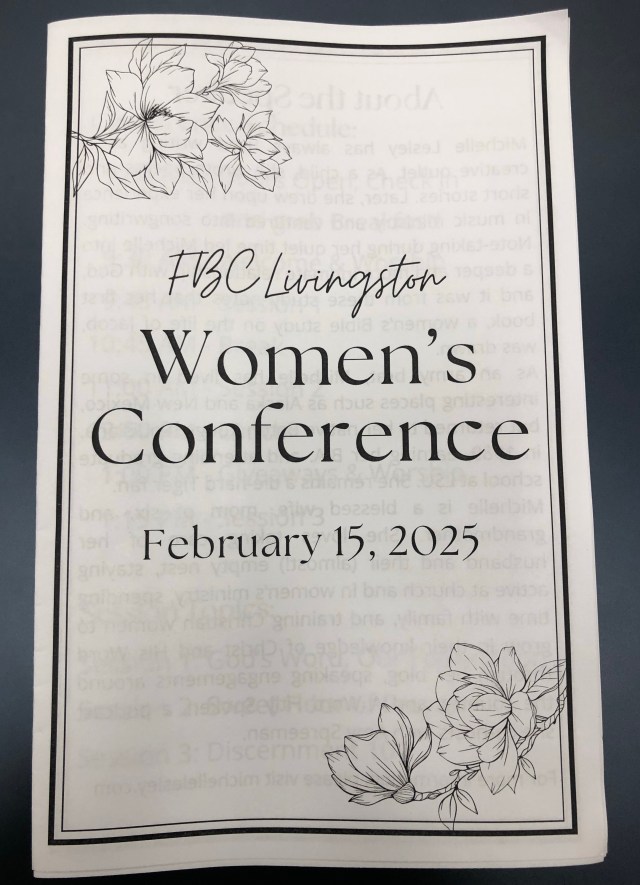
Report Back: FBC Livingston Women’s Conference


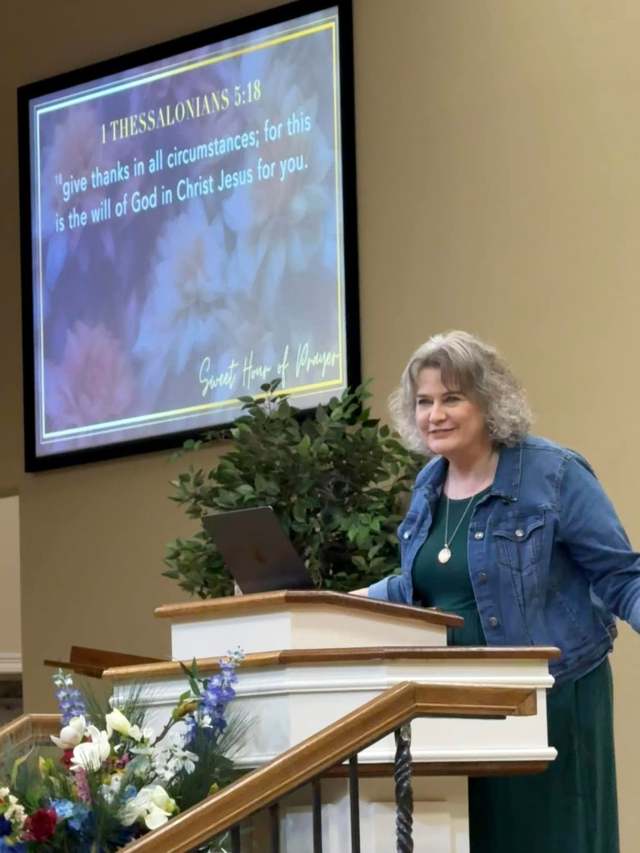
What a pleasure it was to teach at a wonderful sister church right in my own back yard, sleep in my own bed, and have a great group of dear sisters from my own church join me! I loved fellowshipping with the ladies of Livingston, Louisiana, and the surrounding area at First Baptist Church of Livingston’s annual women’s conference!

Attendees were warmly welcomed to the conference in the registration area with swag bags and helpful information.

Next, it was time for an energizing breakfast, with plenty of time to visit.

The conference proper started off with a worshipful time of singing led by these sweet brothers and sisters, and introductory remarks from Vickey, our emcee for the day.

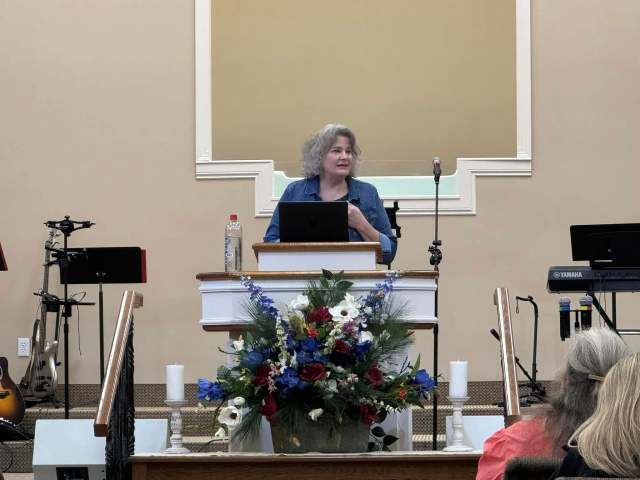
Session 1 was God’s Word, Our Foundation. God’s Word is the very foundation of our lives as Christian women. It is all sufficient, our ultimate authority, and an absolute necessity for our growth in Christ and our wellbeing in life.

Session 2 was all about prayer. In Sweet Hour of Prayer, the ladies learned about biblical and unbiblical prayer practices, using the Lord’s Prayer as a model for our own prayers, praying Scripture and so much more!

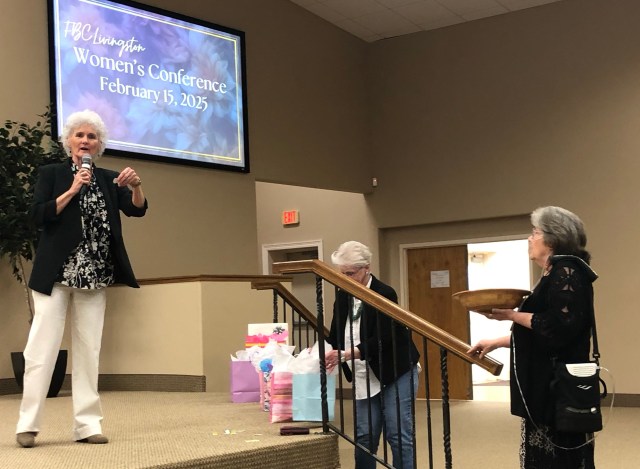
After a delicious lunch of deli sandwiches with all the trimmings, the afternoon session got off to a fun start with door prizes!

Discernment 101: Learn to Discern was our topic for session 3. What is discernment, and why is it important? What makes someone a false teacher? Who are some of today’s popular false teachers? It’s so important to be a good Berean.

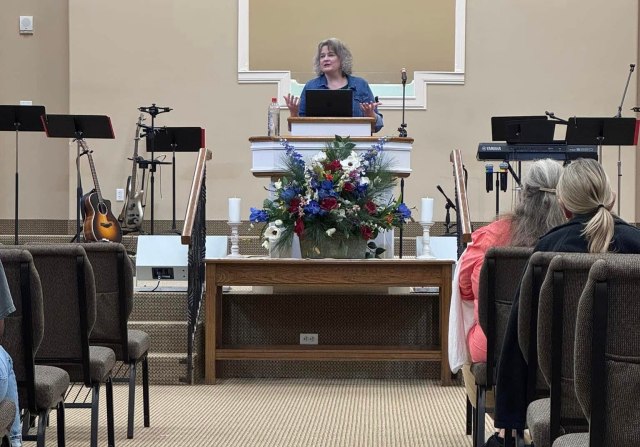
Finishing up the day was our Q&A session. Wherever I go, I’m always so encouraged and sharpened by the questions my dear sisters ask, and these were no exception!

Big thank you’s to my precious sisters from my own church who took a day out of their busy lives to attend and support me at this event. It meant so much to me, and I deeply appreciate and love you all.

It was such a fantastic day with the ladies of FBC Livingston. Thanks so much to Pastor Brian for trusting me to teach these incredible women. Thanks to Joyce for being such a great event planner, and to all the other brothers and sisters of FBC for making me feel right at home and working so hard to host a fantastic conference. If you’re ever in the area and need a good church to visit, make plans to spend the Lord’s Day with these wonderful brothers and sisters.


If your church or organization is ever in need of a speaker for a womenโ€™s event, Iโ€™d love to come share with your ladies as well. Click here for more information, or to find an upcoming event near you!


Photo Credits

Thank you to Anna and Sarah for contributing several of these photos, including the ones of me.

All other photos by Michelle Lesley.

Holidays (Other), Obedience, Sanctification

40 Things to Give Up for Lent

Originally published March 3, 2017

Although, as a Louisiana girl, I’ve had a decades long love affair with king cake, and I totally support the increased availability of fish entrรฉes at local restaurants and getting a few days off school or work, I’m not a big fan of Mardi Gras and Lent.

The intrinsic philosophy behind Mardi Gras – a day of revelry, indulgence, and debauchery to get it all out of your system before you have to start “being good” for Lent – is patently unbiblical.

The practice of Lent often is, as well. Lent is the forty day period, beginning with Ash Wednesday and ending with Easter Sunday, observed by Catholics and some Protestants. Originally, it was simply a time of fasting, prayer, and worship in anticipation of Easter, and for Christians who continue to observe it this way, it can be a valuable and meaningful time of respite and renewal with the Lord.

For many, however, Lent – particularly the aspect of giving something up for Lent in an act of self-denial – is nothing more than an empty religious ritual, or worse, works righteousness. Giving something up for Lent because, “I’m Catholic and that’s what good Catholics do,” or to atone for your sins, or to curry favor with God, or to flaunt your self-righteousness flies in the face of grace alone, faith alone, Christ alone biblical Christianity.

If you give something up for Lent, why do you do so? If it’s for one of the aforementioned unbiblical reasons (or others), or even if you don’t observe Lent at all, I’d like to challenge us all to give up the things below for Lent:

1. Give up Lent for Lent.

2. Give up attending any church that requires the observance of Lent in a sacramental way and find a doctrinally sound one.

3. Give up thinking your good behavior earns you right standing with God.

4. Give up the idea that there’s any such thing as truly good behavior.

5. Give up thinking your good deeds could ever outweigh your sins.

6. Give up willfully indulging in sin as long as you “make up for it” later.

7. Give up the notion that penance or self-denial can pay for your sins.

8. Give up thinking that penance or self-denial curries favor with God.

9. Give up the idea that repentance and obedience belong to a certain season on the calendar. We are to walk in repentance every day.

10. Give up the concept that Christmas and Easter are Christian “high holy days.” We celebrate Christ’s incarnation and resurrection every Sunday, and should prepare ourselves all during the week. Every Sunday is a high holy day for the Christian.

11. Give up rote participation in church rituals. Search the Scriptures and see if they’re biblical first.

12. Give up thinking God concerns Himself strictly with your external behavior rather than the condition of your heart.

13. Give up “sounding a trumpet before you” with humblebrags on social media and in real life about giving things up for Lent, fasting, giving offerings, or any other good works you might do. You just lost your reward, baby.

14. Give up approaching church attendance as punching the time clock for God. The Christian’s entire life, our very beings, belong to Christ, not just a couple of hours on Sunday.

15. Give up the delusion that you’re basically a good person. You’re not.

16. Give up biblical ignorance and become a good student of God’s word.

17. Give up forsaking the assembly and become a faithful, serving member of your local church.

18. Give up thinking that everyone and everything that calls itself “Christian” actually is.

19. Give up the desire to have your itching ears scratched and long for the truth of God’s word. Even when it’s hard to hear.

20. Give up neglecting the daily study of God’s word.

21. Give up rejecting parts of the Bible you don’t agree with. We don’t sit in judgment over Scripture. Scripture sits in judgment over us.

22. Give up neglecting your prayer life.

23. Give up making excuses for failing to memorize Scripture. You can do it!

24. Give up being a non-serving member of your church.

25. Give up being a non-giving member of your church.

26. Give up thinking you’re hearing God speak to you. If you want to hear God speak to you, open your Bible and study it. God has spoken in His word and many are largely ignoring what He has already said.

27. Give up following false teachers and be a good Berean.

28. Give up being afraid to share the gospel and just do it.

29. Give up thinking you can please God apart from faith in Christ.

30. Give up basing your doctrine and beliefs on your own (or anyone else’s) opinions, experiences, and feelings, and base them on correctly handled Scripture instead.

31. Give up following your wicked and deceitful heart, take up your cross daily, and follow Christ.

32. Give up thinking you have to do big things for God in order for Him to be pleased with you and “aspire to live quietly, and to mind your own affairs, and to work with your hands.”

33. Give up worrying and trust God.

34. Give up neglecting to fear God’s wrath if you don’t know Christ.

35. Give up fearing God’s wrath if you do know Christ.

36. Give up the idea that “God is love” means God is a pushover who won’t judge you.

37. Give up thinking you’ve been so bad that God could never forgive you.

38. Give up thinking you’re so good that you don’t need God to forgive you.

39. Give up refusing to forgive others when Christ has forgiven you so much.

40. Give up everything and be saved by grace alone, through faith alone, in Christ alone, and walk in His ways, all the days of your life, to the glory of God alone.

Holidays (Other), Mailbag

The Mailbag: Mardi Gras, Ash Wednesday, and Lent

Originally published March 4, 2019

For an expanded and more detailed treatment of this topic (based on this brief article), please listen to the Mardi Gras, Ash Wednesday, and Lent episode of A Word Fitly Spoken.


What are Mardi Gras, Ash Wednesday, and Lent? Are they biblical? Should Christians participate in them?

If you don’t live in Louisiana or a heavily Catholic area, maybe you’re not very familiar with these observances. Let’s take a look at each of them:

What is…

Lent Lent is a forty day period (not counting Sundays) leading up to Easter. It is observed by Catholics and some Protestants. Historically, it is supposed to be a period of repentance, penance, fasting, and self-denial. The aspect of Lent that people tend to be most familiar with is the idea of giving something up (self-denial/penance) for Lent such as watching TV, chocolate, smoking, or eating meat.

What is the meaning of Lent? at Got Questions

What is Lent? at US Conference of Catholic Bishops*

Ash Wednesday Ash Wednesday is the first day of Lent. Ashes are applied to the forehead in the shape of a cross to indicate repentance and that the recipient will begin the Lenten fast. Ash Wednesday is primarily observed by Catholics and some Protestants.

What is Ash Wednesday? at Got Questions

Ash Wednesday at Catholic Online*

Mardi Gras (Fat Tuesday) Mardi Gras is the day before Ash Wednesday. It has its roots in Shrove Tuesday, which was originally a day of feasting on all of the foods that were forbidden during Lent so these foods would not spoil or go to waste since they could not be eaten again until after Easter. Through the years, this day of feasting has morphed into drunken revelry – sort of a “last hoorah” for getting all the sin out of your system before you have to start “being good” for Lent. In Louisiana (and a few other places), it is much more a cultural holiday than a religious observance. People from various religions as well as non-religious people participate in Mardi Gras. It is celebrated with numerous parades, balls, and other festivities. The colors of Mardi Gras are purple (representing justice), green (representing faith), and gold (representing power).

What is the origin of Fat Tuesday / Mardi Gras? at Got Questions

Mardi Gras History at Mardi Gras New Orleans*

Are these days/observances biblical?

Lent Yes and no. Mostly no. The fundamental components of Lent – repentance, fasting, and the pursuit of holiness – are biblical. Repentance and holy living should be practiced by all Christians every day, and biblical fasting as the Holy Spirit convicts the individual Believer.

However, Lent is not mentioned or even hinted at in the Bible, and any Catholic observance (of Lent or anything else) is fundamentally unbiblical because the Catholic religion itself is unbiblical. It is also unbiblical for a church to require that its members observe a man-made religious ritual or to imply or teach that participating in this ritual earns favor with God or absolves or makes up for sin. Furthermore, to teach that there is a special time of the year set aside for repentance and holiness is unbiblical. Christians are to walk in holiness and repentance every day.

Ash Wednesday Again, yes and no. Mostly no, and for most of the same reasons Lent is generally unbiblical. The fundamental components of Ash Wednesday – repentance of sin and the pursuit of holiness – are biblical and should be practiced by all Christians every day.

In addition to the unbiblical facets of Lent, Ash Wednesday’s forehead ashes “disfigure[s] their faces that their fasting may be seen by others” which is the exact opposite of the humble way Christ teaches us to fast.

Mardi Gras No. The drunkenness, sin, and lasciviousness that go along with typical Mardi Gras celebrations are patently unbiblical as is the idea of getting all the sin out of our systems before we have to start being good. The Bible teaches against these things.

Should Christians participate in…

Lent Catholic observances of Lent – no. Some doctrinally sound churches and individuals freely choose to set aside a time of biblical fasting, prayer, and worship in anticipation of Easter. For Christians who observe Lent in this way, as long as it is observed in keeping with Scriptural principles, it can be a valuable and meaningful time of respite and renewal with the Lord just as it could if observed at any other time of the year.

Ash Wednesday No. It is unbiblical, as cited above.

Mardi Gras Christians should not participate in any sinful activities any day of the year, including Mardi Gras, nor believe or portray to others by their actions, the unbiblical “theology” behind Mardi Gras. (And as a non-theological aside, violent crime in New Orleans during Mardi Gras has made attending Mardi Gras parades and other events very dangerous.)

However, as I mentioned, in Louisiana, Mardi Gras has become much more of a cultural holiday than an observance with religious undertones. Many smaller towns (and even some larger ones) eschew the debauchery that takes place in New Orleans and offer family-friendly parades which are basically as innocuous as our local Christmas parades or a Fourth of July fireworks show. For Christians who have worked and prayed through the appropriate biblical principles and whose consciences allow them to participate in non-sinful Mardi Gras activities such as attending these types of parades, I believe this is an issue of adiaphora (Christian liberty) similar to participating in non-sinful aspects of Halloween. (Don’t forget to take along some tracts to hand out!)


Additional Resources:

Mardi Gras & Lent: I wouldn’t if I were you at Cage Free Theology


*These articles are linked for informational purposes only. Obviously, I’m not endorsing Catholic websites or anything on a secular website that’s ungodly.


If you have a question about: a Bible passage, an aspect of theology, a current issue in Christianity, or how to biblically handle a family, life, or church situation, comment below (Iโ€™ll hold all questions in queue {unpublished} for a future edition of The Mailbag) or send me an e-mail or private message. If your question is chosen for publication, your anonymity will be protected.