Sanctity of Life Sunday is this Sunday, January 18.
Do you know the differences between the abolition movement and the pro-life movement? It’s a good thing for all Christians to be informed about.
Watch A Storm Comes Rolling Down the Plain, then listen in to our A Word Fitly Spoken interview with Brett Baggett, one of the key figures in the documentary.
The position of the abolition movement is that it should be spearheaded by the church, and so most of the leaders of the movement and activities are pastors and other men. But women play a vital role in the abolition movement, too. Listen in as Susan White tells us how to get involved.
I also thought this interview with Samuel Sey, Nathaniel Jolly, and Ekkie Tepsupornchai on the Truth Be Known podcast was insightful and helpful:
The annual meeting of the Southern Baptist Convention is coming up in a few weeks.
As a lifelong Southern Baptist, I have thoughts. Feelings, even.
For the past several years – some might even say it started as soon as the Conservative Resurgence was over – the SBC has been on a slow but steady downward and unbiblical trajectory. False teachers line the (virtual) shelves of LifeWay Retail and headline LifeWay-sponsored conferences. False doctrine like extra-biblical revelation and Critical Race Theory are championed. Women have been preaching to men at conferences and para-church events for decades, and now women preaching the Sunday morning sermon in SBC churches is increasing in frequency and acceptance. NAMB was recently taken to task for sponsoring church plants with female pastors. Yoking with heretical, New Apostolic Reformation organizations – for example, when sitting SBC President Ronnie Floyd was a featured speaker at IHOP’s 2015 conference or when LifeWay’s Sunday School curriculum recommends music by Jesus Culture – a clear violation of Scripture, is defended.
And so much more.
It’s a real mess, folks. And to many average Southern Baptists like me, with no power, no position, it’s a mess that feels insurmountable. Beyond discouraging. Hopeless. Not worth the effort of trying to save.
Why? Because nobody in power cares what doctrinally sound, Joe and Jane Churchmember think. In fact, Joe and Jane often feel like we are seen by some in SBC leadership as ignorant, backwoods annoyances to the ruling class. The huddled unwashed masses stupidly crying, “Biblical reform!” as the multi-seminary-degreed elites condescendingly pat us on the heads and send us back to our pews assuring us they know what’s best.
I watched it happen in 2012 when I attended the annual meeting. A messenger went to the microphone after then president/CEO Thom Rainer’s report on LifeWay and began to express concern about the false teachers LifeWay carries. Dr. Rainer’s answer? “Trust the trustees.” The trustees, of course, being the ones who approved those authors for sale by LifeWay in the first place.
There are several brave and hardy Joes and Janes out there who still have fight left in them. Who believe the SBC is worth saving. Who believe it can be turned around if there’s a groundswell of involvement from the grassroots.
God bless them.
I mean that with all my heart. God bless them – mightily. I admire and heartily support them, and I urge you to support them too. I hope, against all hope, that they are right.
But I think there may be a bit of a disconnect in understanding where the “It’s time to chuck the whole thing” side of the aisle is coming from. So I just wanted to take a few moments to air that out – at least from my perspective.
“Show Up”
“Change is made by those who show up.” I’ve heard it multiple times from several different voices in the “grassroots for change” movement urging Joe and Jane to be present at the annual meeting each year. And, in theory, I completely agree. If you can show up, you should.
But in practice, it’s not as easy as it sounds. Yes, if you’ve got plenty of money, your time is your own, and your health and life circumstances permit you to travel to wherever the convention is being held every year, it’s pretty easy to show up.
It’s also easy to forget that not every Southern Baptist is so blessed. In fact, I would take a wild guess that probably 85% or more of Southern Baptist church members and a significant number of SBC pastors are not that comfortably fixed.
We don’t have hundreds or thousands of extra dollars in our family budgets every year to fly or drive what’s often thousands of miles across the country to the meeting site and pay hundreds more for a hotel, meals, and other expenses once we get there. That’s not the type of expense a lot of families can sacrifice for, save up, or scrape together just because we’re being urged to “show up” – the money simply isn’t there.
We have jobs that prevent us from taking time off for the convention. Many of those jobs don’t offer paid vacation time. If we don’t work, we don’t get paid. In some jobs, if you don’t show up whenever you’re needed, you get fired. Even for those fortunate enough to get paid vacation time, that time is limited and may need to be spent on something else – a family wedding, caring for a sick loved one, painting the house.
Some who can afford to make the trip and have the time to do so are limited by other life circumstances such as their health, local responsibilities, and family obligations.
It’s even difficult for many SBC pastors to attend the convention. Are we forgetting that the majority of our churches are small and many of our pastors are bi-vocational? “According to the 2014 Annual Church Profile (ACP) report, 90% of the churches reporting average fewer than 272 in their worship service, and 75% average fewer than 131.”1 Think about how much it would cost to fly your pastor to Nashville, feed him, rent him a car, and put him up in a downtown hotel for several days. How many of our churches that run 20 or 30 or 40 in Sunday worship can afford that? Some of them can’t even afford to pay their pastors a salary.
And then there are the Janes and Joes who are able and willing to attend the convention but find themselves members of doctrinally unsound SBC churches that actually agree with CRT or women pastors or any of the other aforementioned issues. Maybe their churches were once sound, but have taken an unbiblical turn. Or maybe God has only recently opened their eyes to sound doctrine and they’re trying to effect change in a stiff-necked church before being forced to abandon ship. How many of those church members are going to get approved as messengers by their churches? Having been in that situation myself, I can answer that question: Zero. That’s how many.
Many of these difficulties also hold true for the state conventions and associational meetings we’re urged to attend, meetings which are often held during work hours in the middle of the week and sometimes hundreds of miles from home.
It’s really easy for some to say, “If you don’t show up and vote, you can’t complain,” but the effect on those who want to show up, but can’t, is discouragement.
Are we effectively – albeit unintentionally – being respecters of persons by only giving a voice to those who can afford to “show up”? Are we not functionally discriminating against and silencing smaller, poorer churches and church members?
Biblical dissent is silenced or ignored.
For those of us who have seen how biblical dissent is handled by many SBC leaders, we have no reason to believe we’ll be listened to or taken seriously even if we do “show up” at associational meetings, state conventions, or the national convention.
I know of plenty of pastors and church members (including me) who have attempted to contact their local associational leaders, their state convention leaders, or leaders at the national level about some of these problematic issues. They’ve been placated. They’ve been ignored. Their emails, letters, and phone calls have gone unanswered. They’ve been dressed down and told they were wrong, or didn’t have enough faith, or were unloving or in sin, or weren’t being Christlike.
Last year we saw the grassroots outcry against David Uth, president of the 2020 SBC pastors conference, for inviting false teachers and a female pastor to headline the event. He still dug his heels in and refused to heed the godly reproof he received.
Current SBC president J.D. Greear makes a public statement about the Bible “whispering about sexual sin,” publicly supports and defends false teachers like Beth Moore, and maintains a friendship with at least one female “pastor” – among many other things – and completely ignores anyone who takes him to task for it.
The unspoken “11th Commandment” threat of retaliation against denominational, LifeWay, and seminary employees who, after exhausting all of the “proper channels” to no avail, speak out against unbiblical actions by their employers, superiors, or other denominational leaders, is an open secret, and no joke to those who have been intimidated, negatively impacted, fired, or forced to resign.
At the 2019 convention, messengers attempted to speak against Resolution 9, and their microphones were turned off. And I already mentioned what happened at the 2012 convention.
I appreciate the faith and optimism of those who think our voices can still be heard, I truly do. And I desperately hope they are right. Nothing would make me happier. But in the current SBC climate of ignoring, silencing, and even threatening biblical dissent and correction, surely they can also understand why many of us would wonder why any doctrinally sound Southern Baptist would ever dream of being listened to and taken seriously.
So….what’s the solution?
Many average church members and pastors who want change have no voice because they can’t afford to show up in person at the convention, and even if they do show up, there’s no reason to believe their voices will be heard, much less heeded. So, what’s the solution?
I can think of two practical remedies that might help a little.
Virtual attendance and distance voting- Every time I’ve suggested this or heard someone else suggest this, it has been immediately shot down – often by those urging involvement from the grassroots – in favor of messengers “showing up” in person, and because “the technological capability for this doesn’t exist.”
I’m sorry, I’m fully aware of how dense I am when it comes to technology, but I look around and see online shopping, PayPal, people filing their taxes and census forms online, online classes and testing, and all kinds of other very official things being done online that involve the transmission of sensitive information that has to be accurate, and I have an extremely difficult time believing that the Southern Baptist Convention can’t find some way in the next few years to make streaming the convention, submitting input and questions online, and voting online a reality. This is the 21st century and we still seem to be operating with a horse and buggy mindset.
Convention “Scholarships”- If you really want people to “show up,” you’re going to have to make it financially possible for those who can’t afford it. Commendably, many individual churches already do this for their own pastors and messengers, paying for their airfare, accommodations, and/or other expenses.
What about grassroots organizations establishing some sort of “scholarship” fund for pastors and potential messengers who would like to attend the convention, but neither they nor their churches can afford to send them? (Here’s a wild idea- why don’t we de-fund the ERLC and use those funds for this kind of thing instead?) What about churches and church members in the city in which the convention is being held opening their doors to pastors and messengers traveling on a shoestring budget and providing them with a place to stay, meals, and transportation around town?
Again, I wholeheartedly support my SBC brothers and sisters who are trying to effect change within the current system and structure. And I encourage all doctrinally sound Southern Baptists who can attend this year’s annual meeting to do so, and to fight hard and vote biblically. My own son and several members of my church are going to be attending, and I’m cheering them on. I’d go myself if I could. I’m hoping and praying for lots of good to be accomplished.
I don’t have all the answers. I’m not trying to be a Debbie Downer. I just know that if you do what you’ve always done, chances are, you’re going to get what you’ve always gotten.
And I just don’t think the Southern Baptist Convention can survive much more of that.
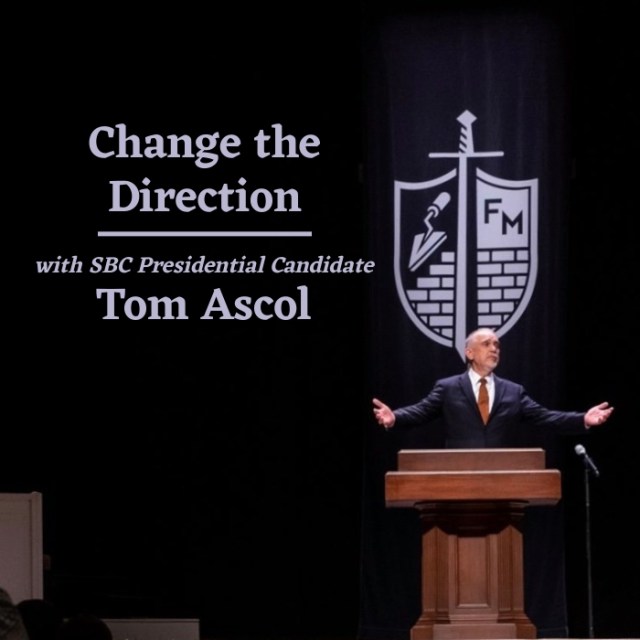
Today, we have a very special guest we’re going to talk with! He is, first and foremost, the pastor of Grace Baptist Church in Cape Coral, Florida, but most of our listeners will probably know him better as the head of Founders Ministries, or, more recently, as an anticipated nominee for president of the Southern Baptist Convention.
Amy and I had the pleasure and privilege of interviewing Tom Ascol on A Word Fitly Spokenseveral weeks ago. If you haven’t had a chance yet, give it a listen. And even if you have, you might want to brush up if you’re headed to the Convention.
Be sure to share this around, especially with Southern Baptists you know will be serving as messengers in Anaheim next week. Let’s…
get Tom Ascol (president), Voddie Baucham (president of the pastors’ conference), and Javier Chavez (recording secretary) elected,
James Merritt, chair of the resolutions committee, pitched a hissy fit that doctrinally sound Southern Baptists still dare to complain about CRT, and then resigned.
And in a runoff between the most conservative candidate and the most liberal candidate, messengers opted for the latter, Ed Litton, to be their president.
That’s not a list of everything that happened, but it’s a few of the more major dismal moments.
It was not good. It is not good. And I am gobsmacked and slack-jawed over the sunshine and rainbows comments I’m seeing and hearing from a few people about the wonderful progress and decisions that were made, and that the SBC’s brightest days are ahead.
Are you kidding me? Is it truly possible to be that blind to what’s going on around you and still be able to pull your socks on every morning?
So I had a few random thoughts I wanted to share to wrap things up and bring this whole ugly nightmare of a convention to an end.
Autonomy of the Local Church
If there were ever a time to remember the autonomy of the local Southern Baptist church and be thankful for it, this is it.
While the SBC president can certainly influence the churches and direction of the Southern Baptist Convention with his bully pulpit (which only extends as far as people actually listen to him), and he does make various decisions that may indirectly affect your church, he’s not the Pope. He does not have the power to hand down edicts that your church is obligated to obey. Ostensibly, with regard to his authority, you and your church can operate in 100% defiance of everything he stands for and still be in friendly cooperation with the SBC. The same goes for SBC resolutions, all of which are non-binding upon you and your church.
Tom Ascol made an important motion to rescind 2019’s Resolution 9 which affirmed CRT as a “useful analytical tool” for dealing with issues of race. His motion was ruled procedurally out of order because previous years’ resolutions cannot be rescinded.
Instead, they put all of these into their resolutions committee Cuisinart and poured us a tall glass of watered-down Resolution 2, “On the Sufficiency of Scripture for Race and Racial Reconciliation“. Now, had this resolution been presented two years ago instead of Resolution 9, it would have been fine. Not super impactful, but fine. But in the wake of the past two years of dealing with the Resolution 9 debacle, it was a toothless, cowardly display of fence-sitting meant to placate those on the anti-CRT side and hopefully not offend those on the pro-CRT side.
And when messengers didn’t bow and scrape in thanks and obeisance to the resolutions committee for throwing them this moldy crust of bread from their royal table, but instead objected, resolutions committee chair (and former SBC president), James Merritt, went on an angry, condescending, insulting tirade.
— Michael S. Miller (@imichaelsmiller) June 15, 2021
“If some people were as passionate about the gospel as they are about [decrying] Critical Race Theory, we’d win this world to Christ tomorrow!” he shamefully bellowed.
And a significant number of messengers cheered.
Never mind that CRT is antithetical to the gospel. Never mind that it’s being taught in our seminaries and even some of our churches. And never mind that the majority of Christians most passionately against CRT are against it precisely because they are so passionate about the gospel.
If you’re a doctrinally sound Southern Baptist who sees the dangers and heresies in Critical Race Theory and you want it eradicated from the SBC, the message is clear: The leadership wants you to sit down and shut up about it. And so do a lot of your fellow Southern Baptists. They don’t care, and they’re tired of hearing about it.
Ignorance, Laziness, and Liberalism by Default
I’m going to take a page out of James Merritt’s book and “just say this bluntly and plainly”.
Too many messengers are ignorant of the issues in the Southern Baptist Convention, the candidates for various offices, and, frankly, their Bibles, and yet they attend the annual meeting and vote in ignorance anyway, just blindly trusting whoever happens to be on stage at the moment.
Stop it.
You’re damaging the convention, and hurting your fellow Southern Baptists in the process, because you’re playing right into the liberals’ hand. They are using you – your ignorance and gullibility – to further their ungodly causes and ideologies. Because a lot of the people running this shebang aren’t biblically trustworthy.
They get up there and smooth talk you with the forked tongue of Eden’s serpent, and just like Eve – instead of planting both feet firmly on God’s Word, standing up to them and declaring, “Thus saith the Lord,” – you get suckered in and fall for it.
Stop it.
It is one thing to be ignorant1 about something. We are all ignorant about various things. But if you’re going to represent your church and your fellow Southern Baptists as a messenger, by gum, you’d better at least attempt to know what’s going on, whether or not what you’re voting on is biblical, and what the implications are going to be.
Some of you knew exponentially more about the candidates and their positions on the issues in the last U.S. presidential election than you knew about any of the candidates for president of the SBC. You wouldn’t think of going into a secular voting booth and casting a ballot for candidates or laws at the local, state, or national level without informing yourself. And when you attend your own church’s business meetings you ask questions, and you know the issues and the people you’re voting on.
Don’t you think your decisions on the issues, the president, and other leaders of your own denomination – the largest expression of the visible church in the world – deserves at least as much attention, study, and vetting as you give those other elections and issues? Is it really too much to ask that you take the responsibility of being a messenger seriously?
As I said, it’s one thing to be ignorant, but if you know you’re ignorant about a candidate or an issue, and you know you’ve been given the responsibility of representing your church and millions of other Southern Baptists by voting on that candidate or issue, and you choose not to lift a finger to inform yourself about them and what the Bible says about them, I’m sorry, but you’re being sinfully lazy.
Nowhere does the Bible ever hint that choosing to remain ignorant is a virtue. Rather Proverbs admonishes us:
The wise lay up knowledge… Every prudent man acts with knowledge, but a fool flaunts his folly. An intelligent heart acquires knowledge, and the ear of the wise seeks knowledge.
Proverbs 10:14a, 13:16, 18:15
You want to attend the convention mainly for the fellowship? Great. Have at it. Fellowship is important, and it’s one of my favorite parts of the many conferences I speak at and attend. But do it on your own dime, and don’t attend as one of your church’s allotted messengers. Give that slot to someone else who’s serious about the issues and about doing the Lord’s business at the convention.
There’s no excuse for showing up to vote at the convention without at least trying to be informed.
Just stop it.
“We just need to get back to evangelism!”
Before, during, and now, after, the annual meeting, I’ve heard a lot of people say, “We just need to get back to evangelism in the SBC and stop dividing over all these other issues.”
If you think that, you’re missing a crucial point that you need to grasp:
We should not be evangelizing anybody with a false or adulterated gospel. And that’s what “all these other issues” are about…
False teachers – promoted, endorsed, and financed by LifeWay – have been running rampant in the SBC for decades.
Critical Race Theory foments strife, bitterness, worldliness, and unforgiveness.
Women preaching and serving as “pastors” teaches the false doctrine that, “It’s fine for God’s people to ignore Scripture and do what’s right in their own eyes.”
Just as Priscilla and Aquila took Apollos aside and corrected him when he was preaching an incomplete, incorrect gospel, these issues, and many more, need to be biblically corrected before anybody attempts to evangelize.
As Ecclesiastes 3:1 says, “For everything there is a season, and a time for every matter under heaven.” And Matthew 7 tells us to build our house on the rock of Christ, of sound doctrine, not on sand.
It is time to correct sin and lies before evangelizing. We must have a sure foundation ourselves, first, before we implore others to build their house on that foundation.
Evangelizing with a false gospel just makes people twice as fit for Hell as they already are.
In dealing with the devastating results of the convention, I have appreciated the Barnabases out there who have encouraged us all to remember that God is sovereign, that the true church will prevail, and so many other precious truths and promises from God’s Word. That is right and good.
Just as it is appropriate to encourage and be encouraged that God’s got this, it is also totally appropriate to take some time to mourn over the visible church throwing away sound doctrine with both hands and running after sin and false doctrine.
This “time to weep and mourn” is also right and good.
Now what?
From what I’m reading and hearing from scores of Southern Baptists and their pastors, a number of doctrinally sound churches are probably going to cut ties with the SBC within the next year. And who could blame them? They’ve been fighting to take the ship for years and now, they discern, there’s no ship left to take.
But many leaders in the conservative stream are urging against that, pleading with them to hang in there and fight. Rome wasn’t built in a day. After all, for how many hundreds of years did the prophets cry out to Israel to repent and return to God? Were they wasting their time?
Honestly, I think both sides make an excellent point, so I guess it’s a good thing God hasn’t called me to make the final decision on this for my tribe, my church, or my family.
So, church ladies, where do we go from here? Here’s my encouragement to you…
Should I stay or should I go?
I dealt with the question of leaving the SBC in Monday’s Mailbag article, When is it time to leave the SBC? and I still mean every word of it. If you haven’t yet read it, I urge you to do so and give the contents some prayerful consideration.
One thing I would add to that article is this: I heard from a lady who – before the convention was even over – told she was already beginning her search for a new, non-SBC church.
I would urge you not to react and make decisions out of emotionalism. If you’re in a doctrinally sound SBC church, don’t jump ship immediately. Take a bare minimum of several weeks to settle down, make an appointment with your pastor, and calmly and patiently talk to him about all of this. And, as I said in the article, make every effort to follow his leadership if at all possible.
Be prayerful and gracious.
Pray for your pastor, elders, church, and husband as they are all working through this issue. This is really going to be a tough one for pastors. No matter which way they lead their churches – to hang in there for a while and fight, or to leave immediately – somebody’s going to be upset with them.
If that somebody is you, be kind. Be patient. Be loving. If you absolutely have to leave your church, do so graciously, not making a big stink or showing your baser nature on the way out the door.
Inform, inform, inform.
Again, one of the primary weaknesses in the convention is that so many Southern Baptists are ignorant about the issues and the leadership. If you and your church decide to stay in and fight the good fight, one of the most helpful things you can do is to inform yourself and see if you can find a way to help inform others.
Ask your pastor if there’s any way you can help him or your church in that regard. You might also want to check with your local SBC association and (if he’s favorably disposed) ask the Director if there’s anything you can do (write a regular column in the newsletter, organize an informational event, etc.) to help Southern Baptists in your area get informed.
There are two organizations I would suggest you and your church follow and/or join to keep abreast of the issues: Founders Ministries and the Conservative Baptist Network. (Founders is more Calvinistic, and CBN is more traditionalist, but both are open to and friendly toward everyone.) And you should probably follow Tom Buck on Twitter, too.
What about the offering plate?
If your church is Southern Baptist, it is, by definition, contributing financially to the SBC at the national level. That’s a requirement for being “in friendly cooperation” (affiliated) with the SBC.
Most churches give a percentage of their offerings to the Cooperative Program, which is sort of like a “general fund” from which monies are disbursed to various entities of the SBC: IMB, NAMB, the six seminaries, the ERLC, Guidestone Finanacial Resources, and the Executive Committee.
Over the last few years, a significant number of churches decided they could no longer, in good conscience, financially support the ERLC due to its worldly stances and unbiblical actions. So instead of sending their offerings in to the Cooperative Program, they sent the money directly to SBC entities they felt more comfortable supporting.
But if you’ve been keeping up with the issues, you know that CRT is being taught in our seminaries, NAMB is attaching social justice to the gospel, I’d bet you dollars to doughnuts that there are unbiblical issues afoot at IMB (you’ll have to do the research on that one), and then there’s the ERLC.
Maybe you’re not comfortable with your family’s offerings going to the Cooperative Program or a particular entity(s). What to do?
First, you need to talk to your pastor or the head of your finance committee and find out exactly where your church’s offerings are going. If you learn they’re going to the Cooperative Program or to any entity you know is promoting something unbiblical, discuss your concerns with your pastor. He may not be aware of the issues (although he should be). Perhaps he will lead your church to alter its giving to the SBC in a way that aligns with your conscience.
If not, and your conscience will not allow you to financially contribute to the SBC at the national level the way your church has currently designated, ask your pastor for his advice about earmarking your family’s offerings to support your own church and other non-SBC ministries your church supports.
If your church is looking for an alternative to NAMB and IMB but still wants to support missions, may I suggest two?
The Master’s Academy International (TMAI) – TMAI originated with The Master’s Seminary (Grace Community Church / John MacArthur) and trains indigenous pastors to plant and pastor churches in their native countries. Not only is this ministry doctrinally sound, it is much more efficient and economical to train a pastor who already lives in the area, and knows the people, culture, and language, than it is to train and relocate an American to a foreign country.
Heartcry Missionary Society – Founded by Paul Washer, Heartcry’s approach is very similar to TMAI’s: training, supporting, and supplying materials to indigenous pastors and missionaries.
Be a pal
If you’ve already left the SBC, or were never in it, I need to let you know that angrily ranting and raving that doctrinally sound Christians should have left the SBC years ago, smug “I told you so’s,” and strutting how great your denomination or non-denominational status is, are not helping anybody.
Many of your Southern Baptist brothers and sisters are basically mourning the death of the only way of church life, polity, and ecclesiastical structure and connection they’ve ever known.
I’m not trying to exaggerate, here.
I’ve been a Southern Baptist since the day I was born, and I’ve been an active, invested member of one Southern Baptist church or another all of my 52 years. I grew up in GA’s and Acteens, taught Mission Friends, did my time in BYW and WMU, and faithfully gave to Annie Armstrong and Lottie Moon every year. I attended a Southern Baptist university, was a Southern Baptist minister of music’s wife, and my husband attended an SBC seminary. I served as our local association’s prayer coordinator, VBS music trainer, and discipleship conference planner and speaker. I helped plant a Southern Baptist church. I’ve provided the special music for our local associational meetings, and served as a messenger at both associational and national SBC annual meetings. And I’ve been doing everything I can for the past thirteen years of blogging, speaking, and podcasting to raise awareness about the issues in the SBC and call for a return to scriptural fidelity.
This has been my life. And it hurts. And I’m sure others feel the same way.
Yes, we know that local church life will go on – probably even better – after the SBC, that independent churches and other denominations are great, that God doesn’t need the SBC, yada yada yada.
But for crying out loud, give us a minute to grieve and gather ourselves.
Give a hug. A kind, supportive word. An “I’m praying for you…your church…the SBC.” Just…be a pal.
It’s been a rough week for the SBC and those of us still in it. Will the convention ever repent and return to obedience to Scripture? Only time will tell, and only God knows.
1The word “ignorant” isn’t pejorative. It simply means you don’t know something. Again, we are all ignorant of a great many things in life, myself included.
Things just keep looking worse and worse for NAMB (the North American Mission Board of the Southern Baptist Convention).
Earlier this year, NAMB was in hot water when it was discovered that some of their church plants were harboring women “pastors”.
Now Kyle Whitt, NAMB church planter in Washington state, has bravely and lovingly come forward to raise awareness about NAMB pimping the gospel out to social justice principles. (Go to the video on YouTube for links to the documents he mentions.)
I’ve written and spoken before about the plague of conflation that’s spreading in the church. For example: Some mistakenly conflate evangelism (sharing the gospel with the lost outside the church) with preaching (expositing the Scriptures to the saved inside the church), and therefore wrongly conclude that since it’s OK for a woman to share the gospel with a man, it’s OK for that same woman to preach the Sunday sermon in church.
What Kyle is talking about in this video goes beyond conflation of two discrete concepts by the biblically ignorant. It’s an intentional adulteration of the gospel by SBC seminary-trained denominational leaders with a woke / social justice agenda.
To boil it down for you, the gospel is: You have transgressed God’s law, and you’re a sinner. You must repent of your sin and trust in Christ’s death, burial, and resurrection to atone for and forgive your sin in order for you to be in right standing with God.
Period. End of story. Yes, there are other important things in the Bible, but they’re not the gospel. They’re something else.
But NAMB is saying that’s not the “complete” gospel. NAMB adds to the gospel what they’re calling “the Great Requirement” – a work – the belief in, and practice of, social justice principles. That’s their “complete gospel.” And that’s what they’re requiring their church planters to preach, teach, and practice.
If you’re a Southern Baptist, you’ve got to watch this. This is what your Annie Armstrong Easter Offering and your church’s contributions (your offerings) to the Cooperative Program are paying for.
But even if you’re not Southern Baptist, you need to know what’s coming down the pike for your church or denomination so you can stand on God’s Word and keep it out.