


Previous Lessons: 1, 2, 3, 4, 5, 6, 7, 8, 9, 10, 11, 12, 13, 14

Read Ezekiel 33-34

Questions to Consider
1. Review your notes from last week’s lesson and be reminded of the things that lead into, and set the stage for, this week’s passage.
2. Read 33:1-9. What was the purpose of a (literal) watchman in Ezekiel’s day? Explain God’s charge to Ezekiel in this passage. Who was he to warn, and what was he to warn them about? What would be the consequences for Ezekiel for not warning the people as God commanded? What would be the result for him if he did obey God’s command to warn them?
Are there any general principles we can draw from this passage about our responsibility to share the gospel with the lost? What about confronting sin in a fellow Christian or warning the church against false teachers? Are the consequences Ezekiel faced for warning/not warning the same for Christians warning/not warning against sin and unbelief? Which New Testament Scriptures can you think of that would seem to be in line with, or would indicate a difference from, 33:1-9 for Christians?
Why do God’s people, in Ezekiel’s day and now, need watchmen? What does this passage teach us about God’s perspective on sin and repentance?
3. Did 33:1-9 or the questions in #2 ring a bell? That’s because God originally called Ezekiel to be a watchman for Israel back in chapter 3. Review your answers to #2 in lesson 3 (link above) and compare them to your answers to #2 here. What are the differences or similarities between 3:16-21 and 33:1-9? Why do you think God addressed this twice? (Hint: Who is God’s message for in 3:16 and 33:2?)
4. Read 33:10-20. Explain the heart of God toward sinners. Does God delight or take joy in exercising His wrath against sinners? What is His posture toward sinners? How does this passage explain repentance and God’s forgiveness of sin? How does it showcase God’s mercy toward sinners?
This passage talks a great deal about people’s wicked or righteous behavior. Is this chapter teaching works righteousness (that we can earn right standing with God by our good behavior or obeying His laws)? How do you know – based on specific Scriptures and the fact that the Bible doesn’t contradict itself – that it is not? What is the spiritual motivation for the righteous behavior described in this passage?
Is 33:18 saying that a person can lose her salvation? How do you know – based on specific Scriptures and the fact that the Bible doesn’t contradict itself – that it is not?
How does 33:18-19 show that God’s way of reckoning sin and righteousness is just and Israel’s way is unjust (33:17, 20)?
Imagine you’re one of the few faithful Israelites during this time. You love the Lord and do your best to obey Him. How would this passage comfort you and reassure you as you keep hearing these messages of God’s impending wrath?
5. Did 33:10-20 or the questions in #4 seem familiar? That’s because God already communicated this message, in greater detail, in chapter 18. Review your answers to #3 in lesson 9 (link above) and compare them to your answers to #4 here. What are the differences or similarities between chapter 18 and 33:10-20? Why do you think God addressed this twice?
6. Read 33:21-33. Apparently a few people fled to the wilderness on the outskirts of Jerusalem and hid there when the city fell. Think about all the wrath God has poured out on Jerusalem thus far. Why would any Israelite in his right mind still think he would have possession of the land? How does God spell things out for them in 33:25-29?
Are there any New Testament passages that come to mind as you read 33:30-33? Compare 33:30-33 with these passages and any others you thought of. How does this demonstrate the principle that those who truly love God will obey Him? What are your thoughts on this principle?
7. Read chapter 34. This chapter contains both “near” prophecy (“right now” meaning and application for Ezekiel and Israel) and “far” prophecy (meaning and application for God’s people far in the future).
Who is/are the following, and what is happening with each of them in the “near” prophecy of Ezekiel’s day?
The sheep (34:31)-
The wild beasts-
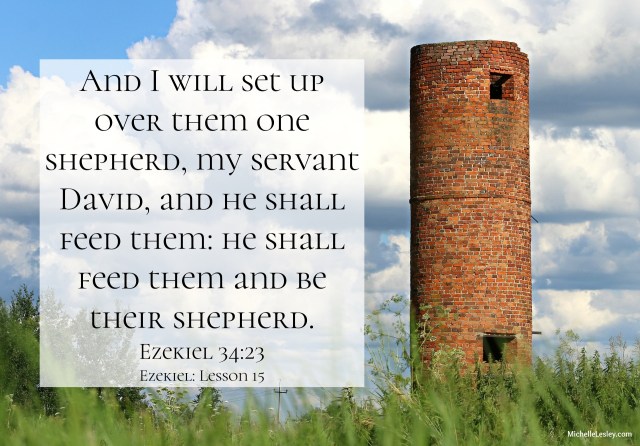
Reading this passage through the lens of “far” prophecy, who is “my servant David” (34:23-24)?
Carefully examine 33:25-31. Has any of this passage been fulfilled yet, either for the nation of Israel or for the church? If so, which parts? What does this passage point ahead to in general?
Compare chapter 34 to the following passages and any other shepherd/sheep motif passages you’re familiar with. How does God shepherd His people? In what ways is Jesus the Good Shepherd? How are we, His people similar to sheep? How are false teachers of today aptly described by chapter 34?
What are some ways the church today can properly apply chapter 34 to itself?
Homework
• Add 33:29, 34:27, 30 to your “And you/they shall know that I am the Lord” list. Write down who will know that He is the Lord, what will cause them to know He is the Lord, and why God wants them to know He is the Lord.
Suggested Memory Verse
Discover more from Michelle Lesley
Subscribe to get the latest posts sent to your email.
