Southern Baptist/SBC

Interview with Anticipated SBC Presidential Nominee: Mike Stone

MAY 2023 UPDATE: Mike ran for president of the SBC again in 2023. We posted my May 2023 interview with him on A Word Fitly Spoken: An Interview with SBC Presidential Candidate Mike Stone


Originally published March 19, 2021

Mike Stone, Michelle Lesley

Earlier this week, I had the opportunity to attend an event sponsored by the Louisiana chapter of the Conservative Baptist Network featuring Pastor Mike Stone, anticipated 2021 nominee for president of the Southern Baptist Convention.

The next morning, Pastor Mike graciously made the time to sit for a brief interview with me, which I’m making available to you today for informational purposes, especially if you’re Southern Baptist.

I’m sure there are some theological topics on which Pastor Mike and I don’t see eye to eye, so this isn’t meant to be an endorsement of anything that conflicts with my theology as outlined in my Welcome and Statement of Faith tabs, nor is the fact that Pastor Mike is appearing on my blog an endorsement of any of my theology that conflicts with his positions. This interview was simply a service both of us are providing to you so that you may know where Pastor Mike stands on the issues I asked him about.

That being said, as a brother and sister in Christ who share a passion for the sufficiency of Scripture, a disdain for so-called “soft-complementarianism,” and a desire to see the Southern Baptist Convention straighten up and fly right, I feel certain we have far more in common than not. I found Pastor Mike to be a warm and caring brother, and I commend him for taking a firm, biblical stand on some issues which, sad to say, will not earn him any brownie points in certain sectors of the SBC. That takes guts, and I respect that. I thoroughly enjoyed our chat.

Listen in on the audio player above or on my YouTube channel (audio only).

I know some of y’all like transcripts when I post audio. I was not able to transcribe Pastor Mike’s portion of interview, but you may read my questions – as well as a post-interview addendum to Pastor Mike’s answer to question #2 – here.

Many thanks to Pastor Mike Stone, the Conservative Baptist Network, the Louisiana chapter of the Conservative Baptist Network, CBN Steering Council member, Pastor Lewis Richerson, and Benjamin Lesley- producer, for making this interview possible.


June 9, 2021 Update: If you had the misfortune of reading former ERLC president Russell Moore’s recent slanderous screed, which basically accused Mike Stone and other biblically conservative SBC leaders of bullying and attempting to silence abuse victims who came forward, I wanted to make sure you got to see Mike’s video response (below) and read his press release.

(I am intentionally refraining from providing a link to the letter because if you’ve read it, you know, and if you haven’t read it, you can skip this entire update. I don’t want to give the letter any more of an airing than it’s already had.)

Southern Baptist/SBC

Change in the SBC? Field Notes from the Grassroots

The annual meeting of the Southern Baptist Convention is coming up in a few weeks.

As a lifelong Southern Baptist, I have thoughts. Feelings, even.

For the past several years – some might even say it started as soon as the Conservative Resurgence was over – the SBC has been on a slow but steady downward and unbiblical trajectory. False teachers line the (virtual) shelves of LifeWay Retail and headline LifeWay-sponsored conferences. False doctrine like extra-biblical revelation and Critical Race Theory are championed. Women have been preaching to men at conferences and para-church events for decades, and now women preaching the Sunday morning sermon in SBC churches is increasing in frequency and acceptance. NAMB was recently taken to task for sponsoring church plants with female pastors. Yoking with heretical, New Apostolic Reformation organizations – for example, when sitting SBC President Ronnie Floyd was a featured speaker at IHOP’s 2015 conference or when LifeWay’s Sunday School curriculum recommends music by Jesus Culture – a clear violation of Scripture, is defended.

And so much more.

It’s a real mess, folks. And to many average Southern Baptists like me, with no power, no position, it’s a mess that feels insurmountable. Beyond discouraging. Hopeless. Not worth the effort of trying to save.

Why? Because nobody in power cares what doctrinally sound, Joe and Jane Churchmember think. In fact, Joe and Jane often feel like we are seen by some in SBC leadership as ignorant, backwoods annoyances to the ruling class. The huddled unwashed masses stupidly crying, “Biblical reform!” as the multi-seminary-degreed elites condescendingly pat us on the heads and send us back to our pews assuring us they know what’s best.

I watched it happen in 2012 when I attended the annual meeting. A messenger went to the microphone after then president/CEO Thom Rainer’s report on LifeWay and began to express concern about the false teachers LifeWay carries. Dr. Rainer’s answer? “Trust the trustees.” The trustees, of course, being the ones who approved those authors for sale by LifeWay in the first place.

There are several brave and hardy Joes and Janes out there who still have fight left in them. Who believe the SBC is worth saving. Who believe it can be turned around if there’s a groundswell of involvement from the grassroots.

God bless them.

I mean that with all my heart. God bless them – mightily. I admire and heartily support them, and I urge you to support them too. I hope, against all hope, that they are right.

But I think there may be a bit of a disconnect in understanding where the “It’s time to chuck the whole thing” side of the aisle is coming from. So I just wanted to take a few moments to air that out – at least from my perspective.

“Show Up”

“Change is made by those who show up.” I’ve heard it multiple times from several different voices in the “grassroots for change” movement urging Joe and Jane to be present at the annual meeting each year. And, in theory, I completely agree. If you can show up, you should.

But in practice, it’s not as easy as it sounds. Yes, if you’ve got plenty of money, your time is your own, and your health and life circumstances permit you to travel to wherever the convention is being held every year, it’s pretty easy to show up.

It’s also easy to forget that not every Southern Baptist is so blessed. In fact, I would take a wild guess that probably 85% or more of Southern Baptist church members and a significant number of SBC pastors are not that comfortably fixed.

We don’t have hundreds or thousands of extra dollars in our family budgets every year to fly or drive what’s often thousands of miles across the country to the meeting site and pay hundreds more for a hotel, meals, and other expenses once we get there. That’s not the type of expense a lot of families can sacrifice for, save up, or scrape together just because we’re being urged to “show up” – the money simply isn’t there.

We have jobs that prevent us from taking time off for the convention. Many of those jobs don’t offer paid vacation time. If we don’t work, we don’t get paid. In some jobs, if you don’t show up whenever you’re needed, you get fired. Even for those fortunate enough to get paid vacation time, that time is limited and may need to be spent on something else – a family wedding, caring for a sick loved one, painting the house.

Some who can afford to make the trip and have the time to do so are limited by other life circumstances such as their health, local responsibilities, and family obligations.

It’s even difficult for many SBC pastors to attend the convention. Are we forgetting that the majority of our churches are small and many of our pastors are bi-vocational? “According to the 2014 Annual Church Profile (ACP) report, 90% of the churches reporting average fewer than 272 in their worship service, and 75% average fewer than 131.”1 Think about how much it would cost to fly your pastor to Nashville, feed him, rent him a car, and put him up in a downtown hotel for several days. How many of our churches that run 20 or 30 or 40 in Sunday worship can afford that? Some of them can’t even afford to pay their pastors a salary.

And then there are the Janes and Joes who are able and willing to attend the convention but find themselves members of doctrinally unsound SBC churches that actually agree with CRT or women pastors or any of the other aforementioned issues. Maybe their churches were once sound, but have taken an unbiblical turn. Or maybe God has only recently opened their eyes to sound doctrine and they’re trying to effect change in a stiff-necked church before being forced to abandon ship. How many of those church members are going to get approved as messengers by their churches? Having been in that situation myself, I can answer that question: Zero. That’s how many.

Many of these difficulties also hold true for the state conventions and associational meetings we’re urged to attend, meetings which are often held during work hours in the middle of the week and sometimes hundreds of miles from home.

It’s really easy for some to say, “If you don’t show up and vote, you can’t complain,” but the effect on those who want to show up, but can’t, is discouragement.

Are we effectively – albeit unintentionally – being respecters of persons by only giving a voice to those who can afford to “show up”? Are we not functionally discriminating against and silencing smaller, poorer churches and church members?

Biblical dissent is silenced or ignored.

For those of us who have seen how biblical dissent is handled by many SBC leaders, we have no reason to believe we’ll be listened to or taken seriously even if we do “show up” at associational meetings, state conventions, or the national convention.

I know of plenty of pastors and church members (including me) who have attempted to contact their local associational leaders, their state convention leaders, or leaders at the national level about some of these problematic issues. They’ve been placated. They’ve been ignored. Their emails, letters, and phone calls have gone unanswered. They’ve been dressed down and told they were wrong, or didn’t have enough faith, or were unloving or in sin, or weren’t being Christlike.

Last year we saw the grassroots outcry against David Uth, president of the 2020 SBC pastors conference, for inviting false teachers and a female pastor to headline the event. He still dug his heels in and refused to heed the godly reproof he received.

Current SBC president J.D. Greear makes a public statement about the Bible “whispering about sexual sin,” publicly supports and defends false teachers like Beth Moore, and maintains a friendship with at least one female “pastor” – among many other things – and completely ignores anyone who takes him to task for it.

The unspoken “11th Commandment” threat of retaliation against denominational, LifeWay, and seminary employees who, after exhausting all of the “proper channels” to no avail, speak out against unbiblical actions by their employers, superiors, or other denominational leaders, is an open secret, and no joke to those who have been intimidated, negatively impacted, fired, or forced to resign.

At the 2019 convention, messengers attempted to speak against Resolution 9, and their microphones were turned off. And I already mentioned what happened at the 2012 convention.

I appreciate the faith and optimism of those who think our voices can still be heard, I truly do. And I desperately hope they are right. Nothing would make me happier. But in the current SBC climate of ignoring, silencing, and even threatening biblical dissent and correction, surely they can also understand why many of us would wonder why any doctrinally sound Southern Baptist would ever dream of being listened to and taken seriously.

So….what’s the solution?

Many average church members and pastors who want change have no voice because they can’t afford to show up in person at the convention, and even if they do show up, there’s no reason to believe their voices will be heard, much less heeded. So, what’s the solution?

I can think of two practical remedies that might help a little.

Virtual attendance and distance voting- Every time I’ve suggested this or heard someone else suggest this, it has been immediately shot down – often by those urging involvement from the grassroots – in favor of messengers “showing up” in person, and because “the technological capability for this doesn’t exist.”

I’m sorry, I’m fully aware of how dense I am when it comes to technology, but I look around and see online shopping, PayPal, people filing their taxes and census forms online, online classes and testing, and all kinds of other very official things being done online that involve the transmission of sensitive information that has to be accurate, and I have an extremely difficult time believing that the Southern Baptist Convention can’t find some way in the next few years to make streaming the convention, submitting input and questions online, and voting online a reality. This is the 21st century and we still seem to be operating with a horse and buggy mindset.

Convention “Scholarships”- If you really want people to “show up,” you’re going to have to make it financially possible for those who can’t afford it. Commendably, many individual churches already do this for their own pastors and messengers, paying for their airfare, accommodations, and/or other expenses.

What about grassroots organizations establishing some sort of “scholarship” fund for pastors and potential messengers who would like to attend the convention, but neither they nor their churches can afford to send them? (Here’s a wild idea- why don’t we de-fund the ERLC and use those funds for this kind of thing instead?) What about churches and church members in the city in which the convention is being held opening their doors to pastors and messengers traveling on a shoestring budget and providing them with a place to stay, meals, and transportation around town?


Again, I wholeheartedly support my SBC brothers and sisters who are trying to effect change within the current system and structure. And I encourage all doctrinally sound Southern Baptists who can attend this year’s annual meeting to do so, and to fight hard and vote biblically. My own son and several members of my church are going to be attending, and I’m cheering them on. I’d go myself if I could. I’m hoping and praying for lots of good to be accomplished.

I don’t have all the answers. I’m not trying to be a Debbie Downer. I just know that if you do what you’ve always done, chances are, you’re going to get what you’ve always gotten.

And I just don’t think the Southern Baptist Convention can survive much more of that.


1So-Called โ€œSmallerโ€ Churches and the Future of the SBC
Southern Baptist/SBC

Interview with Anticipated SBC Presidential Nominee: Mike Stone

Mike Stone, Michelle Lesley

Earlier this week, I had the opportunity to attend an event sponsored by the Louisiana chapter of the Conservative Baptist Network featuring Pastor Mike Stone, anticipated 2021 nominee for president of the Southern Baptist Convention.

The next morning, Pastor Mike graciously made the time to sit for a brief interview with me, which I’m making available to you today for informational purposes, especially if you’re Southern Baptist.

I’m sure there are some theological topics on which Pastor Mike and I don’t see eye to eye, so this isn’t meant to be an endorsement of anything that conflicts with my theology as outlined in my Welcome and Statement of Faith tabs, nor is the fact that Pastor Mike is appearing on my blog an endorsement of any of my theology that conflicts with his positions. This interview was simply a service both of us are providing to you so that you may know where Pastor Mike stands on the issues I asked him about.

That being said, as a brother and sister in Christ who share a passion for the sufficiency of Scripture, a disdain for so-called “soft-complementarianism,” and a desire to see the Southern Baptist Convention straighten up and fly right, I feel certain we have far more in common than not. I found Pastor Mike to be a warm and caring brother, and I commend him for taking a firm, biblical stand on some issues which, sad to say, will not earn him any brownie points in certain sectors of the SBC. That takes guts, and I respect that. I thoroughly enjoyed our chat.

Listen in on the audio player above or on my YouTube channel (audio only).

I know some of y’all like transcripts when I post audio. I was not able to transcribe Pastor Mike’s portion of interview, but you may read my questions – as well as a post-interview addendum to Pastor Mike’s answer to question #2 – here.

Many thanks to Pastor Mike Stone, the Conservative Baptist Network, the Louisiana chapter of the Conservative Baptist Network, CBN Steering Council member, Pastor Lewis Richerson, and Benjamin Lesley- producer, for making this interview possible.

Church, Throwback Thursday

Throwback Thursday ~ Prideful and Prejudiced: Racism, Diversity, and Southern Baptists

Originally published April 1, 2016prideful prejudiced


Racism. The word practically emits the hum of electrical voltage. No decent person wants to be accused of being a racist, and no one wants to be mistreated on the basis of race. If thereโ€™s a more powerful word in the American vernacular right now, Iโ€™m not sure what it is.

Racism isnโ€™t something I normally think about or have to deal with on a daily basis even though it would seem to be swirling all around me here in the Deep South. Iโ€™m white. The majority of my friends are white. Either I donโ€™t know anyone whoโ€™s racist or those who are racist are wise enough, polite enough, or ashamed enough to keep it to themselves. But despite the fact that I donโ€™t have much one on one experience with it, race isย an issue that gets a lot of attention, and the main place Iโ€™m encountering racial issues of late is in my denomination, the Southern Baptist Convention.

Whether you see it as โ€œtoo little, too late,โ€ or โ€œitโ€™s about time,โ€ the upper echelons of the SBC have been talking a good game (and, in many instances, making progress) about diversity for the last couple of decades. It started in 1995 with the Resolution On Racial Reconciliation, in which the SBC confessed, apologized for, and sought forgiveness for past involvement with and support of slavery, racism, segregation, and other civil rights issues. Next came the task force that studied changing the name of the SBC to โ€œGreat Commission Baptistsโ€ due to the negative perceptions and racial implications of the word โ€œSouthern.โ€ This was followed by the election of Fred Luter, the first black president of the Southern Baptist Convention.

Fast forward to 2016. So far this year, three well-known pastors have declared their candidacy for president of the SBC, and each has indicated that diversity is an issue he will give attention to.

J.D. Greear: “I want to see minority leaders take places of real prominence in the SBC, such that diversity might become a hallmark of our denomination.”

Steve Gaines: At Bellevue, we donโ€™t just talk about racial reconciliation โ€“ we actually experience it and live in it as a reality. It works in our church because we focus on Jesus-centered racial reconciliation.

David Crosby (who will be nominated by Fred Luter): I hope to make [diversity] a matter of consideration from the very first as we seek to structure in the present for a future gospel strategy that is ever wider in its reach.

OK, great. More people of diverse racial backgrounds appointed to executive offices in the SBC. More books and resources about diversity. More seminars, conferences, panel discussions, and breakout sessions about race. Super. All of those things are wonderful and well intentioned, and will hopefully have some sort of positive impact at the administrative level.

But I really donโ€™t think itโ€™s going to make much of a dent in the actual problem.

I have a friend whose seminary graduate husband has been searching for a senior pastor position in an SBC church for about a year now. Heโ€™s a great guy who loves Godโ€™s people and rightly handles Godโ€™s word. And heโ€™s been turned down by church after church. Why? Iโ€™m sure the churches who have rejected him would list a variety of factors, but one of the reasons is that heโ€™s black and his wife is white.

Several years ago, my husband was on staff at an SBC church that was located across the street from a lower income housing project inhabited mostly by black, single parent families. The vast majority of our members were retired and I was a stay at home mom. We had a lot of people with a lot of free time on their hands. I suggested we start an after school tutoring program for the kids who lived in the housing project to minister to and reach out to our neighbors. The idea was quickly dismissed by a vocal few because โ€œwe donโ€™t want those people in our church.โ€

That’sย where realย racism lives in the SBC, not at the national, upper management level, but in the hearts of some of our individual church members.

  • Church members who excuse their sin by saying, โ€œWell, thatโ€™s just the way I was raised,โ€ or โ€œIโ€™m too old to change.โ€
  • Deacons, elders, and search committees who โ€“ instead of dealing with sin in the camp – make provision for the flesh of their churches by quietly pushing aside the resumes of minority pastors because they donโ€™t want to deal with the hassle of racist congregants making a stink or risk losing the money they contribute.
  • Churches who sell their buildings and move to a whiter part of town when the surrounding neighborhood โ€œgoes black.โ€
  • Christians whose offerings go around the world to share the gospel with people of all colors but who wonโ€™t go across the sanctuary to share a pew with people of another race.

Racism is an issue of the heart. Itโ€™s sin.

And sin canโ€™t be solved by appointments based on skin color or some sort of โ€œtrickle downโ€ diversity. It can only be solved by individuals repenting before a holy God, receiving His forgiveness, and growing in Christlikeness.

Godโ€™s way in the body of Christ is not โ€œtop down,โ€ with administrators creating programs, holding meetings and conferences, and strategically moving people into various positions like pawns on a chess board. Godโ€™s way is โ€œbottom up,โ€ with local pastors preaching the truth of Godโ€™s word to their people and calling them to repent. It begins with Christ working in peopleโ€™s hearts, one by one, convicting them of their arrogance and self-righteousness, their pride and their prejudice, their failure to see others through Godโ€™s eyes, and their failure to love one another the way God has commanded.

1 pet 1 22

The solution to racism and diversity in the SBC?
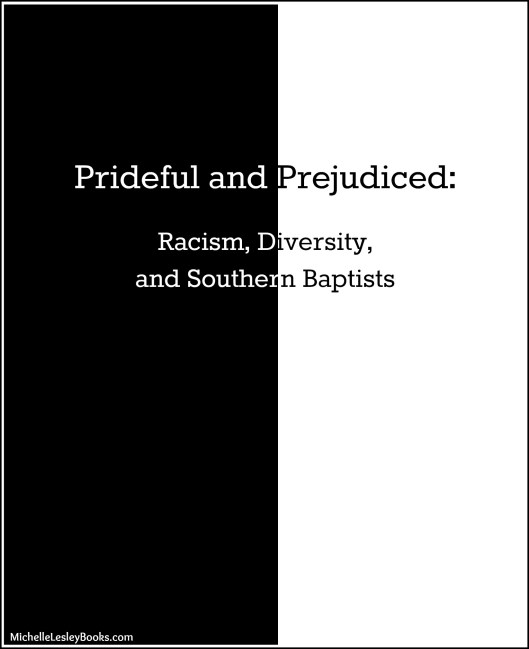
Itโ€™s right there in black and white.

Church

Prideful and Prejudiced: Racism, Diversity, and Southern Baptists

prideful prejudiced


Racism. The word practically emits the hum of electrical voltage. No decent person wants to be accused of being a racist, and no one wants to be mistreated on the basis of race. If thereโ€™s a more powerful word in the American vernacular right now, Iโ€™m not sure what it is.

Racism isnโ€™t something I normally think about or have to deal with on a daily basis even though it would seem to be swirling all around me here in the Deep South. Iโ€™m white. The majority of my friends are white. Either I donโ€™t know anyone whoโ€™s racist or those who are racist are wise enough, polite enough, or ashamed enough to keep it to themselves. But despite the fact that I donโ€™t have much one on one experience with it, race isย an issue that gets a lot of attention, and the main place Iโ€™m encountering racial issues of late is in my denomination, the Southern Baptist Convention.

Whether you see it as โ€œtoo little, too late,โ€ or โ€œitโ€™s about time,โ€ the upper echelons of the SBC have been talking a good game (and, in many instances, making progress) about diversity for the last couple of decades. It started in 1995 with the Resolution On Racial Reconciliation, in which the SBC confessed, apologized for, and sought forgiveness for past involvement with and support of slavery, racism, segregation, and other civil rights issues. Next came the task force that studied changing the name of the SBC to โ€œGreat Commission Baptistsโ€ due to the negative perceptions and racial implications of the word โ€œSouthern.โ€ This was followed by the election of Fred Luter, the first black president of the Southern Baptist Convention.

Fast forward to 2016. So far this year, three well-known pastors have declared their candidacy for president of the SBC, and each has indicated that diversity is an issue he will give attention to.

J.D. Greear: “I want to see minority leaders take places of real prominence in the SBC, such that diversity might become a hallmark of our denomination.”

Steve Gaines: At Bellevue, we donโ€™t just talk about racial reconciliation โ€“ we actually experience it and live in it as a reality. It works in our church because we focus on Jesus-centered racial reconciliation.

David Crosby (who will be nominated by Fred Luter): I hope to make [diversity] a matter of consideration from the very first as we seek to structure in the present for a future gospel strategy that is ever wider in its reach.

OK, great. More people of diverse racial backgrounds appointed to executive offices in the SBC. More books and resources about diversity. More seminars, conferences, panel discussions, and breakout sessions about race. Super. All of those things are wonderful and well intentioned, and will hopefully have some sort of positive impact at the administrative level.

But I really donโ€™t think itโ€™s going to make much of a dent in the actual problem.

I have a friend whose seminary graduate husband has been searching for a senior pastor position in an SBC church for about a year now. Heโ€™s a great guy who loves Godโ€™s people and rightly handles Godโ€™s word. And heโ€™s been turned down by church after church. Why? Iโ€™m sure the churches who have rejected him would list a variety of factors, but one of the reasons is that heโ€™s black and his wife is white.

Several years ago, my husband was on staff at an SBC church that was located across the street from a lower income housing project inhabited mostly by black, single parent families. The vast majority of our members were retired and I was a stay at home mom. We had a lot of people with a lot of free time on their hands. I suggested we start an after school tutoring program for the kids who lived in the housing project to minister to and reach out to our neighbors. The idea was quickly dismissed by a vocal few because โ€œwe donโ€™t want those people in our church.โ€

That’sย where realย racism lives in the SBC, not at the national, upper management level, but in the hearts of some of our individual church members.

  • Church members who excuse their sin by saying, โ€œWell, thatโ€™s just the way I was raised,โ€ or โ€œIโ€™m too old to change.โ€
  • Deacons, elders, and search committees who โ€“ instead of dealing with sin in the camp – make provision for the flesh of their churches by quietly pushing aside the resumes of minority pastors because they donโ€™t want to deal with the hassle of racist congregants making a stink or risk losing the money they contribute.
  • Churches who sell their buildings and move to a whiter part of town when the surrounding neighborhood โ€œgoes black.โ€
  • Christians whose offerings go around the world to share the gospel with people of all colors but who wonโ€™t go across the sanctuary to share a pew with people of another race.

Racism is an issue of the heart. Itโ€™s sin.

And sin canโ€™t be solved by appointments based on skin color or some sort of โ€œtrickle downโ€ diversity. It can only be solved by individuals repenting before a holy God, receiving His forgiveness, and growing in Christlikeness.

Godโ€™s way in the body of Christ is not โ€œtop down,โ€ with administrators creating programs, holding meetings and conferences, and strategically moving people into various positions like pawns on a chess board. Godโ€™s way is โ€œbottom up,โ€ with local pastors preaching the truth of Godโ€™s word to their people and calling them to repent. It begins with Christ working in peopleโ€™s hearts, one by one, convicting them of their arrogance and self-righteousness, their pride and their prejudice, their failure to see others through Godโ€™s eyes, and their failure to love one another the way God has commanded.

1 pet 1 22

The solution to racism and diversity in the SBC?
Itโ€™s right there in black and white.