Marriage

A No-Bull Marriage: Four Lessons from Mr. & Mrs. Samson

Originally published June 5, 2016

“If you had not plowed with my heifer,
you would not have found out my riddle.”

judges 14:18

I love this verse. It’s in the story of Samson, which I’m studying in depth right now, and it makes me giggle every time I come to it. Ripped from its context, it doesn’t make much sense (most Bible verses don’t), so go read Judges 14 really quickly. It’s only twenty verses. It shouldn’t take you more than ten minutes to read. I’ll just wait right here.

Done? Ok. Now you know the context, and you know Samson wasn’t talking about farming. He was talking about his wife. Now, ladies, before you get your bloomers in a ruffle, Samson wasn’t calling his wife a heifer, he was using a metaphor. He could just as easily have said, “If you hadn’t eaten sweet and sour shrimp with my chopsticks…” Well, if he were Chinese and if sweet and sour shrimp had been invented.

But anyway... it still wasn’t the most flattering metaphor a man could choose when referencing his wife, which got me thinking about Samson’s wife and their marriage. They messed some things up, big time. Things that they could have avoided messing up by being obedient to God’s commands about marriage. Maybe we could learn a few “noble,” or “no-bull,” if you prefer, things for our own marriages from Mr. and Mrs. Samson in Judges 14:

Maybe we could learn a few “noble,” or “no-bull,” if you prefer, things for our own marriages from Mr. and Mrs. Samson in Judges 14…

1.
Don’t be an unequally yoked heifer (v. 1-3)

Although the Philistines were not one of the nations God specifically forbade Israel to intermarry with, God’s principle of not marrying foreigners would have been a good one for Samson to follow. Why? Because only Israel worshiped the one true God. All of the other nations were pagan. They will “turn away your sons from following me, to serve other gods,” God told them. “But Samson said to his father, ‘Get her for me, for she is right in my eyes.’” (3) In my eyes. Not in God’s eyes. In Samson’s eyes. Samson wasn’t interested in what God wanted for his marriage. Samson was only interested in what Samson wanted.

As Believers, our hearts should long to obey Christ and to want what He wants for our lives. In 2 Corinthians 6:14-15, God tells us we are not to seek to bind ourselves together in any close relationship with unbelievers. That includes (but is not limited to) marriage. As God told the Israelites, an unbeliever will lead you away from the Lord. Husbands and wives should push each other towards Christ. A lost husband can’t lead you to greater godliness. If you are not yet married, do not marry someone who isn’t saved, whose life does not display the spiritual fruit of someone who has been genuinely born again.

Don’t be an unequally yoked heifer.

2.
Leave and cleave: plow with the bull you’re yoked to (v. 16-20)

Therefore a man shall leave his father and his mother and hold fast [cleave] to his wife, and they shall become one flesh.

Genesis 2:24

This doesn’t mean that we cut all ties with our parents when we get married. It means that we are now committed, first and foremost, to our spouses. We stand with them before, and sometimes against, everyone else.

Samson and his wife both had problems with this, as many newlyweds do. Samson’s wife, instead of standing with her husband by being honest with him about what his companions were up to and trusting him to protect her, ended up siding with “her people” (17) out of fear, by nagging Samson into telling her the answer to the riddle. Samson showed that he was loyal to his parents over his wife when he said in verse 16, “Behold, I have not told my father nor my mother [the answer to the riddle], and shall I tell you?” And when the whole fiasco was over, instead of going back and working things out with his wife, he abandoned her and went back home to live with his parents. (19-20)

Ladies, our husbands come first when it comes to loyalty, unity, bonding, and family decisions. Not our moms, our sisters, our best girlfriends, or even our children. And our husbands are to exhibit that same loyalty to us. Don’t hook yourself up to another plow.

Leave and cleave. Plow with the bull you’re yoked to.

3.
Don’t moonipulate; commoonicate (v. 16-17)

Pack your bags, we’re going on a guilt trip. And Samson’s wife had a saddlebag full of every vixenish wile she could squeeze in: emotional manipulation, shame, blame, nagging, and relentless pressure. Samson’s wife provides us with the perfect example of how not to communicate with our husbands.

Samson’s wife provides us with the perfect example of how *not* to communicate with our husbands.

We can all be tempted to use underhanded methods of getting what we want, but the God who tells us not to lie, to speak the truth, and not to act in selfish ambition but to put others first, is not a God who is pleased by such behavior. God is honored when we treat our husbands with kindness, respect, and honesty, and trust God enough to leave the outcome to Him.

Don’t moonipulate, commoonicate.

4.
Do the no-bull thing: forgive. (14:19-15:1)

While Samson may have had understandable reasons for being angry at both his companions and his wife, and while God may have used a bad situation to take out some of the enemies of His people, God calls husbands and wives to forgive one another.

Again, Samson shows us what not to do. Consumed by his anger, he abandoned his wife and seems to have held a grudge against her for a good while. When he finally went back with a peace offering, it wasn’t a pretty scene.

Be angry and do not sin; do not let the sun go down on your anger, and give no opportunity to the devil.

Ephesians 4:26-27

When we’re angry, self control can go out the window, making it easier to give in to Satan’s temptations to sin. Instead, it is God’s will for us to “Let all bitterness and wrath and anger and clamor and slander be put away from you, along with all malice. Be kind to one another, tenderhearted, forgiving one another, as God in Christ forgave you.”.

Forgive. It’s the noble thing to do.

Do the no-bull thing: forgive.

Marriage

A No-Bull Marriage: Four Lessons from Mr. & Mrs. Samson

“If you had not plowed with my heifer,
you would not have found out my riddle.”

judges 14:18

I love this verse. It’s in the story of Samson, which I’m studying in depth right now, and it makes me giggle every time I come to it. Ripped from its context, it doesn’t make much sense (most Bible verses don’t), so go read Judges 14 really quickly. It’s only twenty verses. It shouldn’t take you more than ten minutes to read. I’ll just wait right here.

Done? Ok. Now you know the context, and you know Samson wasn’t talking about farming. He was talking about his wife. Now, ladies, before you get your bloomers in a ruffle, Samson wasn’t calling his wife a heifer, he was using a metaphor. He could just as easily have said, “If you hadn’t eaten sweet and sour shrimp with my chopsticks…” Well, if he were Chinese and if sweet and sour shrimp had been invented.

But anyway... it still wasn’t the most flattering metaphor a man could choose when referencing his wife, which got me thinking about Samson’s wife and their marriage. They messed some things up, big time. Things that they could have avoided messing up by being obedient to God’s commands about marriage. Maybe we could learn a few “noble,” or “no-bull,” if you prefer, things for our own marriages from Mr. and Mrs. Samson in Judges 14:

Maybe we could learn a few “noble,” or “no-bull,” if you prefer, things for our own marriages from Mr. and Mrs. Samson in Judges 14…

1.
Don’t be an unequally yoked heifer (v. 1-3)

Although the Philistines were not one of the nations God specifically forbade Israel to intermarry with, God’s principle of not marrying foreigners would have been a good one for Samson to follow. Why? Because only Israel worshiped the one true God. All of the other nations were pagan. They will “turn away your sons from following me, to serve other gods,” God told them. “But Samson said to his father, ‘Get her for me, for she is right in my eyes.’” (3) In my eyes. Not in God’s eyes. In Samson’s eyes. Samson wasn’t interested in what God wanted for his marriage. Samson was only interested in what Samson wanted.

As Believers, our hearts should long to obey Christ and to want what He wants for our lives. In 2 Corinthians 6:14-15, God tells us we are not to seek to bind ourselves together in any close relationship with unbelievers. That includes (but is not limited to) marriage. As God told the Israelites, an unbeliever will lead you away from the Lord. Husbands and wives should push each other towards Christ. A lost husband can’t lead you to greater godliness. If you are not yet married, do not marry someone who isn’t saved, whose life does not display the spiritual fruit of someone who has been genuinely born again.

Don’t be an unequally yoked heifer.

2.
Leave and cleave: plow with the bull you’re yoked to (v. 16-20)

Therefore a man shall leave his father and his mother and hold fast [cleave] to his wife, and they shall become one flesh.

Genesis 2:24

This doesn’t mean that we cut all ties with our parents when we get married. It means that we are now committed, first and foremost, to our spouses. We stand with them before, and sometimes against, everyone else.

Samson and his wife both had problems with this, as many newlyweds do. Samson’s wife, instead of standing with her husband by being honest with him about what his companions were up to and trusting him to protect her, ended up siding with “her people” (17) out of fear, by nagging Samson into telling her the answer to the riddle. Samson showed that he was loyal to his parents over his wife when he said in verse 16, “Behold, I have not told my father nor my mother [the answer to the riddle], and shall I tell you?” And when the whole fiasco was over, instead of going back and working things out with his wife, he abandoned her and went back home to live with his parents. (19-20)

Ladies, our husbands come first when it comes to loyalty, unity, bonding, and family decisions. Not our moms, our sisters, our best girlfriends, or even our children. And our husbands are to exhibit that same loyalty to us. Don’t hook yourself up to another plow.

Leave and cleave. Plow with the bull you’re yoked to.

3.
Don’t moonipulate; commoonicate (v. 16-17)

Pack your bags, we’re going on a guilt trip. And Samson’s wife had a saddlebag full of every vixenish wile she could squeeze in: emotional manipulation, shame, blame, nagging, and relentless pressure. Samson’s wife provides us with the perfect example of how not to communicate with our husbands.

Samson’s wife provides us with the perfect example of how *not* to communicate with our husbands.

We can all be tempted to use underhanded methods of getting what we want, but the God who tells us not to lie, to speak the truth, and not to act in selfish ambition but to put others first, is not a God who is pleased by such behavior. God is honored when we treat our husbands with kindness, respect, and honesty, and trust God enough to leave the outcome to Him.

Don’t moonipulate, commoonicate.

4.
Do the no-bull thing: forgive. (14:19-15:1)

While Samson may have had understandable reasons for being angry at both his companions and his wife, and while God may have used a bad situation to take out some of the enemies of His people, God calls husbands and wives to forgive one another.

Again, Samson shows us what not to do. Consumed by his anger, he abandoned his wife and seems to have held a grudge against her for a good while. When he finally went back with a peace offering, it wasn’t a pretty scene.

Be angry and do not sin; do not let the sun go down on your anger, and give no opportunity to the devil.

Ephesians 4:26-27

When we’re angry, self control can go out the window, making it easier to give in to Satan’s temptations to sin. Instead, it is God’s will for us to “Let all bitterness and wrath and anger and clamor and slander be put away from you, along with all malice. Be kind to one another, tenderhearted, forgiving one another, as God in Christ forgave you.”.

Forgive. It’s the noble thing to do.

Do the no-bull thing: forgive.

Faith, Old Testament, Parenting, Prayer, Sunday School, Trust

Meet the Parents (of Samson) ~ Sunday School Lesson ~ 4-6-14

sunday school

These are my notes from my ladies’ Sunday School class this morning. I’ll be posting the notes from my class here each week. Click here for last week’s lesson.

Through the Bible in 2014 ~ Week 14 ~ Mar. 30-Apr. 6
Judges 1-18
Meet the Parents (of Samson)

In this week’s reading, we said goodbye to Joshua and met up with a variety of Israel’s lesser known judges. We also read about three better known characters in Israel’s history, judges Deborah, Gideon, and Samson. Often, when we come to passages like this, it’s like a treasure hunt. We focus on the valuables that are in plain sight. But, if we dig just a little, we can find more gems just beneath the surface. Today, we’re taking a look at two godly people who had a profound impact on Samson’s life: his parents.

Judges 13-14

Mr. and Mrs. Manoah
It’s always interesting to me that, just as we saw last week with the two spies, some of the most faithful of God’s servants are ordinary people like you and me serving God as they go about their daily tasks. And, just as with the two spies, in many cases, we never find out their names.  Samson’s mother was just this kind of nameless, faithful servant. Though we know little about her husband, Manoah, the most important thing about him—his faith—comes through loud and clear.

Barrenness (13:2-3)
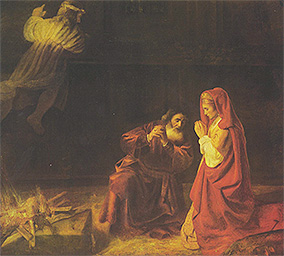
Mrs. Manoah was barren. Have you ever noticed how many “big names” in the Bible had mothers who were previously barren or who conceived miraculously? Joseph (Rachel), Samuel (Hannah), John the Baptist (Elizabeth), even Jesus (Mary), just to name a few. Things are different today, but, in manoah-wife-angel-offering the Bible, a miraculous conception was often a sign that the child would grow up to be a mighty man of God.

Barrenness was usually seen by others in the community as a curse by God or a punishment for sin (and sometimes it was: 2 Samuel 6:23). During that time in history, the only way for women to achieve status and be considered successful was by marrying and having children- particularly sons. A woman’s entire self-worth—in her own eyes, her husband’s eyes, and the eyes of her community—was at stake. So it’s easy to see why women and their husbands would have spent a great deal of time crying out to the Lord in prayer and seeking to be obedient to Him in hopes that He would grant their request for a child. We see this most clearly in the case of Hannah (1 Samuel 1), and it’s reasonable to surmise that this was likely also the case for Manoah and his wife.

Belief, Not Doubt (13:3-8)
It’s interesting that both times the angel of the Lord appeared to deliver His message, He initially appeared, not to the man, Manoah, but to the woman, his wife. Was it because she was praying at the time, or because her faith was stronger than her husband’s? This passage doesn’t tell us, so we don’t know. But, notice Mrs. Manoah’s reaction to the news that she would conceive. Did she laugh in disbelief like Sarah and Abraham did (Genesis 17:17,18:12)? Did she doubt like Zechariah (father of John the Baptist: Luke 1:18)? No, Mrs. Manoah believed. And, as a godly wife should, the first person she shared the news with and sought direction from was her husband.

Now let’s consider the reaction of Manoah to his wife’s news. Did he think her desire for a child had sent her over the edge or that she was making this up? No. He believed her without question. What does this tell us about the character, faith, and influence on her husband of Mrs. Manoah? “The heart of her husband trusted in her” (Proverbs 31:11) because she was a godly, trustworthy woman.

A Household of Faith (13)
In addition to spending time praying for a child, Mr. and Mrs. Manoah probably prayed regularly, like many other faithful Israelites, for deliverance from the Philistine oppressors, and here, we find them in prayer again.

Manoah not only trusted his wife, he had faith that the Lord would fulfill His promise. His first reaction was to believe and ask God the best way to obey Him. “And God listened to the voice of Manoah…” and answered his prayer of faith. He came back—to Manoah’s wife. Again, Manoah believed her without question and followed her out to meet the angel of the Lord.

When they met up with the angel, we see further evidence of this couple’s godliness. Though the angel had appeared and spoken twice with Mrs. Manoah, she, as a godly wife, does not take control of the situation or assert superiority over her husband. She takes a step back and, as a godly husband and leader of his home, Manoah steps up to the plate to assume the responsibility for his family and receive God’s instructions.

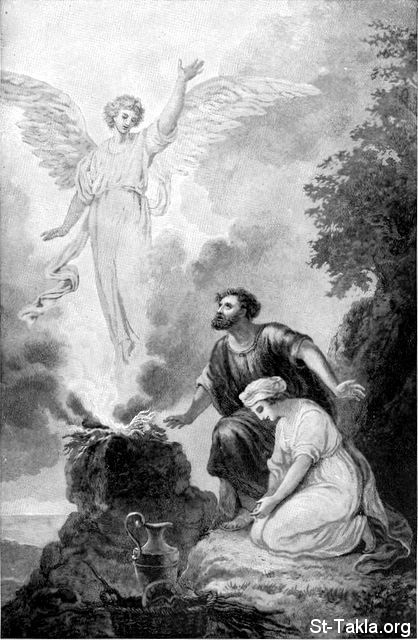
Manoah’s conversation with the Lord is fraught with faith. He doesn’t ask how or why they’re suddenly being blessed with a miracle child even though they’re just ordinary people. He simply accepts that it will happen. Manoah is confident that God is telling the truth and will keep His promise when he says, “When [not if] your words come true…” (12, 17). He believes God’s word that Samson will “begin to save Israel from the hand of the Philistines,” (5) when he asks about “the child’s manner of life, and…his mission” (12) so that he and Mrs. Manoah could prepare him to do so. He trusted in the www-St-Takla-org--12-Angel-Visits-Manoah-and-His-Wifecharacter of God, “the one who works wonders,” (19) and worshiped Him as such. He and Mrs. Manoah feared and trusted in God’s holiness as they fell on their faces at His departure (20).

Without a total grasp of the situation (22), Manoah believed God’s word that, “no man can see Me and live” (Exodus 33:20). Only later (21) did Manoah understand that He had been speaking with the angel of the Lord (Jesus – theophany: an appearance of the pre-incarnate Christ – {“My name…is wonderful” (18)- see Isaiah 9:6}—this is how people could “see God and live” even though God had said, “you cannot see Me and live.” They could not live through seeing God the Father, but they could live through seeing God the Son. Also a piece of supporting evidence for the Trinity). Jesus, the true deliverer and judge came personally to announce the birth of this temporal deliverer and judge who would point ahead to Christ.

Finally, we come full circle to Mrs. Manoah’s quiet trust in the Lord. Even with a strong faith like Manoah had, there can be moments of confusion. How could God say to Moses –the greatest leader Israel had ever known, the friend of God!—“you cannot see My face, for man shall not see me and live,”—yet here he and his wife were, having seen Him, but somehow still unscathed? How could anyone understand this?

But Mrs. Manoah shows us that faith means trusting God’s word even when we don’t fully understand His actions. Yes, it was true that God had said that people couldn’t live through seeing Him, but it was also true that He had visited them and told them they were going to have a son who would be a deliverer for Israel. How could both of those things be true at the same time? She probably couldn’t understand it either, but she encouraged her husband to trust God even in their confusion (23). And God kept His promise (24-25)

Trusting Despite the Circumstances (14:1-10)
Kids grow up, and as broken, sinful human beings, they sometimes make foolish decisions despite being raised in a godly home. That’s what Samson seems to have done here. While the Philistines were not one of the seven nations the Israelites were specifically forbidden to intermarry with, the principle behind God’s forbidding of intermarriage with those other nations was the same for the Philistines: they were idolaters and enemies of God and His people.

As godly parents, Mr. and Mrs. Manoah tried to steer their adult son to a godly choice of a wife. They reminded him that he was one of God’s people, and surely wanted him, as a leader in Israel, to set a good example for the people. Once again, they were seeking to be faithful to God.

thInstead of honoring his parents, Samson chose poorly. Or so it seemed. Either Samson was operating solely on lust and God sovereignly used the situation to His own advantage, or Samson, moved by God, was intentionally trying to infiltrate the Philistines by marrying in. The passage doesn’t make this precisely clear to us.

And, it wasn’t clear to Samson’s parents, either. So, perhaps thinking that they could influence the girl’s family or hoping Samson would change his mind, they went along with his decision and accompanied him to meet the new in laws. Once again, though the circumstances were worrisome and hard to understand, Mr. and Mrs. Manoah trusted that the God who had already worked so many wonders in their lives could handle this situation. They had faithfully obeyed what God had asked them to do and raised Samson in a godly home. Now, they had to sit back and watch God take care of the rest. And He did. Again, God kept His promises.

And we know that for those who love God all things work together for good,
 for those who are called according to his purpose. Romans 8:28