If you’re just joining me from ICRS, or from anywhere else for that matter, welcome! Thanks for joining the journey here at MichelleLesleyBooks!
Enjoy some of the archived articles, my on-line Bible study of the book of Jonah, some fun videos, or visit some of my favorite links. Click one of the tabs above to schedule a speaking engagement, find out how you can order Jacob: Journaling the Journey, or learn more about the Unreached People Group being reached by the royalties from the sale of the book.
For a more interactive experience, join us over on Facebook by clicking on the Facebook icon to the right.
For some reason there is some sort of technical difficulty over at Facebook right now that caused the title of my page, “Michelle Lesley- Author” to disappear from the top of my page, and some of the information to disappear from my “Info” page, but the page itself and all the rest of the content is still there. Hopefully, the problem will be solved soon. You can still click on the icon and “like” the page when you get there– and I hope you will!
For the next year, I’ll be donating all the money I personally make from the sale of Jacob: Journaling the Journey to reach an Unreached People Group of Bedouins with the gospel and other aid. These folks “journey” around in roughly the same area of the world as Jacob did, but most have never heard the good news of Jesus.
When you purchase Jacob: Journaling the Journey at ChristianBook.com, you’ll not only be getting a great Bible study to help you grow in your walk with the Lord, you’ll also be helping others to meet Jesus– maybe for the very first time. Order your copy(s) today, and let’s get the gospel out to these folks!
I’m a person who doesn’t like loose ends. I like everything tied up in a nice neat little package with a bow on top, so much so that, in my mind, my favorite book, Gone With the Wind, doesn’t end with Scarlett wondering whether or not she’ll get Rhett back. I’ve mentally re-written the ending. He comes to his senses before he gets to the end of the driveway and takes her back. And also, they both repent of being such scallywags and get saved. Because that’s how it is supposed to end.
I have a feeling Jonah was the kind of guy who needed closure, too. All God told Jonah to do was to go to Nineveh and preach the message He gave him. Jonah didn’t have to hang around and wait for the results. But aggravated as he was, Jonah felt the need to see things through. And he did much more than just dream up an alternate ending for a novel. This guy went to the trouble of building himself a little lean-to and hanging around in the desert heat and wind for who knows how long, to see what the Ninevites would do and how God would respond. And with each passing moment of Ninevite repentance, Jonah grew angrier and angrier. Because things weren’t ending the way he thought they were supposed to end.
It was time for an object lesson.
Castor Bean Plant
Overnight, God planted and grew some sort of vine—some scholars speculate that it was a castor bean plant—to grow up over Jonah and give him some relief from the sun and scorching wind. (Again, skeptics will cite the overnight growth of this vine as evidence that the book of Jonah couldn’t be literally true. Obviously none of them are from the South, or they would be familiar with kudzu, a climbing vine which has the ability to engulf your whole house while you’re walking to the mailbox.)
Kudzu
Oh, how wonderful it was! Oh, how Jonah probably praised God for it. And then, our “the Lord giveth and the Lord taketh away” God killed Jonah’s shade.
And Jonah lost it.
I mean, he was fit to be tied furious.
I see him ranting and raving, yelling at God, “MAD?!? OF COURSE I HAVE THE RIGHT TO BE MAD!!!”
Now, I’m not sure why God didn’t turn Jonah into a little wet spot on the sand right then and there. He certainly could have, and He had previously done so to people who seemed to have committed far lesser offenses than hollering right in His face. But while we look on the outward appearance, God looks on the heart (I Samuel 16:7), and there was something in Jonah’s heart that God wanted to deal with, not by striking him down, but by reasoning with him.
“Jonah,” God said, “Get over it. It was just a plant, here today and gone tomorrow. You didn’t plant it. You didn’t sweat over it and tend it. You didn’t lift a finger to make it grow. What’s the big deal?”
“What’s the big deal? Get over it? Lord, that plant was great! I enjoyed it! It was beautiful and brought me delight!”
“Yeah, and you know what, Jonah? That’s how I feel about the Ninevites. Only they’re not just some dumb plant. They have eternal souls. I’ve watched as each and every one of them was born. It has broken My heart as time after time they have each dived headlong into sin when they could have delighted in Me instead. I want to heal them. I made them. I love them. You care more about that stinkin’ plant than you do about human beings who desperately need Me.”
The End.
Wait, what do you mean “The End”? Is this another one of those stories that leaves loose ends out there? How could the story end right here? What happens next?
Well, in my mind, Jonah comes to his senses and grasps the irony of the situation. The God who loves him and forgave his rebellion is the same God who loves the Ninevites and forgives them of their rebellion. Jonah repents completely this time and rejoices in the work God has done. He makes friends with the Ninevites and plants First Baptist Church of Nineveh right where the pagan temple used to stand. They celebrate the ribbon cutting with an all-day singing and dinner on the grounds—a fish fry, of course. And everybody lives happily ever after.
Because that’s how it’s supposed to end.
Journal Time:
Compare Jonah’s attitude about God forgiving and showing mercy to Nineveh with the attitude of Simon towards the sinful woman in Luke 7:36-50. What are some similarities or differences? How would you fit into the story? Would you be Jonah/Simon, Nineveh/the sinful woman, neither, or both? Explain.
Did you ever have a missionary come to your church to tell you about his work? Maybe he told you about getting Bibles to people who have never had one in their own language. Or maybe he told you about a church he built for people who had been worshipping out under a tree or something. A missionary usually excited about the work God is doing, even if that work is difficult.
If I were a gambler, I’d be willing to bet you’ve never had a missionary come to your church and say,
“I never wanted to go there in the first place, but God sort of made me an offer I couldn’t refuse. So I get there, preach one sermon, and the whole city, including the king, demonstrates serious, heartfelt repentance and believes in God. (Insert disgusted sigh here.) I knew this was going to happen. Just kill me. Kill me now.”
You know, when I study someone in the Bible, I bend over backwards to give him the benefit of the doubt. I consider his cultural context, the fact that he was a fallible human just like the rest of us, the fact that he didn’t have the whole Bible like we do, etc. But I’ve got to be honest with you—I just want to smack this clown upside the head.
Are ya kidding me, Jonah? Seriously?
First, God gives you the unimaginable honor and blessing of placing a calling on your life. He—the Creator, Savior, and Sustainer of the entire universe; the all knowing, all powerful, perfect in holiness God—He wants to use you—Jonah—a slimy little piece of fish food.
Do you thank Him? Stand in awe that He would choose you? No. You don’t like the assignment that the almighty, perfectly wonderful God gave you, so you run off in rebellion like an idiot and nearly get killed for your trouble. And this same God, in Whose face you’ve just pitched a fit like a petulant child, saves your sorry little life—miraculously, I might add—and gives you another chance. And what do you do? You stomp your foot and say, “Fine. I’ll go.”
So you get there, reluctantly do what God told you to do, and get a storybook ending without even breaking a sweat. This is usually where the confetti and balloons fall down from the ceiling and everybody cheers. But noooooooo. Not our buddy Jonah. Jonah pouts, hollers at God: “See, I told You so!”, and throws another hissy fit. Why does God put up with this guy?
Wait…
There’s something oddly familiar about this story. Seems like I’ve heard it before.
Oh, yeah.
That would be me. My life story.
How many times have I clearly heard the Holy Spirit saying, “Nope. Don’t say that. Keep your mouth shut.” but because I wanted to smart off, or pierce someone with a verbal barb, I said it anyway, and then tried to justify myself to the Lord later?
How many times have I complained about household chores when that’s part of the calling God has placed on my life right now? And He’s blessed me with the house, and with the family I’m caring for by doing the chores!
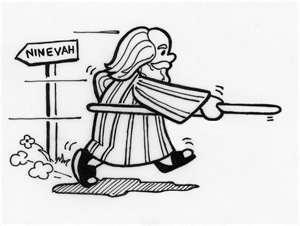
What about the times during the course of writing this study, that I’ve put my feet on the road to Joppa by goofing off and giving in to distractions instead of sitting down to study and write?
Wow. That patience God showed Jonah looks a lot more precious when the sandal’s on the other foot.
Journal Time:
Does Jonah’s story (above) sound familiar to you, too? Write about a time when you acted like Jonah.
Request: that God remind you to be thankful in all things.
Seek God: about any ways you may have been running from Him or rebelling against Him of which you were not aware, and ask Him to bring those areas in line with His desires.
One of the reasons people sometimes give for not believing that the book of Jonah is literally true is the mass repentance of the Ninevites. If you’ll recall, the city of Nineveh was huge for its time—120,000 to 600,000 people (by the way, if you’re wondering where this figure comes from, check out 4:11. Some scholars believe the phrase “120,000 persons who do not know the difference between their right and left hand” refers to the children of Nineveh, and they add on extra people to account for teens and adults. Some believe that phrase is a metaphor for being spiritually blind and leave the number at 120,000. Others take the size of Nineveh, perhaps 60 miles in circumference, divide the area of the city into square yardage and assign a certain number of people per square yard based on population formulas. Anyway, it was big.)
But when people say Jonah’s story couldn’t be true because such a large number of people would never repent, they are essentially denying the character and/or the power of God. Think about it—repentance is an act of God. Every single one of us is born into the “default mode” of a sin nature. Nobody has to teach us how to lie or be selfish or be disobedient; we just do those things naturally. We do not repent of our sin and turn to Christ in faith unless God first draws us to Himself (John 6:44). So to say that a large number of people would not repent is to say either: a) God is not capable of drawing that many people to Himself for repentance (we know that’s not true from verses like Job 23:13 and Psalm 135:6), or b) that God would not want to draw that many people to Himself (which we know is not true from verses like Ezekiel 18:23, 33:11, and II Peter 3:9) and, therefore, would never choose to do so.
We also know, just anecdotally, that God does sometimes draw people to Himself en masse. Ever heard of the Great Awakening? The Welsh Revival? Billy Sunday? Acts 2:41?
Before He ever called Jonah the first time, God was already at work in Nineveh, stirring the people’s hearts—and the heart of the king—to be ready to repent when they heard His word. And He did His job well. Notice in verse 5, it says that the people of Nineveh believed in God. They are the ones who first initiated fasting and putting on sackcloth and ashes. It wasn’t until after this that Jonah’s preaching reached the king (6). He was then also convicted, fasted in sackcloth and ashes personally, and then codified these acts of repentance into a three day law. This wasn’t a king trying to score popularity points, either. Kings back then, especially pagan ones, did as they pleased, including killing off their subjects if they felt like it. This was entirely an act of God.
All of which might lead us to wonder, if God desires for all people to come to repentance, and God is capable of drawing both individuals and large groups of people to Himself, why doesn’t He just go ahead and draw everyone on the planet to such an irresistible degree of conviction and repentance that everyone gets saved, and no one ever has to spend eternity in hell?
The answer is…
I don’t know.
And, truth be told, it’s not my business to worry about it.
Because what I do know is:
God is sovereign. He knows everything and is in complete control of everything. He never drops the ball.
God’s ways are higher than my ways and His thoughts are higher than my thoughts (Isaiah 55:8-9). He knows more about how things work and how to handle things than I do. A LOT more.
God is always right, no matter what (Psalm 145:17). He has never made a wrong decision.
God is always perfectly just (Deuteronomy 32:3-4). No one will ever be able to stand before Him and rightly accuse Him of being unfair.
If I don’t understand God’s ways or if I think He’s doing something the wrong way, it’s not because He’s wrong, it’s because of my lack of knowledge and understanding of His ways. (I Corinthians 13:12)
My business is to love Him and obey Him (John 14:15) and let Him handle everything else.