
Parenting, Throwback Thursday

Throwback Thursday ~ The 10 Commandments of Parenting- 7

Originally published June 9, 200810 Commandments Parenting 7

7.

Thou shalt consistently and lovingly
discipline thy children.

Whoever spares the rod hates his son,
    but he who loves him is diligent to discipline him. Proverbs 13:24

These kids today! Every generation since Adam and Eve has probably said it. Certainly today, you can’t throw a rock out the window without hitting half a dozen ill-behaved brats. We’ve all cringed at the temper tantrum-throwing child seated at the next table in the restaurant, or watched a mom in the store tell her little sweetie “no” a dozen times, only to finally give in to his demands. Heck, most of us have probably been that mom on occasion.

Hundreds of books, both Christian and secular, have been written on the topic of how to discipline children, but much rarer are the writings about why we should discipline them. As always, the easy answer to that question for the Christian is: “because God said so”. But why does God tell us to discipline our children? Because discipline teaches our children that we love them.

The most important way we can love our children is to lead them to salvation. Learning obedience to parents not only teaches them about sin, law breaking, punishment, and repentance, it also teaches them the concept of setting aside their own desires in favor of submitting to the authority that has been placed over them. This has direct application to the spiritual construct of salvation. Salvation does not take place until, through faith in Christ, we repent of our sin and submit our will to the authority and Lordship of Christ and commit to follow and obey Him.

First John 4:20 says: “If someone says, “I love God,” and hates his brother, he is a liar; for the one who does not love his brother whom he has seen, cannot love God whom he has not seen.” I really believe this principle generally applies to obedience as well. One of the things I tell my kids when I discipline them is that, although I don’t enjoy punishing them or letting them suffer the consequences of their actions, I have to do it because I want them to start learning, through obeying me, how to obey God. I’m flesh and blood standing right in front of them, clearly telling them what to do and what will happen if they don’t obey. If they can’t obey me, how in the world are they going to learn to obey God, whom they can’t see or hear with their eyes and ears? Conversely, if a child has been lovingly and consistently disciplined, how much easier will it be to introduce him to the concept of submission to God’s authority?

Another vital spiritual principle that discipline helps teach is an understanding of sin, its consequences, and punishment. A child who has been disciplined knows what it means to be guilty of breaking the rules. He also knows that because he has broken a rule, some sort of undesirable consequence will follow swiftly. A child who has not been disciplined believes he does no wrong and that the world around him should be catering to his wants and demands. Which child will be able to grasp the idea that he is a sinner in need of salvation? Which one will understand contrition, eternal punishment, and eternal reward?

Teaching obedience also teaches our children that we are concerned about how they fare with others. My children have come to me in the past and told me that they don’t like being around certain friends of theirs who constantly misbehave. On these occasions, I very carefully (to ensure that they don’t become critical or develop an attitude of superiority) explain to my children that this is one of the reasons Daddy and I teach them good behavior. We don’t want them to experience the sadness that misbehaving child is sure to feel when he realizes that people don’t want to be around him. We teach them that we love them enough to want others to delight in them.

Discipline shows love for our children through concern for their safety. If my child doesn’t obey me when I tell him not to run into the street, he could be killed by an oncoming car. If he runs into the street and then stands there and argues with me when I tell him to get back on the sidewalk, he could also be killed.

Many years ago, when I was teaching school, a kindergarten student of mine was killed in a house fire. He didn’t die because he was unable to get out of the house. He was rescued, unharmed, and was told not to go back into the house. This little boy, notoriously disobedient, went back into the house. He died as a result of lack of discipline.

I have told my children these stories on occasion, not to scare them unnecessarily, but to show them just how serious the consequences of disobedience can be. All the spiritual principles in the world won’t matter if a child isn’t alive to learn them.

Love your children by disciplining them. Show them love through their physical safety; show them love through their social well-being; and show them love through their eternal security
Wednesday's Word

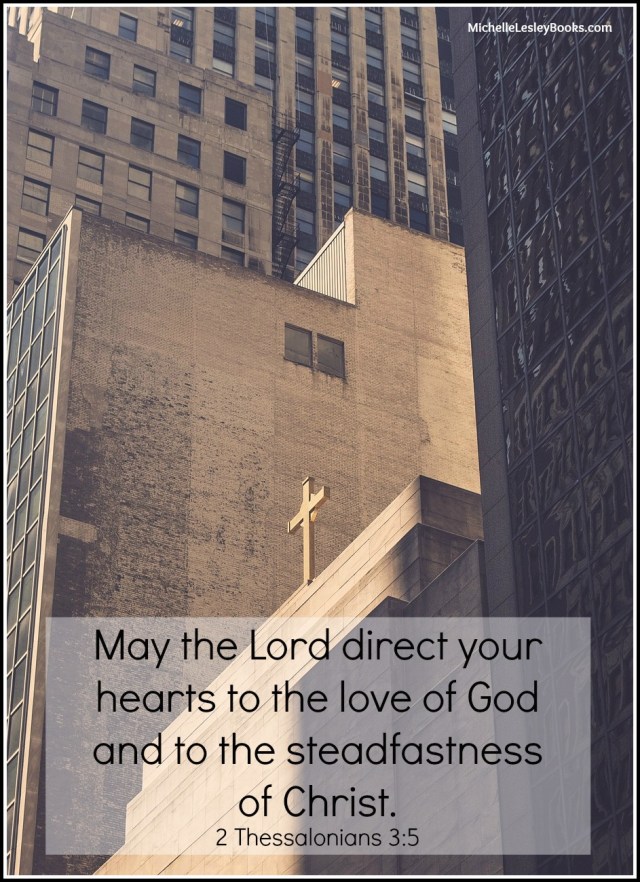
Wednesday’s Word ~ 2 Thessalonians 3

2 Thess 3 5

2 Thessalonians 3

Finally, brothers, pray for us, that the word of the Lord may speed ahead and be honored, as happened among you, and that we may be delivered from wicked and evil men. For not all have faith. But the Lord is faithful. He will establish you and guard you against the evil one. And we have confidence in the Lord about you, that you are doing and will do the things that we command. May the Lord direct your hearts to the love of God and to the steadfastness of Christ.

Now we command you, brothers, in the name of our Lord Jesus Christ, that you keep away from any brother who is walking in idleness and not in accord with the tradition that you received from us. For you yourselves know how you ought to imitate us, because we were not idle when we were with you, nor did we eat anyone’s bread without paying for it, but with toil and labor we worked night and day, that we might not be a burden to any of you. It was not because we do not have that right, but to give you in ourselves an example to imitate. 10 For even when we were with you, we would give you this command: If anyone is not willing to work, let him not eat. 11 For we hear that some among you walk in idleness, not busy at work, but busybodies. 12 Now such persons we command and encourage in the Lord Jesus Christ to do their work quietly and to earn their own living.

13 As for you, brothers, do not grow weary in doing good. 14 If anyone does not obey what we say in this letter, take note of that person, and have nothing to do with him, that he may be ashamed. 15 Do not regard him as an enemy, but warn him as a brother.

16 Now may the Lord of peace himself give you peace at all times in every way. The Lord be with you all.

17 I, Paul, write this greeting with my own hand. This is the sign of genuineness in every letter of mine; it is the way I write. 18 The grace of our Lord Jesus Christ be with you all.


The Holy Bible, English Standard Version Copyright © 2001 by Crossway Bibles, a publishing ministry of Good News Publishers.


Questions to Consider:

1. What three things does Paul ask the members of the church at Thessalonica to pray for his team? (1-2)

2. Do the first five verses of this chapter seem to indicate that the Thessalonian church is generally healthy, obedient to the Word, and headed in the right direction, or unhealthy and declining? Which words and phrases lead you to think this? Could the same be said of your church?

3. What topic is Paul dealing with in verses 6-12? Which word, repeated three times (6, 7, 11) is a key word for this section? What does it mean? What is God’s will for Christians with regard to work versus idleness? How could this theology of work affect the way you do your job, run your business, or vote on economic issues?

4. Some pastors are bi-vocational. They have a regular job during the week and a part time pastorate. Do verses 7-9 require pastors to be bi-vocational? Why (9) does Paul say that he and his team worked in addition to their pastoral duties?

5. What are Paul’s instructions (14-15) regarding disobedient church members? How do these instructions compare with other New Testament teaching about church discipline? What is the ultimate goal of church discipline?

Calvinism/Arminianism, Throwback Thursday

Throwback Thursday ~ What is Reformation Day?

Originally published at
Satisfaction Through Christ
on October 10, 2014.

reformation day

The Protestant Reformation. Outside of Biblically recorded events and the closing of the canon of Scripture, it is arguably the most important event in church history, and one of the most important events in world history as well, yet many Christians today are unaware of this landmark incident in their heritage which birthed the Protestant church.

The year was 1517. A monk named Martin Luther gripped his hammer and nailed a list of biblical grievances against the Roman Catholic Church to the door of Castle Church in Wittenberg, Germany, much like we might post a notice to a community bulletin board today. These 95 Theses protested the Catholic Church’s unbiblical policy of selling indulgences,  part of an effort to raise funds for the building of St. Peter’s Basilica in Rome. The Catholic Church had created the idea of the Treasury of Merit, sort of a “bank account” of merit deposited by Christ, Mary, the saints, and others as a result of their good works. When church members sinned, they could purchase an indulgence, which was akin to asking the Church to “transfer funds” from the Treasury of Merit to the sinner’s account. The indulgence basically excused the sinner from a certain amount of time in purgatory and/or temporal punishment for that sin.

In addition to protesting the sale of indulgences, Luther’s 95 Theses called the Catholic Church to conform to Scripture by abandoning its unbiblical practices and teachings regarding the doctrines of salvation, religious authority, the nature of the church, and the essence of Christian living.

95Thesen

Luther’s calls for reform spread quickly throughout Europe, inspiring the likes of church fathers Ulrich Zwingli (Zurich), John Calvin (Geneva), and John Knox (Scotland) to join the effort in their own locales. As they worked to address the issues raised in Luther’s document, these men codified what we know today as the “Five Solas of the Reformation,” the basis of Protestant church doctrine. The five solas are:

1. Sola ScripturaScripture alone is the basis for all church doctrine, belief, and practice. (2 Timothy 3:16-17)

2. Sola Gratia– Salvation is by grace alone. It is an unmerited gift of God based solely on His goodness, not our own (because we don’t have any). (Ephesians 2:8-9)

3. Sola Fide– Salvation is through faith alone. Faith is a gift bestowed by God. We are saved only by placing that faith in Christ’s finished work on the cross, not by doing good works or by any other attempts to earn salvation. (Ephesians 2:8-9)

4. Solus Christus– Salvation is found in Christ alone. As Acts 4:12 says, “And there is salvation in no one else, for there is no other name under heaven given among men by which we must be saved.”

5. Soli Deo Gloria– God saves man for God’s glory alone, and Believers are to live our lives to glorify Him alone. (Romans 11:36)

One of Luther’s most cherished ideals, from which we still benefit today, was that common people should have access to both the Scriptures and worship services in their own language. Prior to the Reformation, the Bible was only available in Latin. Likewise, all masses and other church services were conducted in Latin. Luther translated the Bible into German, and was later followed by William Tyndale, Myles Coverdale, David Brainerd, and others who translated the Bible into various languages.

On Reformation Day, we commemorate the work, zeal, and sacrifices of Luther and the other reformers. Reformation Day is observed on October 31.

Wednesday's Word

Wednesday’s Word ~ Nehemiah 8

neh 8 6

Nehemiah 8

And all the people gathered as one man into the square before the Water Gate. And they told Ezra the scribe to bring the Book of the Law of Moses that the Lord had commanded Israel. So Ezra the priest brought the Law before the assembly, both men and women and all who could understand what they heard, on the first day of the seventh month. And he read from it facing the square before the Water Gate from early morning until midday, in the presence of the men and the women and those who could understand. And the ears of all the people were attentive to the Book of the Law. And Ezra the scribe stood on a wooden platform that they had made for the purpose. And beside him stood Mattithiah, Shema, Anaiah, Uriah, Hilkiah, and Maaseiah on his right hand, and Pedaiah, Mishael, Malchijah, Hashum, Hashbaddanah, Zechariah, and Meshullam on his left hand. And Ezra opened the book in the sight of all the people, for he was above all the people, and as he opened it all the people stood. And Ezra blessed the Lord, the great God, and all the people answered, “Amen, Amen,” lifting up their hands. And they bowed their heads and worshiped the Lord with their faces to the ground. Also Jeshua, Bani, Sherebiah, Jamin, Akkub, Shabbethai, Hodiah, Maaseiah, Kelita, Azariah, Jozabad, Hanan, Pelaiah, the Levites, helped the people to understand the Law, while the people remained in their places. They read from the book, from the Law of God, clearly, and they gave the sense, so that the people understood the reading.

And Nehemiah, who was the governor, and Ezra the priest and scribe, and the Levites who taught the people said to all the people, “This day is holy to the Lord your God; do not mourn or weep.” For all the people wept as they heard the words of the Law. 10 Then he said to them, “Go your way. Eat the fat and drink sweet wine and send portions to anyone who has nothing ready, for this day is holy to our Lord. And do not be grieved, for the joy of the Lord is your strength.” 11 So the Levites calmed all the people, saying, “Be quiet, for this day is holy; do not be grieved.” 12 And all the people went their way to eat and drink and to send portions and to make great rejoicing, because they had understood the words that were declared to them.

13 On the second day the heads of fathers’ houses of all the people, with the priests and the Levites, came together to Ezra the scribe in order to study the words of the Law. 14 And they found it written in the Law that the Lord had commanded by Moses that the people of Israel should dwell in booths during the feast of the seventh month, 15 and that they should proclaim it and publish it in all their towns and in Jerusalem, “Go out to the hills and bring branches of olive, wild olive, myrtle, palm, and other leafy trees to make booths, as it is written.” 16 So the people went out and brought them and made booths for themselves, each on his roof, and in their courts and in the courts of the house of God, and in the square at the Water Gate and in the square at the Gate of Ephraim. 17 And all the assembly of those who had returned from the captivity made booths and lived in the booths, for from the days of Jeshua the son of Nun to that day the people of Israel had not done so. And there was very great rejoicing. 18 And day by day, from the first day to the last day, he read from the Book of the Law of God. They kept the feast seven days, and on the eighth day there was a solemn assembly, according to the rule.


The Holy Bible, English Standard Version Copyright © 2001 by Crossway Bibles, a publishing ministry of Good News Publishers.


Questions to Consider:

1. What were some of the events that led up to Nehemiah 8? Why would this “worship service” have been especially meaningful for the people?

2. Which phrase in verse 2, repeated in verse 3, show us God’s desire for all people to hear and understand His word? How does this phrase hint at the love God has for women and children?

3. Read verses 2-8 and describe the scene in your own words or make a sketch of what it might have looked like. Which elements of this worship service are similar to the elements of the services at your church today? Why are these elements important? Why do you think they have lasted until the present time?

4. Why were the people weeping (9)? Why were they told not to weep (10-11)? Were the spiritual leaders ignoring the people’s desire to repent? What was the Feast of Booths (14)? How was the recent return from exile (17) similar to the original event the Feast of Booths commemorated?

5. Two key words in this chapter are “understand” and “rejoice/joy.” How many times do you see these words mentioned? What does God want us to learn from this chapter about understanding His word and taking joy in His word and in obedience to it?

Wednesday's Word

Wednesday’s Word ~ Ezra 3

For further study on the book of Ezra, try my study, Ezra.

ezra 3 11

Ezra 3

When the seventh month came, and the children of Israel were in the towns, the people gathered as one man to Jerusalem. Then arose Jeshua the son of Jozadak, with his fellow priests, and Zerubbabel the son of Shealtiel with his kinsmen, and they built the altar of the God of Israel, to offer burnt offerings on it, as it is written in the Law of Moses the man of God. They set the altar in its place, for fear was on them because of the peoples of the lands, and they offered burnt offerings on it to the Lord, burnt offerings morning and evening. And they kept the Feast of Booths, as it is written, and offered the daily burnt offerings by number according to the rule, as each day required, and after that the regular burnt offerings, the offerings at the new moon and at all the appointed feasts of the Lord, and the offerings of everyone who made a freewill offering to the Lord. From the first day of the seventh month they began to offer burnt offerings to the Lord. But the foundation of the temple of the Lord was not yet laid. So they gave money to the masons and the carpenters, and food, drink, and oil to the Sidonians and the Tyrians to bring cedar trees from Lebanon to the sea, to Joppa, according to the grant that they had from Cyrus king of Persia.

Now in the second year after their coming to the house of God at Jerusalem, in the second month, Zerubbabel the son of Shealtiel and Jeshua the son of Jozadak made a beginning, together with the rest of their kinsmen, the priests and the Levites and all who had come to Jerusalem from the captivity. They appointed the Levites, from twenty years old and upward, to supervise the work of the house of the Lord.And Jeshua with his sons and his brothers, and Kadmiel and his sons, the sons of Judah, together supervised the workmen in the house of God, along with the sons of Henadad and the Levites, their sons and brothers.

10 And when the builders laid the foundation of the temple of the Lord, the priests in their vestments came forward with trumpets, and the Levites, the sons of Asaph, with cymbals, to praise the Lord, according to the directions of David king of Israel. 11 And they sang responsively, praising and giving thanks to the Lord,

“For he is good,
    for his steadfast love endures forever toward Israel.”

And all the people shouted with a great shout when they praised the Lord, because the foundation of the house of the Lord was laid. 12 But many of the priests and Levites and heads of fathers’ houses, old men who had seen the first house, wept with a loud voice when they saw the foundation of this house being laid, though many shouted aloud for joy, 13 so that the people could not distinguish the sound of the joyful shout from the sound of the people’s weeping, for the people shouted with a great shout, and the sound was heard far away.


The Holy Bible, English Standard Version Copyright © 2001 by Crossway Bibles, a publishing ministry of Good News Publishers.


Questions to Consider:

1. The book of Ezra deals with the second wave (out of three) of Israelites returning from exile in Persia after the destruction of Jerusalem. Why was it important to them (3) to set up the altar? Why did they begin keeping the feasts and offering sacrifices before the temple was rebuilt?

2. What was the Feast of Booths (4), and which event in Israel’s history did it commemorate? What are some similarities between the Exodus and Israel’s recent return from exile which might have made this celebration of the Feast of Booths especially meaningful for the people? Which attributes of God are on display in both the Exodus and the return from exile?

3. Why would it have been important for the Levites (8) to supervise the work on the temple? How does this show the people’s reverence for God’s house and their desire to do things “decently and in order“?

4. Try to put yourself in the shoes of the average Israelite in verses 10-11. Think about what your experience in exile might have been like and how you might feel finally back, free, in your homeland. Now, the temple is at last being rebuilt so you can worship God – maybe for the first time in your life – in the place and the way He intended. What emotions might you be experiencing? What sorts of things might you be praising God for? Take some time to thank God for some specific things about your own church.

5. For what reasons might the old men have been weeping? (12-13) How could both tears and joy be proper expressions of worship in this passage and in worship today? What gives you joy in worship? What brings you to tears when you worship?