Faith, Sin

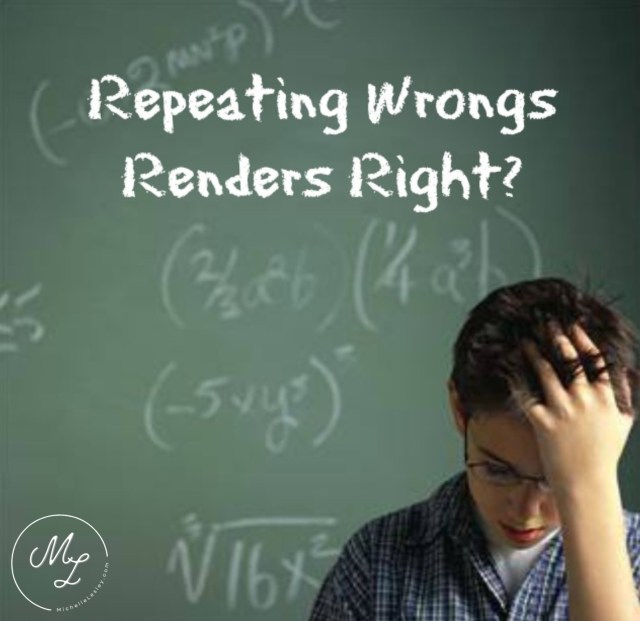
Repeating Wrongs Renders Right?

“Four hundred thirty seven.”

“Sorry, that’s not right. Try again, Buddy.”

scribble scribble scribble

“Oh, ok. Four hundred thirty seven.

“No, Honey. You just said that, and I just told you it was wrong. Give it another try.”

“But it’s 437!”

“Son, I have the answer book right here in front of me. The answer is not 437. Repeating the wrong answer over and over again doesn’t magically make it right.”

I can’t tell you how many times I’ve had this conversation -nearly verbatim- with each of my four children in the fourteen years I’ve been home schooling.

But I can tell you that this morning was the first time I realized that this is the same way many people relate to God and the Bible.

When this dialogue takes place between my child and me, it is because the child has done something wrong. He has forgotten to carry the one. Confused a peninsula with an isthmus. Mistaken an adverb for an adjective.

But he can’t see what he’s done wrong, or indeed, that he’s done anything wrong. And because he’s blind to his wrongness, his default position is to assume that he is right and I am wrong. Forget that he’s in fifth grade and I have a bachelor’s degree, half a master’s degree, and nearly two decades of teaching experience. Never mind that this is the fourth time I’ve taught fifth grade from this very same book. Completely disregarded is the fact that I have the teacher key right in front of me that shows exactly what he did wrong and what the right answer is.

No. He’s right. I’m wrong. The book is wrong. Math is stupid.

Foolishness is indeed bound up in the heart of a child.

But foolishness is bound up in all of our hearts when it comes to sin:

“My husband doesn’t treat me right.
God wouldn’t want me to be miserable
for the rest of my life, so my relationship
with the guy at work is just fine.”

“What the Bible says about
homosexuality only had to do
with male cult prostitutes, so my
monogamous homosexual relationship
with my partner isn’t a sin.”

“I’ve gone to church all my life.
Once, I even repeated a ‘sinner’s
prayer’ and was baptized. It doesn’t
matter what my life looks like now,
I’m sure I’m saved because of that.”

“The Bible says women aren’t
to instruct men in the church?
But I feel that God has called me
to be a pastor, so that verse must
not mean what it clearly says.”

Over and over we say it, hoping to convince ourselves, to drown out God’s law that’s written on our hearts, and to shout down anyone who would call us to repentance. Because we’re blind to our wrongness, our default position is to assume that we’re right and God, and His Word, are wrong. Never mind the fact that He’s God -Creator of the entire universe, knows everything, sees everything, has power over everything, and is perfect in holiness- and we’re, well… not.

No. We’re right. He’s wrong. The Bible is wrong. People who agree with God’s Word are just haters.

But, just like I tell my children: repeating the wrong answer over and over again doesn’t magically make it right.  When each of us stands before God on the day of judgment, it’s not going to matter how many times we’ve tried to convince ourselves, others, and God that our way is right. It’s only going to matter what God says is right.

There is a way that seems right to a man,
but its end is the way to death.
Proverbs 14:12

Faith, Gospel, Salvation, Sin, Tragedy

Never Forget…

9-11neverforgetNever forget.

We will remember.

The words jump off the page, off the screen, from our lips. A haunting breath whispering of unspeakable tragedy and heart rending grief.

The terrorist attacks of September 11, 2001 did something to this country. It changed our history. It changed us.

It was a despicable act of cruelty. People innocent of any crime against their executioners were brutally slaughtered in service to a god who demands the death of infidels.

It was egregious. Horrific. Abominable. And we will never forget. Nor should we.

Do this in remembrance of Me.

The words lie quietly on the page, beckoning us back to another day. A day dusty with the passing of centuries. But it changed our history. It changed us.

It was a despicable act of cruelty. Jesus, innocent of any crime, was brutally slaughtered by executioners serving a God who demands the death of infidels.

But this was no infidel. This was no innocent victim dying needlessly and for no one. This was God Himself laying down His life to take the place of the infidel. You. Me. He satisfied His own wrath against us by pouring it out on His Son.

The cross drove a stake into the heart of sin and death that day and shouted across the expanse of creation, “NO MORE.”

It was egregiously beautiful. A horrific triumph. Abominably liberating. And we will never forget. Nor should we.

cross_phixr

Faith, Justice, Tough Passages

Shall Not the Judge of all the Earth Do What Is Just?

Now therefore, kill every male among the little ones, and kill every woman who has known man by lying with him.

Numbers 31:17

That’s a pretty tough verse, isn’t it?

Married women. Widows. Little boys.

When I read that verse, I think of somebody like me. Or, somebody like my ten year old. It’s hard for me to put myself in a Midianite woman’s sandals and imagine the Israelites coming for my son. My son, who’s basically a good kid, and certainly hasn’t done anything worthy of an army coming after him to execute him.

Do you ever follow criminal trials in the news? With 24-hour news channels and courtroom TV channels, we’ve probably all watched for the verdicts of a few. Have you ever been surprised by a jury’s verdict or a judge’s sentence? Maybe you were certain the defendant was guilty, but the jury acquitted him. Or, you figured a life sentence was a sure thing but only a few years were handed down.

It’s easy to lambaste a judge or jury for making what we consider to be the wrong decision. But, think about it: that judge and jury sat through hours of testimony, legal arguments, instruction on the law, and presentation of evidence. They know much more about the case and all the players in it than we do. They know things we don’t know. And those things we’re ignorant about are likely the very things that led them to make a different decision than we, with our limited knowledge of the case, would have made.

What if your spouse, parent, or best friend had been a juror in one of those cases in which you were appalled at the verdict, and he had voted opposite the way you thought he should have? What if he told you, “Look, I’ve been told not to discuss the case, but, trust me, this was the right decision.”? Would you trust him?

It’s the same way with God.

We come to passages like this one, and our first reaction is righteous indignation. How could God make a decision like this? It seems so unjust. An arbitrary, capricious, and callous verdict. It’s easy to throw stones thousands of years later.

But, if God is God, He is, by definition, absolutely perfect in justice, perfect in love, perfect in mercy, perfect in patience, perfect in wisdom, and perfect in His knowledge of every detail of every situation on earth, ever, including people’s thoughts and intentions. He never makes a wrong decision. If He were lacking one iota in any of these areas, He would cease to be God, and there would be no reason to trust Him.

But He isn’t. So we can.

We generally trust human judges and juries to carry out justice in the cases they’re assigned, despite the fact that we know of cases of judges who have been bribed, juries that have been tampered with, defendants who have been framed, and jurors who vote guilty based on race, sex, status, or some other irrelevant condition.

But God doesn’t fall into any of those categories. He is the perfect Judge, able to mete out perfect justice, because He’s also the perfect eyewitness. He knew everything about the case of the Midianites because He saw each of them, and everything that was going on in the world around them, inside and out.

I can’t say that about my knowledge of this case. Can you?

God’s not discussing the case of the Midianites with us, but, “Trust Me,” He says, “This was the right decision.”

He’s got a pretty good track record of being right. I’m going to trust Him on this one since I don’t know all the details. How about you?

Far be it from you to do such a thing, to put the righteous to death with the wicked, so that the righteous fare as the wicked! Far be that from you! Shall not the Judge of all the earth do what is just?”

Genesis 18:25
Evangelism, Faith, Forgiveness, Gospel, Heaven, Hell, Homosexuality, Legislation, Marriage, Salvation, Sin

From the ERLC: “Your Church and the Same Sex Marriage Decisions”

erlc_logo0501


The ERLC has come out with a helpful fact sheet on the recent Supreme Court decisions on same sex “marriage.” It can be distributed or even used as a bulletin insert at your church, (it’s a free PDF download available in both English and Spanish). Anyone is free to use it– it’s not just for Southern Baptists. It’s really a great resource, so I wanted to share it with you.

I think there’s one point of clarification that needs to be made, though. Under the heading “What Hasn’t Changed,” we find this statement:

“Jesus Christ is still alive, and ultimately will bend history toward His kingdom.”

I read that, then read it again, then turned it over in my mind several times, then tried to recall a verse of Scripture that says anything about Jesus ultimately “bending history towards” His kingdom. Nada. Bupkis. Zilch.

I’m still not exactly sure what the fact sheet writer meant by this phrase. All I can figure (and perhaps I’m misunderstanding his intent) is that he’s referencing Christ’s return and the coming judgment.  When I read Scriptures referencing Christ’s return, I see things like Revelation 19:15:

“From his mouth comes a sharp sword with which to strike down the nations, and he will rule them with a rod of iron. He will tread the winepress of the fury of the wrath of God the Almighty.”

and Matthew 21:44:

“And the one who falls on this stone will be broken to pieces; and when it falls on anyone, it will crush him.”

Not exactly a soft summer breeze gently bending a stalk of golden grain, is it? At least that’s the mental picture I get when I read a phrase like “bending history toward His kingdom.”

Judgment is coming for all of us, lost and saved, regardless of sexual preference. It’s going to be fast and furious and without any second chances to change your mind. The wheat is going to be gathered into the barn and the tares burned up. The sheep are going to be placed on the right, and the goats on the left. Period. End of story. That’s all she wrote.

Sounds scary, doesn’t it?

It should. And that’s a good thing.

As Christians, it should scare us enough for ourselves that we do what 2 Corinthians 13:5 says to do: examine ourselves– our hearts and the fruit of our lives –against Scripture and make certain we are, indeed, saved. (If you’re not sure where to start with that, here’s an excellent tool that I’ve found very helpful.)

It should also scare us for our lost friends and loved ones. It’s a hard, cold, frightening fact, but anyone who does not repent of his sin and place His faith in Christ’s atoning sacrifice for his sin is going to spend eternity in hell when he dies. There’s no Purgatory. There’s no god who just forgives everybody and lets everybody into heaven.

Does that scare you for your children, your parents, your siblings, your spouse, your best friend?

Yeah, me too. And it makes me want to plead with them to repent and believe the gospel so they can escape that terrible fate and we can all spend eternity together with the Lord.

So use these fact sheets at church and share them with your friends. They’re good! They’re informative! But forget the “bending” and remember the sword, the fury, the wrath, and the crushing that are coming, and let them ignite a passion within you to love your lost neighbors enough to plead with them to flee to the cross for cleansing, forgiveness, and eternal life.

Book Reviews, Entertainment, Faith

Book Report: Chronicles of The Kings

9934I don’t write book reviews by request, but when I happen across a book (or in this case a series) I really like, I enjoy recommending it and giving the author kudos.

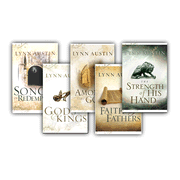
Such is the case with Chronicles of the Kings, a biblical history novel series by Lynn Austin. The five books in the series are:

Gods and Kings
Song of Redemption
The Strength of His Hand
Faith of my Fathers
Among the Gods

I originally picked up Gods and Kings because the blurb I had read about the series said it was about Hezekiah, who is tied for first place with Josiah as my favorite Old Testament king. Gods and Kings begins with the story of the evil, Molech-worshiping king of Judah, Ahaz. As the series progresses, we also walk through the reigns of Ahaz’s righteous son Hezekiah, who sets out to restore Judah both materially and spiritually after Ahaz’s idolatry, and its consequences, have ravaged the land. Hezekiah’s son Manasseh then takes the throne, bringing new meaning to the words polytheism and debauchery. Along the way, we meet with the kings’ contemporaries, Isaiah, Eliakim, Micah, and other biblical as well as fictional characters.

I could insert the obligatory gushing here about how well crafted the stories were and how Ms. Austin’s writing turned me into the literary equivalent of a chain smoker, but there were two things about this series that eclipsed how artfully it was written.

First, Ms. Austin did her homework. And she did it extremely well. As someone who had to research biblical culture, geography, customs, etc., myself for my own book, it is blindingly obvious that the books in the Chronicles of the Kings series were well and thoroughly researched. I can only imagine the hours Ms. Austin must have spent in the biblical text, commentaries, and extrabiblical historical sources. From details about dress to architecture to meals, Ms. Austin was attentive to the minor tidbits that helped me “see” what was happening and feel like I was part of the story.

On a more “macro” level, Ms. Austin’s description of Assyrian warfare, atrocities, and sweep to tyrannical domination over the Middle East gave me a clearer picture of the way events transpired that supported and even clarified the biblical text for me. If you have ever wondered why God used the Assyrians as an arm of judgment against Judah and Israel, or if you have ever wondered why God commanded that nations similar to Assyria be wiped off the face of the earth, you’ll understand after reading Chronicles of the Kings. Normally, I would never recommend that people go to a novel for clarity on details in God’s word, but Ms. Austin’s research is that good.

Finally, and most importantly, Ms. Austin gets the theology right, and in a way that is applicable to believers on this side of the cross. Her characters come to the realization that salvation is through grace, not through the works of empty ritual. That anything we put before God, even our own ideas of who God is, is an idol. That any sinner, no matter how despicable, can repent and experience God’s forgiveness. And on, and on, and on. I rarely read Christian fiction because I have found so much poor and even heretical theology in so many books in this genre. But somewhere around the middle of this series, I nearly came to tears as I realized that Ms. Austin was going to stay true to God’s word and not let me down by stooping to ear tickling or apostasy. And for that, I sincerely thank her.

All of the books in the series are available through Amazon.com, Barnes&Noble.com, and CBD. The Kindle, Nook, and e-version of the first book in the series, Gods and Kings, is currently free at these sites. You may also, as I did, be able to find Chronicles of the Kings at your local library.

I highly recommend the Chronicles of the Kings series. I can’t say enough good things about it.