


Kudos to the Center for Baptist Leadership for essentially breaking this story. If you’re still in the SBC, fighting back against the darkness at the national level, give them a follow. They’re doing the Lord’s work over there at CBL!
(I don’t know Brandon, but when I grabbed this, his was the only post I had seen with the video on the bottom. I’m grateful he posted it.)
Hopefully, you’ve seen this story by now. I would say “news story,” but, as you might imagine, the mainstream media (including my own local media) isn’t giving it much, if any, coverage.
I posted my thoughts about this on my Facebook and X accounts. Since my husband helps lead the security team at my church, that’s where my mind initially went. A Facebook follower had a few questions and comments that I thought might be helpful to answer and address in a public forum. Below, slightly edited, is our exchange. My words are in black, hers are in blue.
My original post: If your church does not have a security team, you need to get one in place, like, yesterday. If it’s not this, it’ll be something else. Don’t wait until something happens. Get some guys* trained to protect the flock NOW.
Just wondering what you think a security team could have/would have done with a large group of unarmed individuals all coming in at once. Besides try to stop them from entering the sanctuary, and calling the police. Surely proper security in a church does not involve drawing a weapon on unarmed people?
(My church does have security, but as I read all the comments that this is why churches need it, I can’t see how you could make these people leave without physical harm. Maybe you and others are encouraging security so the assembling would have been noticed outside and police called to remove them from trespassing, but that is not the impression I get from all the “don’t try this in the south” comments on X. As I watched it last night I wondered why the congregation didn’t stand up and start corporately singing “Amazing Grace” or something.)
My husband helps lead our security team at church. Different churches handle security in different ways, but in general, here’s what would happen:
1. The security team follows the local and national news, and stays in touch with law enforcement and government officials when necessary, so they know what kinds of potential threats are out there.
2. They train and drill regularly to respond to various kinds of threats. This includes training in de-escalation as well as the use of force, and immediately contacting law enforcement should a threat situation occur.
3. They patrol the grounds, the buildings, and the security cameras before and during services and other activities to be on the alert for potential threats.
4. During worship service and certain other events, all of the exterior doors are locked (that alone probably would have helped in the Minnesota situation), and, as I said in #3, security team members are patrolling (They’re also stationed by main entrances and exits in case, for example, someone needs to leave the worship service to run out to her car, and then re-enter.). There are also security team members seated in the worship service to implement security measures and instruct and direct the congregation if that becomes necessary.
5. I don’t want to say any more than I should in a public forum in order not to give away any security strategies, so I’ll just put it this way: If a trained, armed security team is in place and doing all of the above, those protesters are very unlikely to penetrate from outside to the sanctuary.
I would also add that the congregation singing Amazing Grace or anything else is not helpful in a situation like this. It adds to the chaos, it further angers the perpetrators, it distracts the congregation from paying attention to any instruction the pastor, security team, or law enforcement might give them, and it prevents them from hearing said instructions. The congregation should sit quietly and calmly unless instructed to do otherwise.
Yes. These are good things. Reading comments elsewhere, the implication is not so proactive, but rather reactive, involving force, which is not what we see with Paul in Acts 19.
“Reactive” isn’t good because it means nobody was prepared, alert, and ready beforehand, so you’re right about that. Preparing, training, and having a plan in place before something happens is much better and more effective, and it serves as a deterrent to keep things like this from happening in the first place.
But there is nothing wrong or unbiblical about using appropriate force, when necessary, to protect God’s house and God’s people (or anyone else for that matter), and you can’t correctly use the Ephesian riot in Acts 19:21-40 to argue against the use of force. That was a completely different situation.
Read the context and the text carefully. The Ephesian rioters did not attack a church. They were having their own large “meeting” (24-25, 40-41), whipped themselves up into a frenzy, thronged through the streets from the meeting place to the theater – throwing the entire city into an uproar in the process – and then dragged two of Paul’s companions into the middle of this riot (29).
Paul wanted to go into the middle of this chaos and preach/explain/fix things, but the disciples wouldn’t let him (30). Why? Not because they were trying to prevent him from using force – because that isn’t what he was going to do – but to keep him and Gaius and Aristarchus from getting killed by this mob of at least hundreds, possibly thousands. Three men against a whole city. Of course they weren’t thinking of using force – they were just trying to escape with their lives. This is completely different from what happened in the church in Minnesota.
The Ephesian riot also happened in a different country with a different government and different laws. In America, it is illegal to attack, disrupt, or damage a church, and it is legal to defend yourself and others, which, in the case of an attack on a church, also means it’s legal to protect the church property (i.e. prevent these criminals from entering the building).
Additionally, Acts is historical narrative. It is DEscriptive (a description of what happened) not PREscriptive (a command or doctrine to follow).
(I’ve discussed more about descriptive vs. prescriptive passages in this article.)
I would point out a couple of other descriptive passages that are much more applicable to protecting churches and congregations:
- 1 Chronicles 9:17-27, 26:12-32 talk about the gatekeepers, doorkeepers, and guards of the temple. The “security team” of the temple, if you will. They’re even mentioned again in Acts 4:1, 5:24. God commanded that His house be protected and appointed people to do it.
- Luke 22:35-38: Jesus is preparing the disciples to go out and start the New Testament church, and He tells them to take swords with them – even to sell their garments and buy one if they don’t have one. What were those swords for if not defending themselves if attacked?
- The entire Old Testament is filled with accounts of Israel killing the enemies of God’s people – sometimes even “innocent” women and children – and this use of force was often initiated by Israel (in other words, they attacked the enemy; it wasn’t always self-defense).
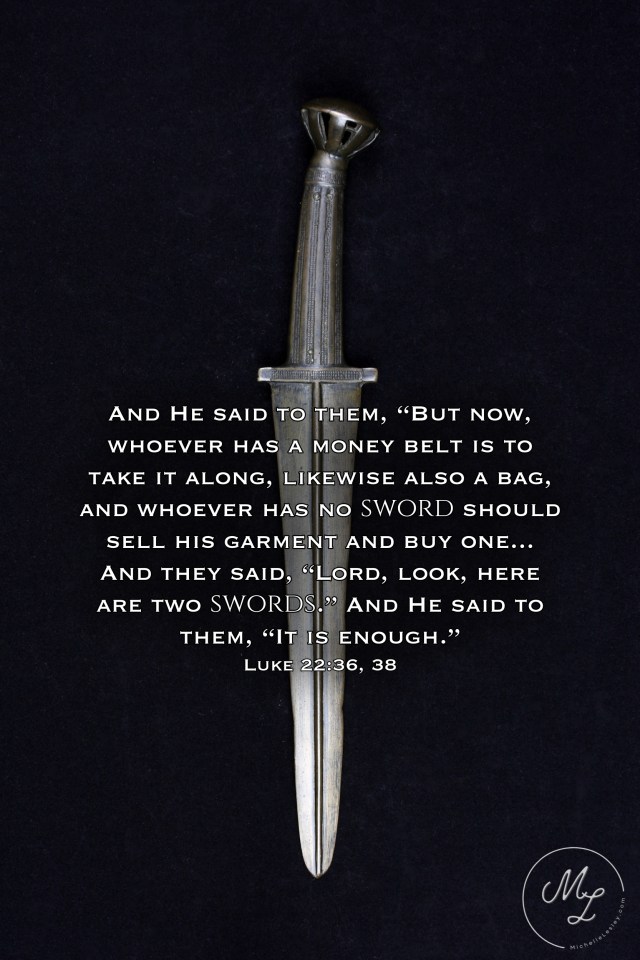
God is OK with Christians defending ourselves and others with force if necessary.
*A couple of other followers mentioned or suggested women serving on the security team alongside men. If you have women church members who have professional experience or contacts with law enforcement, the military, relevant areas of government, etc., it’s fine for them to act as liaisons between the church and these entities, offer needed input appropriately behind the scenes, etc., but when it comes to actively engaging in protecting God’s house and God’s people, biblically, that’s a job for men, not women.
Furthermore – and this is anecdotal, but it’s worth thinking about – nearly all of the commenters on my posts who were objecting to the use of force, security teams, and offering bad “touchy feely” advice (such as singing Amazing Grace during a threat situation), were women. Generally speaking, God has gifted women in the areas of compassion, mercy, and nurturing, and those attributes are wonderful when exercised in the appropriate situations that call for those things. Protecting people against dangerous thugs is not one of those situations. Protecting people from dangerous thugs calls for men, whom God has graciously gifted in dispassionately killing people and breaking things when a threat, and the need, arises. All things considered, everyone is safer with men protecting them than with women protecting them.
Additional Resources:
Your Church Needs a Security Team – NOW by Dusty Deevers
No, You Don’t Have a First Amendment Right to Disrupt Worship at The Cripplegate
This is an excerpt from the full video from CBL, above.
If you have a question about: a Bible passage, an aspect of theology, a current issue in Christianity, or how to biblically handle a family, life, or church situation, comment below (I’ll hold all questions in queue {unpublished} for a future edition of The Mailbag) or send me an e-mail or private message. If your question is chosen for publication, your anonymity will be protected.
Discover more from Michelle Lesley
Subscribe to get the latest posts sent to your email.

Thank you for this well thought out and researched post dear one.
LikeLike