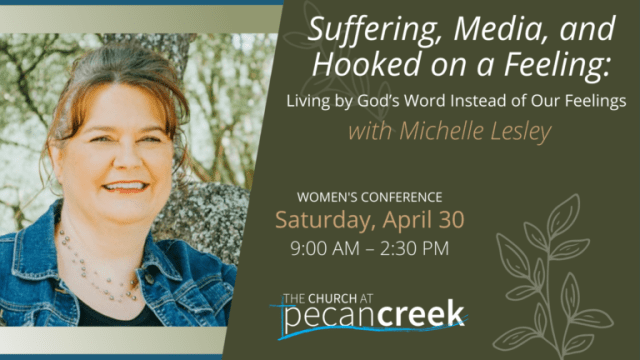
I had a such a wonderful time recently sharing with the ladies of The Church at Pecan Creek of Denton, Texas, at their spring women’s conference! Ladies from as far away as Louisiana and Oklahoma, as well as various areas of Texas, came out to fellowship with us.
The FAA’s mask mandate was dropped about ten days or so before my trip to Denton. I fly a lot, and – no joke – I haven’t been this excited to fly since I was a little kid.
Felicia (wife of TCPC’s pastor, Trey Talley) was my charming hostess for the weekend and greeted me with this awesome gift bag when she picked me up at the airport Friday afternoon. Boy, were my husband and sons jealous! They love them some Bucc-ee’s, and we don’t have one in Louisiana. (Don’t worry, I shared a little bit when I got home.)
Dinner at The GreenHouse that night was tasty, and I spent a lovely evening chatting about all things women’s discipleship with Felicia and the other two elders’ wives, Melodie and Carrie.
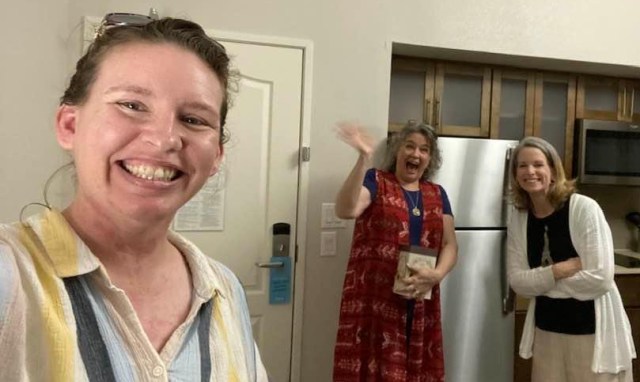
My dear friends, Beki (Mrs. Gabriel Hughes) and Jennifer (Mrs. Tom Buck), came all the way from First Baptist Church, Lindale, Texas, for the conference. Providentially, we discovered we were staying in the same hotel, so we got to catch up for a little while after dinner. (I was just the tiniest bit excited to see them. :0)
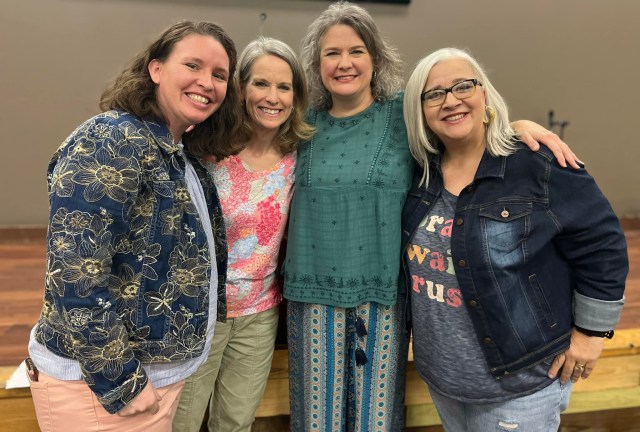
Beki, Michelle, Jennifer Photo courtesy of Beki Hughes
Beki brought along Sonya, another sweet friend of ours, and they blessed me with these great gifts. Beki didn’t know it when she bought the mug, but “You Are My Sunshine” is Louisiana’s state song. They told me that the Lindale Candy Co. is just down the street from FBC Lindale, so both places are now, of course, on my bucket list of places to visit.
Saturday morning, it was conference time!
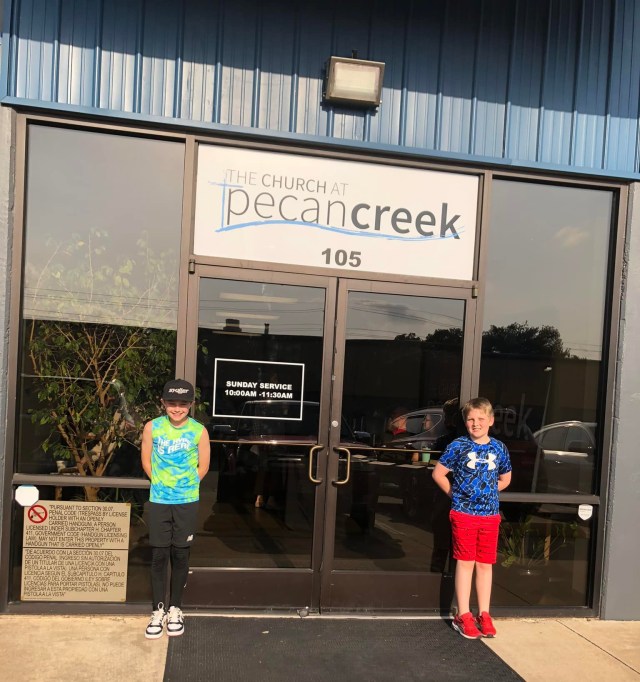
All of the ladies were greeted by these two handsome gents. Holding the door open for ladies will take you far in life, young men! :0)
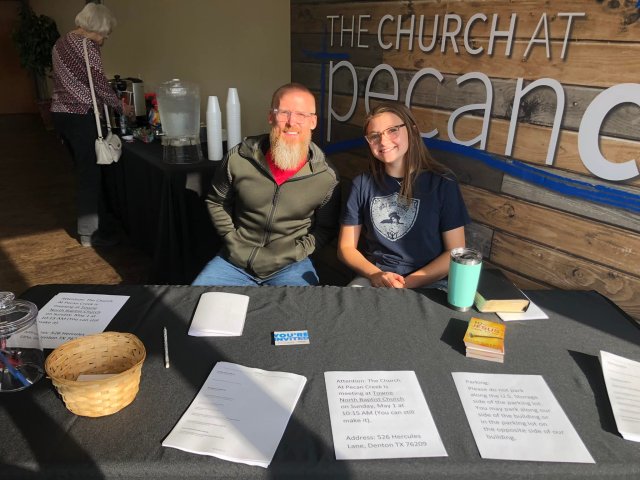
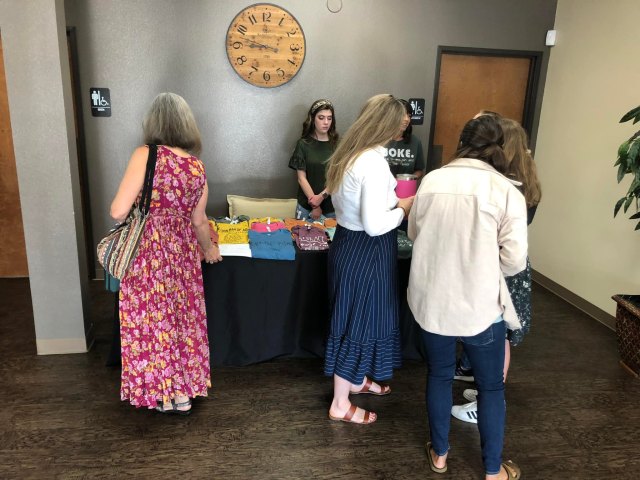
Welcome and check in. It was such a great idea to invite conference guests to visit TCPC for worship the next day!
Check out these cool tees!
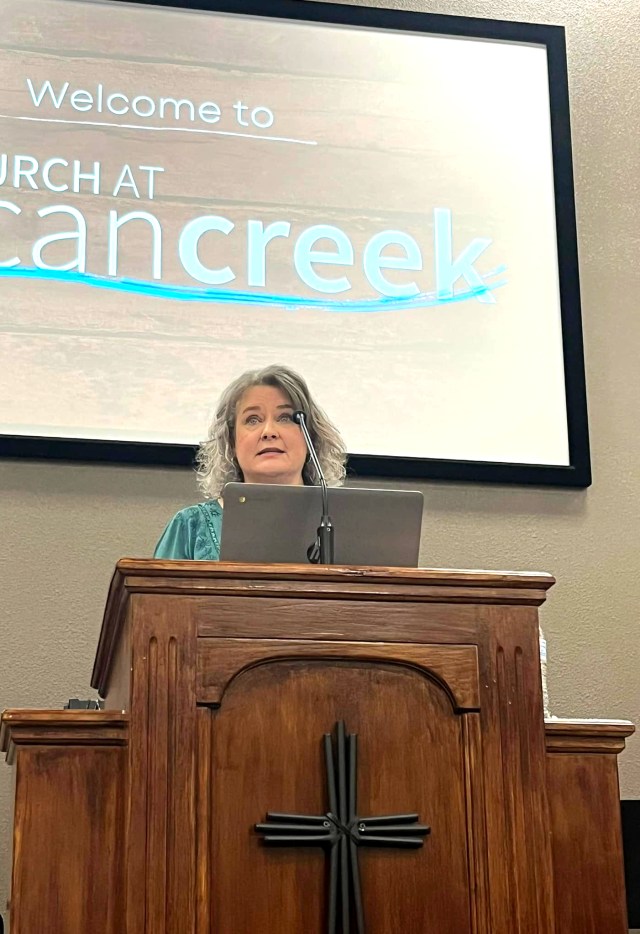
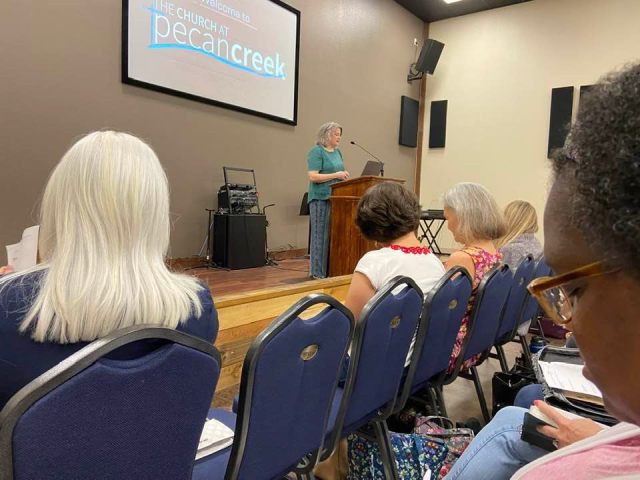
I like big, heavy wooden pulpits, and this one’s a beauty.
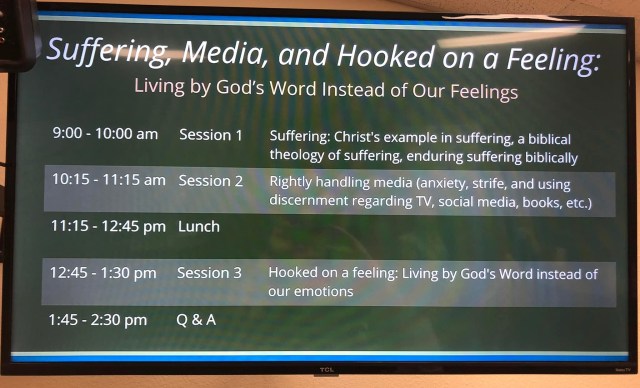
It was super helpful to have the schedule up on the screens throughout the church.
In our first session on Suffering, we explored Jesus as our hero in suffering, the hope in our suffering, and ways to biblically handle our suffering.
Session two was all about Managing Media – being wise and discerning with news, social media, movies and TV, and other media we consume.
Session three was Hooked on a Feeling: Living by God’s Word Instead of Our Emotions. We studied Jesus’ example of living by every word from the mouth of God and some practical ways to be led by God’s objective Word rather than our subjective feelings.
We finished up the day with a fun Q&A session. These ladies asked some sharp questions!
Keep an eye on TCPC’s website for soon to be posted conference video. In the mean time, my good friend Robin Self over at A Worthy Walk was also able to attend, and she has kindly shared her thoughts and notes on the conference with us in her article, A Day With Michelle Lesley.
Photo courtesy of Jennifer Buck
Photo courtesy of Robin Self
Photo courtesy of Morgan Lynn
Photo courtesy of Beki Hughes
For lunch, Felicia whisked me away to Rosa’s Cafe, and I am crushed that we don’t have one here at home. The food was delicious and the atmosphere was fun!
All photos courtesy of Rosa’s Cafe.
During and after the conference there was a little time for a few more pictures…
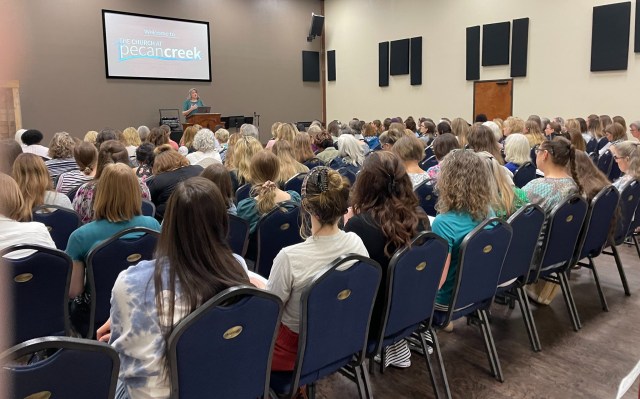
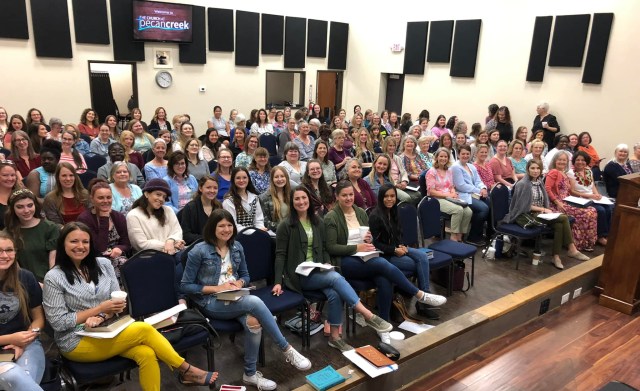
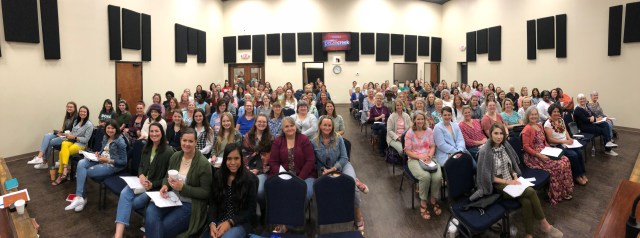
It was a full house!
You’re never too young to learn sound doctrine! Photo courtesy of Morgan Lynn
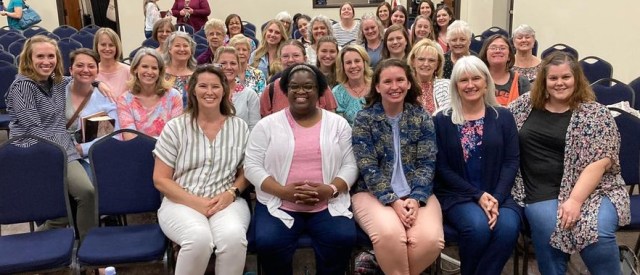
FBC Lindale brought a group of 41 women to the conference! Photo courtesy of Jennifer Buck
Beki, Jennifer, Michelle, Robin Self I love these ladies! Photo courtesy of Jennifer Buck
And all too soon, it was time to head home.
Many thanks to Felicia, Melodie, Carrie, the pastors, elders, and all of the other ladies and gentlemen of The Church at Pecan Creek who worked so hard to host a great conference, took care of all my needs, and made me feel so welcome. If you’re ever in the Denton area, be sure to stop in to TCPC for a visit!
If your church or organization is ever in need of a speaker for a women’s event, I’d love to come share with your ladies as well. Click here for more information.
Or maybe I answered your question already? Check out my article The Mailbag: Top 10 FAQs to see if your question has been answered and to get some helpful resources.
For any men who might be reading – this question is about breastfeeding. If that’s a sensitive issue for you, please just scroll right on past this section.
I have searching for biblical content about breastfeeding and your post from 3 years ago “The Mailbag: Should Christian women cover up while breastfeeding? really did make think. I’m currently studying to become a pediatric dietitian if God allows it, and I have a debate in myself. I’m starting to create content in social media in order to teach about these topics: breastfeeding, nutrition, etc. But now I don’t know if it’ correct to share real videos that are educative to teach how to properly breastfeed, showing examples and different cases that help mothers to understand. Since it is shameful to show breast according to Bible, am I wrong if I am looking to share or record these types of videos? Just to clarify, these videos only shows the necessary.
I hope my email can reach you and have an advice for this, may the Lord continuing giving you wisdom and excuse me any grammatical error since english is not my first language.
Can I first just say – I have the utmost admiration for anyone who tackles English as a second language. Its intricacies and inconsistencies are often difficult even for us native speakers! When I get English messages from followers whose native language is not English, they almost always apologize for grammar and spelling errors. Please rest assured, when I read your messages, I’m not critiquing them, I’m wishing I were as proficient in a second language as you are!
Instructional videos for mothers about breastfeeding are not the same thing as a mother who is breastfeeding in public. For one thing, your videos are aimed specifically at women (new mothers), and for a legitimate purpose (teaching breastfeeding). If a man (assuming he’s not a health care worker who needs to view your videos for professional purposes) proactively clicks on and watches your videos in order to see women’s bare breasts, he is the one at fault, not you. His actions would be more similar to a man who peeks through the window of a woman’s bedroom to watch her breastfeed, not a man out in public, minding his own business, who’s suddenly confronted with a view of a woman’s breasts because she’s not making any effort to reasonably cover while nursing.
Additionally, aiming your videos at new mothers (women) is more similar to a woman breastfeeding her baby in a group meeting for new moms (all women), than out in public (random men and women present).
Here are a couple of things I would suggest:
Make sure the titles of your videos make it obvious in some way that they are educational, instructional videos on breastfeeding for new mothers and postpartum/neonatal healthcare workers.
Instead of, say, just posting these videos on your personal Facebook, Twitter, Instagram, etc., pages, set up a separate professional social media page or group specifically for your videos and other breastfeeding materials. (I would suggest also setting up a website and YouTube channel specifically for your breastfeeding materials.) Not only will this help build your professional online platform, but your male friends and family members won’t be randomly running across your videos (which might make them uncomfortable) every time they scroll through social media.
I think that’s really as far as your responsibility goes. Men have to take responsibility for what they view at some point, too. It’s not all on you.
I have a question about women who are ordained. My cousin is ordained to perform marriages in the state of South Carolina. Would that be considered the same as an ordained preacher and against I Timothy 2 teaching? As far as I know all she does is perform marriage ceremonies and does not “preach” in the pulpit.
Great question!
I’m thinking there might be a little confusion about the term “ordained” here. “Ordaining” is what a church does when it sets someone apart for ministry. “Licensing” is what the government does that allows a person to legally perform marriages recognized by the state.
For example, pastors, elders, and (usually) deacons are ordained by the church to their respective offices, but they are not automatically licensed to legally perform marriages. For that, they have to go downtown to the courthouse and fill out some paperwork. By the same token, people can go to the courthouse, fill out the paperwork, and become licensed to perform marriages, and never have set foot in a church in their lives.
So, I think maybe you mean your cousin is licensed by the state to perform marriages, not that she is ordained by her church to do so. (I’ve never heard of a church that ordains someone just to perform marriages, but if that’s what’s going on here, the more pressing problem is the church’s ecclesiology, not your cousin officiating at weddings.)
So let’s go with your cousin being licensed by the state, not ordained by the church: No, that’s not technically a violation of 1 Timothy 2:12, assuming she’s not preaching a sermon as part of the marriage ceremony. The biblical prohibition is against women pastoring, preaching to men, instructing men in the Scriptures, and holding unbiblical authority over men in the context of the church gathering.
But there are all kinds of variables that play into whether or not it’s wise or appropriate for her to be officiating weddings. Does your cousin profess to be a Christian? Where do these weddings take place – in a church, park, reception hall, beach, etc.? Is she performing these weddings, or being viewed as performing these weddings as an official representative of her church? (In other words, would those not in the know confuse her performing weddings for her being a pastor of her church?) Do the bride and groom profess to be Christians? If so, why would they not want their pastor (or at least a pastor) to perform the ceremony in their own church?
I’m just saying I would need to know a lot more, probably on a case by case basis, to weigh in on whether or not it’s actually a good idea for her to perform any or all of these wedding ceremonies.
FIRST, I want to say thank you for your recent list of doctrinally sound men. My reason for writing comes from referring to them as “awesome” in your social media post about them:
“Today on the blog: Check out these awesome men to follow and learn from…”
I would just would ask you to consider the use of the word “awesome” when it applies to “mere” men (or women, for that matter.) Never mind the “world,” but Christians use that word so freely when talking about truly “good” things (and we also use it for things like movies and ice cream.)
Is it wrong to want there to be a word that is reserved for God and what he does? When something is clearly a work of God, even working through a person, there are times I can agree that it is something awesome. But largely, the things we call awesome are not.
It’s always good to evaluate our words to make sure we are representing Christ well, and, no, it’s not wrong to want there to be a word that is reserved for God and what He does. But let me challenge us to take this a bit deeper than just the surface level use of a particular word.
I’ve received this same basic question a handful of times over the years, and the question has always been about the word “awesome”. And I just have two questions about that:
First, why “awesome”? I think a much stronger biblical case could be made against using “good” or “holy”.
I’m betting that, like the reader who wrote in, we all use the word “good” in the same ways the word “awesome” is used – “truly good things,” movies, ice cream, saying “Good dog!” etc. – because they both mean the same thing, except that awesome is a little more intense. And yet, while Scripture doesn’t speak to our use of the descriptor “awesome,” Jesus Himself addressed the use of the word “good” in Mark and Luke:
And a ruler asked him, “Good Teacher, what must I do to inherit eternal life?” And Jesus said to him, “Why do you call me good? No one is good except God alone.
Now, when we read this passage in context, we know that Jesus isn’t telling this guy (or us) that he shouldn’t call Him good, that he shouldn’t call anything good, that Jesus isn’t good, or that Jesus isn’t God. Quite the opposite of most of those, in fact.
He’s directing the rich young ruler’s attention to the fact that only God is completely good. That God is the only and perfect standard and embodiment of good. He was basically saying, “You’re calling me good in this context. Does that mean you’re prepared to call me God?”.
But what Jesus doesn’t say (here or anywhere else in Scripture) is, “Since only God is truly, completely, and perfectly good, you can’t use the word “good” to describe anything else.”. In fact God Himself uses the word “good” to describe other, lesser things besides Himself. He has prepared good works for us to do. God pronounced everything He created good. He gives us good gifts. He says good trees bear good fruit. And so on.
Personally, if I got to choose the word we were all going to consecrate to use only for describing God, it would be “holy”. I would be totally OK with us losing expressions like “holy cow,” “holy moly,” etc., forever. (And when my kids were little and would use one of those expressions, I would remind them, “Only God is holy.”.) First of all, there are far fewer people and things that could correctly be called “holy” than “awesome” or “good”.
“Only Thou art holy,” we sing. And it’s true. Though Christians are a holy nation, and we’re to strive for holiness, we are only positionally holy and set apart because Christ’s righteousness has been imputed to us. Even our righteous deeds are as filthy rags. In a common grace sense, we might say someone is a “good” man for the job, or a store is having an “awesome” sale, but there is no common grace sense in which anyone but Christians – and we, only through Christ – could, in any way, properly be called holy.
My second question about reserving “awesome,” or any other adjective, strictly for God is: If you’re going to be consistent with your line of reasoning, how far are you going to take this? If you’re going to stop using “awesome” for anything but God, are you also going to stop using the word “good” for anything but God? What about “perfect”? Powerful? Just? Kind? Compassionate? Merciful? Are you going to stop saying, “I love you” to your family because God is love, and only He loves perfectly and completely?
I hope not. I hope you won’t stop using any of those words, because God doesn’t require you to. It would be self-imposed legalism. Remember when Jesus said to the Pharisees, “The Sabbath was made for man, not man for the Sabbath.”? He was trying to teach them that the Sabbath was meant to be a blessing and a benefit of rest to God’s people, not a slave driver of legalism adding one more day of work (to earn God’s favor) to their week.
It’s kind of the same general idea with language in this case. Language is one of God’s good and awesome gifts to us. It gives us a way to express our reverence for Him, but also our delight in the work of His hands – like ice cream and dogs. Just as with the Sabbath, there’s a godly and appropriate way to use language, but, outside of those parameters, language was never meant to enslave us or hamstring our ability to communicate. When we use language to appreciate God’s good gifts, or to express delight or pleasure, knowing that every good gift and grace redounds to His glory, He is exalted.
When we use language to appreciate God’s good gifts, or to express delight or pleasure, knowing that every good gift and grace redounds to His glory, He is exalted.
If you’re convicted not to use the word “awesome” for anything but God, or you don’t want people calling you awesome as a matter of conscience, that’s totally fine. Don’t violate your conscience. But you must realize that it is a matter of your conscience, not everybody’s. And you can’t bind others to your conscience. Whether or not to use the word “awesome” is an issue of Christian liberty. It is not a biblical command.
If you have a question about: a Bible passage, an aspect of theology, a current issue in Christianity, or how to biblically handle a family, life, or church situation, comment below (I’ll hold all questions in queue {unpublished} for a future edition of The Mailbag) or send me an e-mail or private message. If your question is chosen for publication, your anonymity will be protected.
You can hardly say the sky is blue or water is wet these days without offending somebody. It shouldn’t be surprising to us that when self reigns on the throne of a person’s heart, she will bow down and serve the king of personal feelings. And as a loyal subject, she will fight to the death any perceived threat to that ruling authority. It is normal for unsaved people to live their lives with their feelings leading them around by the nose.
It is normal for unsaved people to live their lives with their feelings leading them around by the nose. It is not normal for Christians to live that way.
It is not normal for Christians to live that way. And it concerns me that I’m seeing more and more Christian women who allow themselves to be controlled by their feelings rather than being controlled by Christ.
(I’m about to step on some toes, here, so if you’re offended {maybe especially if you’re offended} by what follows, hang in there with me until we get past the hurt feelings and arrive at God’s Word, or you’re actually going to be proving my point.)
❤ Last May, the day before Mother’s Day, I was sort of mindlessly flipping through my Facebook and Twitter feeds, when something caught my notice. Tweet after tweet, status after status, article after article about Mother’s Day. But the vast majority of those posts were not honoring and encouraging women who are mothers, which is the whole point of Mother’s Day. They were focused on women for whom Mother’s Day is painful. Women who are infertile. Single women who haven’t had children. Women who have lost children in miscarriage or other tragedies. People whose mothers have died. Mothers whose children are estranged.
❤ As April Fool’s Day approached this year, I began noticing admonishments not to say, “I’m pregnant,” as an April Fool’s joke on social media in order to protect the feelings of women struggling with infertility or have miscarried.
❤ I have heard from dozens of women who refuse to obey God’s command to join with a doctrinally sound local church – even though they’re physically and logistically able to – because they have been hurt by a previous church.
❤ Christian women who follow false teachers commonly lash out in anger – often displaying the opposite of every one of the fruits of the Spirit – when presented with incontrovertible biblical evidence that the teacher is promoting false doctrine.
❤ And have you seen the fracas over racism in evangelicalism lately? Ungodly statements and accusations are flying from both sides of the aisle because, feelings: feelings of being owed something, fear of man feelings of not wanting to appear racist, feelings of retribution, feelings of pride and self-righteousness.
Life circumstances and other people genuinely and validly hurt us sometimes. No sane person would deny that, and certainly no Christian with a modicum of Christlike compassion would deny it. I’ve been on the receiving end of some of the painful situations I mentioned above. Pain – deep, agonizing, and often undeserved pain – goes with the territory of being human. None of us are immune.
And, if you’re a Christian, you worship a Savior who more than understands what it’s like to be hurt – not just the physical torture of flogging and crucifixion, but the emotional pain during his life of being “despised and rejected by men, a man of sorrows and acquainted with grief”. Jesus experienced far more misery than you or I ever will, and yet, He handled it in a way that brought honor and glory to God. As His disciples, we are called to follow His example when it comes to our own pain.
Jesus could have allowed this grief to stay at the forefront of His heart and mind, governing His thoughts and reactions towards others and towards life in general. But He didn’t. He chose to deal with His pain in a godly way, refusing to allow it to control Him, paralyze Him, or deter Him from His mission, but putting it in its proper perspective. Pain is not paramount – holiness is. Jesus didn’t allow His pain to reign – He determined that His heart and mind would be led by holy thoughts and actions.
Jesus didn’t allow His pain to reign – He determined that His heart and mind would be led by holy thoughts and actions.
Jesus didn’t expect people to accommodate His feelings
Can you imagine Jesus demanding a safe space or that people refrain from posting certain things on social media in order to protect His feelings? Neither can I. It must have been monumentally difficult to endure the insults and mockery that constantly came His way, especially when He had the power (and the right) to shut those people up so He wouldn’t have to deal with all of that. Instead, Jesus accepted that hurtful people and circumstances are part of life and He proactively chose to respond to those people and circumstances in a godly way – setting an example for us in the process.
Can you imagine Jesus demanding a safe space or that people refrain from posting certain things on social media in order to protect His feelings? Neither can I.
Not just one person, one time, or one situation. Seventy times seven. Even if the person didn’t ask for forgiveness. Even if the person innocently stuck his foot in his mouth. Not once do we see Jesus harboring bitterness in His heart or holding a grudge against someone who hurt Him personally, whether intentionally or unintentionally. Jesus forgave and moved on with His life and ministry.
Jesus was content
Sometimes, it’s not a person who hurts us, but the circumstances God has sovereignly brought or allowed into our lives. Did you catch that? Anything that’s going on in your life is only going on because God is permitting it or causing it. From infertility to medical conditions to racism to the consequences of sin, God is in charge of what happens to you, and He uses these painful situations to teach you obedience, cause you to depend on and trust in Him, and conform you to the image of Christ.
“Foxes have holes, and birds of the air have nests, but the Son of Man has nowhere to lay his head,” Jesus said. Jesus was homeless, poor, unmarried, and childless, yet never once do we see Him complain about any of these circumstances. He accepted the station in life to which God had assigned Him and was content with His lot, making the most of His situation to the glory of God. We can follow Jesus in that godly mindset, realizing that “godliness with contentment is great gain” and that the Holy Spirit can empower us to find ways to be content no matter our situation.
Jesus didn’t retaliate or sin when His feelings were hurt
If our response to a hurtful person or situation is to take vengeance, lash out in anger, or wallow in self-pity, we aren’t acting the way Jesus did. He never retaliated against those who hurt him, failed to exercise self-control in responding to unkind people, or felt sorry for Himself as a result of his situation. Jesus alwaysperfectly showcased the Fruit of the Spirit: love, joy, peace, patience, kindness, goodness, faithfulness, gentleness, and self-control.
Jesus focused on others, not Himself
Did Jesus stay home from the wedding at Cana because He couldn’t deal with the fact that someone else was getting married and He wasn’t? Was He overcome by hurt and jealousy when people brought their children to Him because He longed to experience the joys unique to fatherhood? No. He made sure the happy couple’s big day was even better by celebrating with them and giving them an awesome gift. He embraced and blessed other people’s children, pouring out His love upon them.
It is absolutely and inarguably incumbent upon us as compassionate, caring, kind, and merciful followers of Christ to weep with those who weep in the midst of suffering. We follow in Jesus’ footsteps by comforting others with the comfort He has shown us. We do our best to be sensitive to the hurts of others and not cause additional or unnecessary pain. We lift up the fallen and strengthen the knees that are weak, just like Jesus did.
It is absolutely incumbent upon us to weep with those who weep in the midst of suffering. But God also requires us to draw upon His strength, look past our own pain, and rejoice with those who rejoice.
But God also requires us to draw upon His strength, look past our own pain, and rejoice with those who rejoice. Just as it is good and right to comfort a friend who’s infertile or grieve with parents who have miscarried, it is also good and right for that friend and those parents to rejoice on Mother’s Day and Father’s Day with those whom God has chosen to bless with children, or to celebrate with loved ones who have just announced a pregnancy. We take the focus off ourselves and put it on others, just like Jesus did.
Life hurts sometimes. And it’s OK to feel that pain. To grieve over loss. To mourn over suffering. But we cannot let those feelings be the boss of how we act and think. If we are to follow Christ, we must ask Him to help us follow His example of dealing with our raw and tender feelings: not expecting people to tiptoe around us, not allowing bitterness or unforgiveness to take over our hearts, not allowing our pain to reign and cause us to sin. We follow Christ’s example by taking up our cross daily, following Him, serving others, and living to the full the lives God has ordained for us. Whether it’s easy or it’s hard. Whether we’re joyful or sorrowful. Whether we feel like it or not.