Faith, Gospel

Throwback Thursday ~ Being Slaughtered by Terrorists Isn’t the Worst Thing that Can Happen to You

Originally published October 17, 2014

Everybody seems to be walking around scared these days. I’m a little scared, myself. It’s understandable. There’s a lot of scary stuff happening. Boko Haram. Ebola. ISIS. The persecution of Christians abroad, and, increasingly, here at home.

Terrorism, suicide bombers, the seemingly daily acts of violence that take the lives of innocent bystanders– that all used to happen over there. Thousands of miles across the ocean. And all we had to do to make it go away was turn off the TV, click over to Farmville, or put down the paper. Problem solved. It was unfortunate, but didn’t really touch our lives in any meaningful way.

Until now.

Now we know that there are terrorists living among us right here in the United States, as well as those trying to infiltrate our country by stealthily crossing our borders. When will the next beheading or 9-11 take place on U.S. soil? Who will the next victim be? Will it be you? Will it be me? Will it be thousands of us in one fell swoop?

Any reasonable person would be afraid of that.

Don’t.

That’s what Jesus said. Just don’t.

We’ve got bigger fish to fry in the fear department. Even though it would be awful, the worst thing that could happen to someone is not being killed or even tortured by a terrorist. The worst thing that could happen is for someone to spend an eternity in Hell because she has rejected Christ (which should tell you something about how horrific Hell is).

If you have never turned from your sin and placed your faith in Christ’s death, burial and resurrection as payment for the penalty for your sin, how you’re going to die is the least of your worries compared to what’s going to happen to you after you die. That should scare the living daylights out of you.

If you have never turned from your sin and placed your faith in Christ, how you’re going to die is the least of your worries compared to what’s going to happen to you after you die.

The good news is, Christ offers to forgive you today. His goodness for your badness. His purity for your sinfulness. His grace for your gross. He will set you free from your sin so you’ll no longer fear standing before Him on the day of judgment.

Christ offers to forgive you today. His goodness for your badness. His purity for your sinfulness. His grace for your gross. He will set you free from your sin.

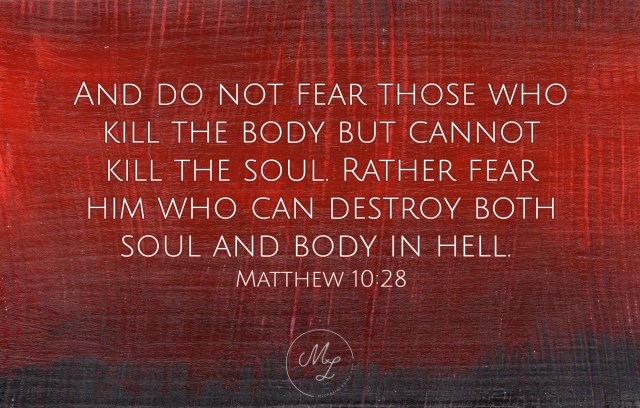
And, if you belong to Christ, you have nothing to fear in this life or the next. Take a look back at that verse. It says to “fear him who can destroy both soul and body in hell.”  But if you’re in Christ, you no longer have to be afraid of Him. And the first part of the verse says not to be afraid of people who can kill your body but not your soul. Nothing to fear now. Nothing to fear later.

So what’s left to fear? Nothing.

What must I do to be saved?

Evangelism, Faith

Throwback Thursday ~ In Your Dreams

Originally published July 20, 2015

Photo credit

When you wish upon a star
Makes no difference who you are
Anything your heart desires
Will come to you.

If your heart is in your dream
No request is too extreme
When you wish upon a star
As dreamers do.

Fate is kind
She brings to those who love
The sweet fulfillment of
Their secret longing

Like a bolt out of the blue
Fate steps in and sees you through
When you wish upon a star
Your dream comes true1

If you used to be a Disney fan, youโ€™ll recognize those words as the lyrics to the song When You Wish Upon a Star from the movie Pinocchio. Itโ€™s a sweet little song that tugs at our hearts. After all, we all want a fairy to wave her wand and make the wishes of our hearts come true, right? โ€œGod wants to help you realize all your hopes and dreams,โ€ is the mantra of pop Christianity. But is it biblical?

Moses dreamed of leading Israel into the Promised Land.

David dreamed of building the temple.

Hosea dreamed of marrying the girl next door and having children with normal names.

Amos dreamed of being a fig farmer and a flock follower.

Paul dreamed of snuffing out Christianity.

Stephen dreamed of living to preach the gospel.

Jude dreamed of writing about the gospel.

Nope, not one of those dreams โ€“ some of them much more godly than your dreams or mine โ€“ came true. Why? Because our dreams donโ€™t always fit with what God wants to do. Because God isnโ€™t someone whose sole function is to help us get what we want out of life.

God is for God. God is about His glory. And what brings Him the most glory is redeeming wretched sinners from the gaping maw of hell and making them look like Jesus. And, as His children, we have the unbelievable privilege of participating in that mission.

So, church, letโ€™s leave the Blue Fairy and Genie to Pinocchio and Aladdin. More money, fame, impact, and power is but a petty vision. We were created for the earth-shattering honor of dying to ourselves, clothing ourselves with humility, and serving the King by serving our families, our neighbors, everyone we know, His way, in the hope that we might win them to Christ for His glory.

To dream of anything else is, for the slave of Christ, to aim too low. So dream high, and dream on.

1 โ€œWhen You Wish Upon a Star,โ€ copyright 1940 by Bourne, Co., NY.

Church, Discernment, Worship

Throwback Thursday ~ The Way We Wor(ship)

Originally published on May 22, 2013

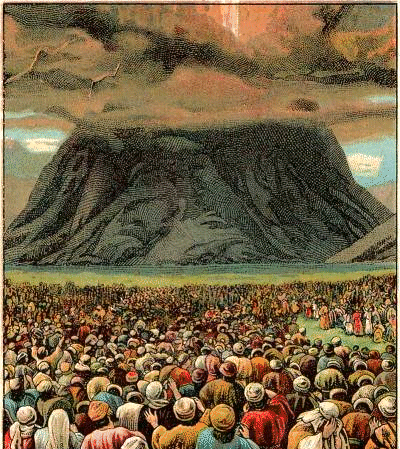
mt_sinai

And you shall set limits for the people all around, saying, โ€˜Take care not to go up into the mountain or touch the edge of it. Whoever touches the mountain shall be put to death.  No hand shall touch him, but he shall be stoned or shot; whether beast or man, he shall not live.โ€™ When the trumpet sounds a long blast, they shall come up to the mountain.โ€
Exodus 19:12-13

From Cain and Abel to the Israelites in the wilderness to Ananias and Sapphira, God sets limits on the way we may approach Him. He has always said “whosoever will” may come to Him, but He is just as exacting about the way in which we come to Him today as He was back then.

It’s no small matter that many people in the Bible were put to death for approaching God in anything less than an attitude of utmost awe, fear, and reverence for His holiness. Uzzah touched the Ark of the Covenant. Nadab and Abihu offered strange fire before the Lord. The Corinthians took the Lord’s Supper in an unworthy manner.

I recently heard Perry Noble, a well known leader of a seeker sensitive megachurch, who has done such things as having his church’s band play AC/DC’s “Highway to Hell” on Easter Sunday, say, “I’m willing to offend the church people to reach people for Jesus.” When asked where he drew the line at what was too offensive in church, he went on to say, “Iย probablyย wouldn’t have a stripper on stage…” and continued to justify using worldly and irreverent antics in church in order to “bring people to Jesus.”

But Perry has missed the point. Worship isn’t about people and what they like or don’t like. It isn’t about entertaining people and making sure they have some sort of enjoyable or emotional experience. It isn’t about attracting the attention of people.

Worship is about God.

What does God think? How does He want to be worshiped? What does He find offensive?

God is not the God of “anything goes.” If you doubt that, go back to the Old Testament and read His precise instructions on constructing the tabernacle, offering sacrifices, the behavior and duties of priests and Levites, and so on. Anything goes? Far from it.

Christ should be the sun in our solar system of worship. Just as the sun’s gravity exerts just the right force on each planet, keeping them revolving around it in exactly the right path, so, when Christ is at the center of our worship, every song, every prayer, every word spoken will fall into exactly the right orbit around Him.

What about your church? The next time you attend a worship service, sit back and view it through the lens of discernment. Is it designed to make you happy? Comfortable? Entertained? Emotional? Or is every element of the service centered on Christ– His holiness, His sacrifice for sin, His love and grace — leading you to exalt Him and forget about yourself?

Pastors and worship leaders, one day you will answer to God for the way you led your church. Do you design worship services to attract and hold the attention of people, manipulate their emotions, and entertain them, or do you sit at your desk, pray, and consider what will please God, how you can best lift up the name of Christ, expose His glory, and keep things centered on Him? God has not called you to be a shock jock, stand up comedian, or motivational speaker. He has called you to preach Christ and Him crucified.

Let’s stop the silliness and stupidity, and repent. Worship is serious business.

Church

Throwback Thursday ~ Finding a New Church- Starting from Scratch

Originally published March 29, 2008

When my husband and I have looked for a new church in the past, we’ve had our choices narrowed down for us because we are comfortable in our denomination and are not looking to change. When you’re starting from scratch, you have a lot more choices to wade through, so it can be more difficult. Here are a few guidelines I’d suggest.

1. The absolute most important thing is to find a church that preaches and teaches only what matches up with what the Bible says, and all of what the Bible says. In other words, they shouldn’t be teaching anything that’s clearly contrary to Scripture and they shouldn’t be leaving things out that are unpopular because they’re afraid they won’t attract as many people.

2. Pray about it. Ask God to lead you to exactly the right church in which to serve Him.

3. If you were raised in a particular denomination and felt comfortable in it, that might be a good place to start, either at the same church or a different church of the same denomination.

4. Ask around. Ask Christian friends about their churches and try visiting with them one Sunday. If you end up joining, you have the bonus of already knowing someone.

5. Do your homework. If there’s a particular church or denomination you’re interested in, chances are, they have a web site. There will probably be a section on the web site called “Our Statement of Faith” or something like that. Check that out and make sure all the tenets line up with Scripture. (But do bear in mind a significant number of churches have a perfectly biblical statement of faith “on paper” but they do not adhere to it in practice, or they are unbiblical in an area the statement of faith doesn’t cover. The best a statement of faith can do for you is to weed out some of the really bad churches. It’s not a guarantee that a church is good.) A lot of churches also have their pastor’s sermons and/or their music on line, so you can get a feel for how things go on Sundays. You’ll also be able to find out when services start, what kinds of programs are available, whether or not they have a nursery, etc.

6. “Interview” churches. Most pastors I know would be thrilled to death if a prospective visitor would call up and make an appointment to come in and talk to them about the church. Ask him whatever you want, find out what’s required for membership, share your concerns, etc. He should be able to answer your queries openly and honestly. I would be very leery about attending a church if the pastor seemed secretive about general doctrinal issues, his own background, or church activities. Sometimes just meeting with the pastor will give you an idea of whether or not you want to give the church a try.

7. Try it on for size. You might fall in love with the first church you try, or it might be like shoe shopping and you have to try several before you find one that fits.

Don’t give up. God has a place for you somewhere.


Additional Resources

Searching for a new church? Lots of great church search engines, plus check out the “What to look for in a church” section, especially if you’re a new Believer or coming out of an unbiblical church background.

How Can I Find a Good Church?ย 

7 Reasons Church is Not Optional and Non-Negotiable for Christians

Church

Throwback Thursday ~ Persecution in the Pew

Originally published August 7, 2015

Beheadings of Christians by ISIS. Crosses forcibly torn off churches by the Chinese government. Pastors imprisoned. Believers tortured for leaving Islam or sharing the gospel.

The treatment our brothers and sisters across the globe receive at the hands of pagans is nearly unfathomable. They are made to suffer – simply for claiming the name of Christ – by those who openly hate God and want nothing more than to stamp out Christianity.

This is how we, as the American church, have come to define persecution. Outsiders, non-Christians, and the government, all on the attack against the Bible, our faith, our practices, and other beliefs we have long held dear. It’s a correct definition, but it’s not a complete definition.

While we already see a “light” form of this type of persecution in the U.S. – mainly over the issue of homosexuality – there’s another kind of Christian persecution that is mushrooming right under our noses, which most church members either seem oblivious to, or are actually participating in. It’s the persecution in the pew.

If you’re a Christian who has ever dared to vocally take a stand on the truth of God’s word against the false teaching so prevalent in today’s pop Christianity, you’ve almost certainly experienced this type of persecution at the hands of people who call themselves “Christians.”

Don’t believe me?

Try posting a Facebook status that says the Bible prohibits women from being pastors or teaching men.

Demonstrate from Scripture to a Beth Moore, Joyce Meyer, or Joel Osteen groupie that she’s following a false teacher.

Talk to a church member who supports Planned Parenthood “because they provide health care”.

Explain why Christians ought not attend same sex weddings.

Discuss the Bible’s account of Creation with someone from your church who has embraced Darwinian evolution.

Certainly, there are new and immature Christians who simply don’t know these things are unbiblical and are still struggling to embrace God’s word in these areas. And there are those who know what God’s word says, but rebel against it in these areas, who silently ignore Christians who espouse biblical truth, or can politely discuss why their “Christian” views differ from Scripture. However, the willfully biblically ignorant, “screaming banshee” contingent is growing, both in volume and in number.

Surprised? Me too. I’ve been on the receiving end of verbal abuse (and I do mean abuse – name calling, swearing, mocking, the questioning of my salvation, and any number of other nasty and condescending remarks) from “Christians” defending these and other unbiblical views numerous times and I still can’t get over my shock every time it happens.

Call me crazy, I guess I just expect people who call themselves “Christians” to love, obey, and uphold Scripture, not attack those who actually do.

But this kind of thing really shouldn’t be cause for wonder and amazement. We should expect it. Persecution of God’s people by those who claim to be God’s people has been happening since the Old Testament.

Jeremiah:
Now Pashhur the priest, the son of Immer, who was chief officer in the house of the Lord, heard Jeremiah prophesying these things. 2 Then Pashhur beat Jeremiah the prophet, and put him in the stocks that were in the upper Benjamin Gate of the house of the Lord. Jeremiah 20:1-2

Amos:
Then Amaziah the priest of Bethel sent to Jeroboam king of Israel, saying, โ€œAmos has conspired against you in the midst of the house of Israel. The land is not able to bear all his words…12 And Amaziah said to Amos, โ€œO seer, go, flee away to the land of Judah, and eat bread there, and prophesy there, 13 but never again prophesy at Bethel, for it is the king’s sanctuary, and it is a temple of the kingdom.โ€ Amos 7:10, 12-13

Isaiah:
For they are a rebellious people, lying children, children unwilling to hear the instruction of the Lord; 10 who say to the seers, โ€œDo not see,โ€ and to the prophets, โ€œDo not prophesy to us what is right; speak to us smooth things, prophesy illusions, 11 leave the way, turn aside from the path, let us hear no more about the Holy One of Israel.โ€ Isaiah 30:9-11

Perhaps Jesus had in mind some of these instances of Israel’s persecution of the prophets when He said in the Sermon on the Mount:

Blessed are those who are persecuted for righteousness’ sake, for theirs is the kingdom of heaven. 11 โ€œBlessed are you when others revile you and persecute you and utter all kinds of evil against you falsely on my account. 12 Rejoice and be glad, for your reward is great in heaven, for so they persecuted the prophets who were before you. Matthew 5:10-12

The balance of the New Testament is rife with examples of Christians, and even Jesus Himself, being persecuted by those who claim to be God’s people:

Stephen was martyred by “the people and the elders and the scribes,” while Paul, “circumcised on the eighth day, of the people of Israel, of the tribe of Benjamin, a Hebrew of Hebrews; as to the law, a Pharisee;” who went on to be a zealous “persecutor of the church” held their coats.

It was the “high priest, the senate of the people of Israel, and the Pharisees” who imprisoned and flogged the apostles and “charged them not to speak in the name of Jesus” in Acts 5:17-42.

Peter and John were arrested by “the priests and the captain of the temple and the Sadducees” and threatened by “Annas the high priest and Caiaphas and John and Alexander, and all who were of the high-priestly family.”

Even Jesus “came to his own, and his own people did not receive him.” He was nearly stoned twice by Jewish leaders. And, even though it was the Romans who actually carried out the crucifixion, it was only because it was illegal, under current Roman law, for the temple authorities to execute their own criminals.

It was one of Jesus’ own followers who betrayed him to the chief priests. It was the “chief priests and the elders” who arrested Jesus. It was “the high priest…scribes and the elders” who presided over the kangaroo court that condemned Jesus to death. And it was “all the chief priests and the elders of the people” who finally handed Jesus over to Rome.

We may think of these people as Jews, scribes, and Pharisees, but they were the “church people” of their day. It was these “church people” – as much, if not, at times, more so than pagans – who were the ones shouting down, threatening, persecuting, and murdering Jesus and Christians who upheld the truth of His word.

Jesus knew this would happen. In John 16:2-4 He warned the disciples:

They will put you out of the synagogues. Indeed, the hour is coming when whoever kills you will think he is offering service to God. 3 And they will do these things because they have not known the Father, nor me. 4 But I have said these things to you, that when their hour comes you may remember that I told them to you.

And so it goes today. Deceived, self-proclaimed “Christians”, those inside the church who are often just as unsaved as the pagans outside the church, those who prove that they don’t belong to Christ by fighting against His word instead of loving and obeying it, these “church people” are the ones viciously attacking Christians who dare to stand on and for the truth of Scripture. And they think they’re doing God a favor by acting this way.

Continue to cling to Christ and His word and you’ll be one of their victims. It’s inevitable. Jesus said, “If they persecuted me, they will also persecute you.” But keep your eyes on Jesus, not on your circumstances, and remember He also said, “Blessed are those who are persecuted…theirs is the kingdom of heaven.” When you’re persecuted, even by “Christians” you can “rejoice and be glad, for your reward is great in heaven!”