
Wednesday's Word

Wednesday’s Word ~ Deuteronomy 30

circumcise heart

Deuteronomy 30

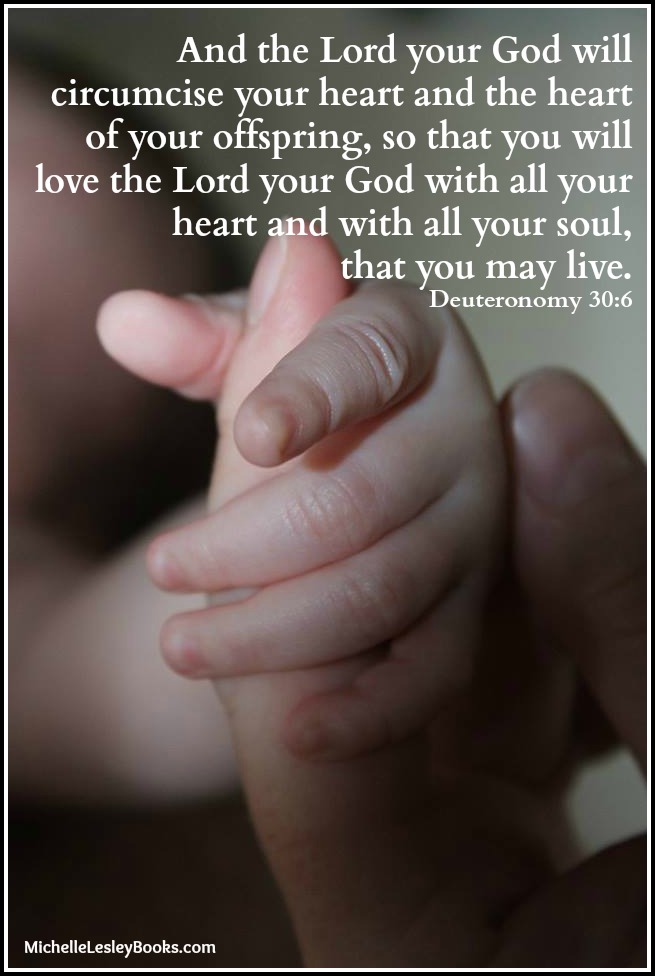
“And when all these things come upon you, the blessing and the curse, which I have set before you, and you call them to mind among all the nations where the Lord your God has driven you, and return to the Lord your God, you and your children, and obey his voice in all that I command you today, with all your heart and with all your soul, then the Lord your God will restore your fortunes and have mercy on you, and he will gather you again from all the peoples where the Lord your God has scattered you. If your outcasts are in the uttermost parts of heaven, from there the Lord your God will gather you, and from there he will take you. And the Lord your God will bring you into the land that your fathers possessed, that you may possess it. And he will make you more prosperous and numerous than your fathers. And the Lord your God will circumcise your heart and the heart of your offspring, so that you will love the Lord your God with all your heart and with all your soul, that you may live. And the Lord your God will put all these curses on your foes and enemies who persecuted you. And you shall again obey the voice of the Lord and keep all his commandments that I command you today. The Lord your God will make you abundantly prosperous in all the work of your hand, in the fruit of your womb and in the fruit of your cattle and in the fruit of your ground. For the Lord will again take delight in prospering you, as he took delight in your fathers, 10 when you obey the voice of the Lord your God, to keep his commandments and his statutes that are written in this Book of the Law, when you turn to the Lord your God with all your heart and with all your soul.

11 “For this commandment that I command you today is not too hard for you, neither is it far off. 12 It is not in heaven, that you should say, ‘Who will ascend to heaven for us and bring it to us, that we may hear it and do it?’ 13 Neither is it beyond the sea, that you should say, ‘Who will go over the sea for us and bring it to us, that we may hear it and do it?’ 14 But the word is very near you. It is in your mouth and in your heart, so that you can do it.

15 “See, I have set before you today life and good, death and evil. 16 If you obey the commandments of the Lord your God that I command you today, by loving the Lord your God, by walking in his ways, and by keeping his commandments and his statutes and his rules, then you shall live and multiply, and the Lord your God will bless you in the land that you are entering to take possession of it. 17 But if your heart turns away, and you will not hear, but are drawn away to worship other gods and serve them, 18 I declare to you today, that you shall surely perish. You shall not live long in the land that you are going over the Jordan to enter and possess. 19 I call heaven and earth to witness against you today, that I have set before you life and death, blessing and curse. Therefore choose life, that you and your offspring may live, 20 loving the Lord your God, obeying his voice and holding fast to him, for he is your life and length of days, that you may dwell in the land that the Lord swore to your fathers, to Abraham, to Isaac, and to Jacob, to give them.”


The Holy Bible, English Standard Version Copyright © 2001 by Crossway Bibles, a division of Good News Publishers.


Questions to Consider:

1. To whom was this chapter written?

2. What are “all these things, the blessing and the curse which I have set before you” in verse 1? (Hint: Read Deuteronomy 28)

3. What are some of the material ways God promises to bless Israel if they will repent of their sin and obey Him (1-10)? Does God make these same promises of material prosperity to Christians today? Compare these promises to Israel with these promises God makes to Christians. Is God being inconsistent?

4. What would “I will circumcise your heart” (v. 6) have meant to an Old Testament Israelite? What does it mean for Christians today?

5. Was Israel capable of obeying God the way He was asking them to? (11-14) How does God enable Christians today to obey Him?

Homosexuality, Law- Old Testament, Old Testament, Sunday School

Law and Order: CVI (Christians Vs. Israel) ~ Sunday School Lesson ~ 3-23-14

sunday school

These are my notes from my ladies’ Sunday School class this morning. I’ll be posting the notes from my class here each week. Click here for last week’s lesson.

Through the Bible in 2014 ~ Week 12 ~ Mar. 16-22
Deuteronomy 14-34, Psalm 91
Law and Order: CVI (Christians Vs. Israel)

th

About a month ago we took a look at the Law in the Old Testament, and talked about why God gave the Law to Israel in the first place. Christians are often accused of “picking and choosing” which laws to obey (like the prohibitions against homosexuality) and which not to obey (laws about clothes, food, etc.), so, today, we’ll be talking about why Israel had to obey all the laws but Christians can’t and shouldn’t.

Deuteronomy 31:9-13
Did God consider His Law to be important? How can you tell from this and the rest of the book of Deuteronomy, Leviticus, and other passages we’ve read? Why did God consider His Law to be important?

All Laws Are Not Created Equal
While all laws are equally holy because they were all set forth by a holy God, there are different kinds of laws and different penalties for breaking various laws. The three main categories of Law are: civil, ceremonial, and moral.

Civil Law (22:1,8; 23:19; 24:5-6; 21:15-17; 14:28-29)
At this time in history, Israel had a unique form of civil government: theocracy. This meant that, while they had human leaders such as Moses, elders, and tribal leaders, God was their king and lawgiver. This included civil or societal “law and order” types of laws as well as inheritance laws, property regulations, taxes, etc. These laws were similar to the laws our local, state, and federal governments make for us today. All citizens of Israel were bound by them, and violation of these laws required punishment and/or restitution.

Christians and the Civil Law (Romans 13:1-2)
Which country are we citizens of? Are citizens of other nations bound by U.S. law (in their own nations)? Are we, living in the U.S., bound by the laws of other nations? This is why Christians are not bound by OT Israel’s civil laws, and it is not a problem for us to wear clothes made of two types of fabric, or build houses without parapets around the roofs (unless our own government decides to make these things law). Those laws were for the citizens of that nation at that time in history. We are bound by our city, parish, state, and federal laws at this time in our history.

After Christ’s ascension, the gospel was opened up to people of all nations and God’s people –Christians – began to spread all over the earth. We are no longer under a theocracy, but various forms of government in various nations. This is why Romans 13 tells us to obey those in authority over us, not to obey OT civil law. We are to obey the laws of our own country as long as they do not conflict with anything God has stated in His word.

Ceremonial Law (16:1-17; 26:1-2)
The ceremonial laws mostly had to do with making sacrifices, feasts, “unclean” laws, and who could or could not serve in God’s house. Again, all of these laws applied to Old Testament Israelite Jews (many of them also applied to sojourners in Israel, especially those who wanted to embrace Judaism). They did not apply to other religions, other nations, or non-Israelites outside of Israel. All of these laws, regulations, and practices pointed to the coming of the Messiah, who would fulfill them. Ceremonial law was always intended to be temporary and limited.

Christians and the Ceremonial Law (Hebrews 10:1, 11-14)
Christians are not OT Jews under the Mosaic Covenant. We are NT Christians under the covenant of grace (which is also why the blessings for obedience and curses for disobedience in Deut. 28 do not apply to us). All of the ceremonies, sacrifices, even the temple itself, were a picture and foreshadow of what was to come: Christ. Because Christ was the perfect, once for all, sacrifice for our sin, we no longer need to make sacrifices. If we did, it would almost be like preferring to read the menu than actually eat the steak, or preferring to stand out in the theater lobby looking at movie posters instead of going in and watching the movie.

Actually, it would be a slap in God’s face for Christians to go back to the OT ceremonial laws and ways of worship because it would be like saying, “I prefer the imperfect blood of bulls and goats covering my sin to the perfect sacrifice of Your precious Son which can take away my sin.”

Moral Law (Exodus 20:1-17; Leviticus 11:45, Romans 2:14-15)
The moral portion of the law covers behaviors, thoughts, and attitudes that are intrinsically right or wrong: lying, murder, coveting, adultery, helping the disadvantaged, etc. Because God is good and holy, His people are to portray His goodness and holiness to a watching world. We constantly see God telling Israel, “Be holy for I am holy.” The moral laws reflect the nature and character of God. God is truth, so do not lie. God is loving, so do not hate. God is faithful, so do not be unfaithful. God is generous and giving, so do not steal.

Moral Law is “transcendent,” which means that it applied even before it was codified (Remember when Cain killed Abel? Murder was still wrong then even though the Law would not be given until Exodus 20.), and will continue to apply until Christ returns. Moral Law applies to all people everywhere. God says this Law is written on our hearts; we know basic right from wrong by our consciences. As we discussed last week, the first and highest moral law was to love God only, and love Him above all else. When God holds first place in a person’s life, obedience to His moral law is a natural overflow of the heart.

Christians and the Moral Law (1 Peter 1:14-16; 1 John 2:4-6)
While Christians cannot and should not obey the OT ceremonial or civil laws, we are to obey the moral laws, most of which are restated somewhere in the NT. Often, Jesus reminds us that God is not after behavior modification, rather, He’s after our hearts. It’s not enough to restrain yourself from murdering someone; Jesus says to love our enemies and pray for those who persecute us. It’s not enough to refrain from adultery; Jesus tells husbands to love their wives to the point of laying down their lives for them and wives to respect and submit to their husbands. This kind of selfless love for God and others was always the intent behind the OT moral laws. It becomes clearer in the NT through the teaching and sacrificial example of Jesus. We follow His example of love for God, obedience to God, laying down His life for others, and serving others.


Jesus and the Law (Matthew 5:17-18)
Jesus Himself said that He did not come to abolish the Law, but to fulfill it. He did this by perfectly obeying the civil, ceremonial, and moral law. He further fulfilled the ceremonial law by concluding it. When Jesus said, “It is finished,” it was. The final sacrifice had been made, once for all. When Jesus died, the veil of the temple that separated people from the Holy of Holies—the very presence of God—was split in two, signifying that, through the final sacrifice, Jesus, we may now enter into God’s presence and be reconciled to Him.


Additional Resource:
The Gospel by Numbers by Ligon Duncan at the 2014 Together for the Gospel conference (This is one of the best sermons I’ve ever heard. I encourage everyone to take the time to listen to it.)